Get Full Government Meeting Transcripts, Videos, & Alerts Forever!
Get email alerts on the Budget Dpw Water Sewer topic
No spam. Unsubscribe anytime.
Finance Committee reviews DPW 2024–25 budget; flags staffing, building repairs, sewer lining and lead inventory
Summary
The Finance Committee examined the proposed 2024–25 Department of Public Works budgets for water and sewer, questioning staffing reallocations, low building‑repairs line items, increases in some capital lines and plans for lead service‑line inventory and sewer lining tied to a consent order.
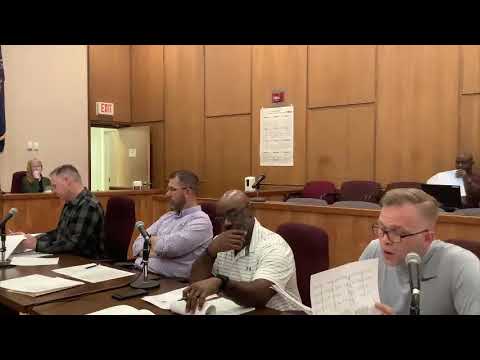
The Finance Committee met March 13 to review the proposed 2024–25 public works budget, focusing on water and sewer funds, personnel allocations, building‑repair funding and capital projects, committee members and city staff said.
Committee members said the engineering personal‑services line shows a roughly 55% decrease after salary costs were reallocated so each engineer position is budgeted one‑third to general operations, one‑third to water and one‑third to sewer. Ben, the committee lead, and City staff said the proposed budget retains a senior engineer and includes a junior engineer in the proposed document, but staff had not provided the time‑study or workload analysis the committee requested to justify added positions.
Brad, a city staff member presenting the water and sewer budgets, explained proposed changes for water purification, distribution and transmission. He said the water fund’s total personal‑services line rose about 21% largely because of contractual wage increases and the addition of four positions (two in IT and two in the auditor’s office) that are partially funded from water/sewer funds. Brad said the city plans a door‑to‑door inventory of lead service lines on numbered streets in the last week of the month and that the inventory will be used to apply for outside grant funding to replace lines: “Once we have our inventory once we know exactly how many lead service lines we have … then we can apply for a grant to … replace these,” Brad said.
Committee members pressed on multiple low line items for building repairs. President Mia and other members said the proposed $5,000 line for building repairs at the city building (and similar low amounts for the central garage and parks buildings) is not realistic given recent expenditures; one member noted last year’s expenditures exceeded $60,000. President Mia said the committee should “be realistic and conservative” on repair funding and earmark the item for follow‑up.
Staff detailed a one‑time $40,000 replacement for the plant’s Ansell (fire‑suppression/retardant) system to remove material the staff identified as containing a carcinogen and to replace it with a compliant substitute; Brad said disposal and replacement are included in that estimate. The budget also reflects an ongoing telephone‑system transition; Brad said the water fund had budgeted $5,000 but year‑to‑date charges were about $14,003 and recommended increasing that phone line to $10,000.
On fleet and central garage lines, members noted savings from newer vehicles and in‑house tire work but also pointed to high parts and repair costs for some large trucks (examples cited in the discussion included a near‑$15,000 exhaust repair). Alderman Robinson said he expected lower repairs because newer vehicles were purchased but acknowledged spikes when major breakdowns occur: “I’m pretty confident we didn't break $90,000 unless we had a significant breakdown,” Robinson said.
The committee reviewed capital‑outlay proposals. For the water fund, staff reduced a proposed capital outlay to $250,000 to help balance the budget but noted many needs (curing‑in‑place pipe, lead service replacements and other mains). For the sewer fund, staff proposed increasing the annual sewer‑lining capital outlay from $250,000 to $350,000 to make continued progress under the consent order; Brad said the additional funds would allow more lining work and might also be applied to related work such as manhole rehabilitation or other inflow/infiltration (I&I) repairs, depending on engineering recommendations.
Members discussed mandated training tied to the consent order and staff recommendations to train sewer‑maintenance personnel to identify and rate pipe defects. Brad said four people need training at roughly $1,500 each (about $6,000 total). Several committee members supported finding or reallocating funds to provide the required trainings.
Other items discussed included the tree program and the city’s share for resident cost‑share removals (a $25,000 line for shared tree removal), snow‑removal and salt budgets (staff reported the salt account currently carries about $48,035), a questioned allocation for custodial/cleaning services that raised the building personnel line to roughly $112,000 in one line item, and parks capital requests (lighting, backstop and fencing work on Fields 1–2 and Field 10). Staff said some park work could be moved to capital projects and noted possible alternate funding sources such as the auto fund.
The meeting concluded with a motion to enter an executive session to discuss litigation. President Mia moved to go into executive session and the motion was seconded; no vote or final outcome on that motion is recorded in the transcript excerpt.