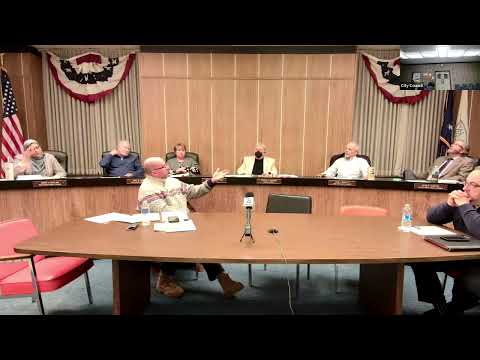
Lackawanna holds public hearing on proposed ordinance allowing remote council participation under "extraordinary circumstances"
Loading...
Summary
City council held a public hearing on a proposed local law that would let members attend meetings by video conferencing in extraordinary circumstances; speakers asked how "extraordinary circumstances" will be defined, raised concerns about abuse and notice, and discussed technology and public-comment implications.
A public hearing at the Lackawanna City Council considered a proposed local law to allow council members to attend meetings by video conferencing under "extraordinary circumstances," council President Frederick Moreno said. The notice for the hearing said publication occurred on Dec. 27, 2024, and Jan. 17, 2025, in Buffalo Business First and on the city's website and public venues.
The proposal would let members participate remotely when they cannot be physically present for reasons such as illness, a death in the family, travel delays or hazardous weather, Attorney Gaughan, the city attorney, said. "You can't narrowly tailor the law to cover every circumstance," Gaughan said, and the council president would have authority to approve or deny remote participation on a case-by-case basis.
Ian Schroeder, a resident of 22 Cook Street, asked, "what is it that is going to qualify as extreme circumstances?" expressing a taxpayer concern that elected officials be physically present for meetings when possible. Schroeder and others said they worry the option could be abused if not clearly limited.
City officials described several constraints in the proposed language and the associated protocol. The ordinance text and its protocol list examples of permissible "exigent or extreme circumstances," but do not attempt to define every possible situation, Gaughan said. The hearing record includes language noting a public-notice timing requirement related to remote participation; speakers referenced a four-day public notice period for announcing that a member will appear remotely, though the transcript also recorded references to "two days" and that short-notice exceptions could arise for true emergencies.
Officials emphasized that a live quorum must be present for a meeting to proceed, and that remote participation is not intended to allow a council member to vote from vacation. "If you're on vacation, you know, you're not supposed to call in because that's not an extenuating or extreme circumstance," Moreno said. One commenter noted a limit that remote participation is not permitted if three members are absent, and officials reiterated that the council president must manage quorum and meeting continuity.
Speakers also raised technical and public-participation issues. Gene Oliveri, the city's IT specialist, said the city does not have a built-in buffer or time delay for remote speakers and that staff can shut off a remote participant if needed, but managing remote connections could require additional attention from IT staff. Attorney Gaughan noted that, under the Public Officers Law as applied locally, if the council permits public comment in person then remote attendees must also be allowed to comment; that parity raised concerns about moderating disruptive remote participants and the limits of control over remote attendees.
No formal vote or council decision on the ordinance was recorded during the hearing. The session included procedural details: speakers were asked to limit remarks to three minutes, the hearing was scheduled to end at 6:20 p.m. to allow a caucus at 6:30 p.m., and the proceedings were being recorded.
The discussion repeatedly distinguished between discussion, potential administrative directions and formal action: members and staff described how the council president would exercise discretion under the proposed law (administrative direction), questions and concerns were aired by residents and officials (discussion), and no final adoption or vote on the ordinance was taken at the hearing (formal action: none). The council did not set new binding limits or adopt additional enforcement mechanisms at the hearing; speakers said such measures could be revisited if the remote option is later abused.
The hearing record shows the council seeking to balance continuity of government and public access with safeguards against abuse and technological limits. Further steps and any formal vote were not specified at the hearing.