Get Full Government Meeting Transcripts, Videos, & Alerts Forever!
Get email alerts on the Layoff Notice topic
No spam. Unsubscribe anytime.
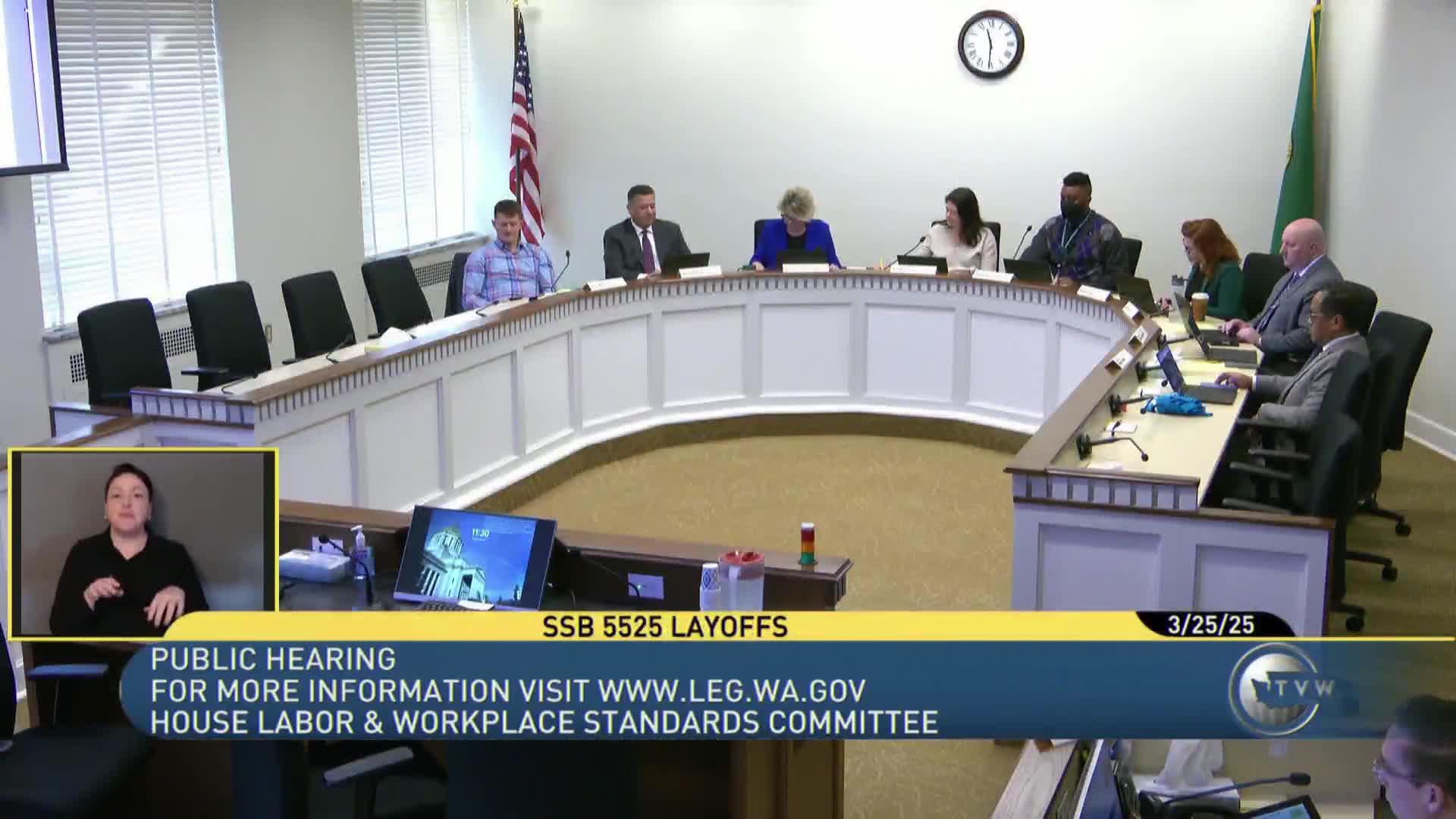
Panel hears state WARN‑style bill to require 60‑day notice for mass layoffs and closings
Summary
Engrossed SB 5525 would create a Washington WARN act requiring covered employers to provide 60 days’ notice of business closures or mass layoffs, expand coverage to employers with 50+ employees, and add state penalties and specific notice content; witnesses included laid‑off employees and contractors.
Senate Bill 5525, titled the Securing Timely Notification and Benefits for Laid Off Employees Act in staff briefing, would create a Washington‑level WARN statute that requires covered employers to provide 60 days’ notice before a business closing or mass layoff and prescribes notice content, exemptions, and penalties.
Staff outlined the bill’s scope: a covered employer is a person with 50 or more full‑time employees in Washington (state and political subdivisions are excluded). A business closing or a mass layoff that causes employment loss for 50 or more full‑time employees in a 30‑day period would trigger the notice requirement. The bill largely parallels the Federal WARN Act but differs in several elements, including employer threshold and additional notice content required by the bill.
Notable provisions: The bill requires notice to unrepresented employees, union representatives of affected employees, and the Employment Security Department and adds specified content such as whether a temporary action is expected to be longer or shorter than three months, names of employees holding affected jobs, whether jobs are being relocated or contracted out, and addresses of affected employees for the ESD notice.
Exemptions and penalties: Staff described five exemptions (three mirror federal exemptions — active pursuit of capital, unforeseeable business circumstances, and natural disaster — plus two Washington‑specific exemptions related to completion of construction projects and multi‑employer construction projects with union dispatch). Penalties for failure to notify include back pay and benefits to each affected employee for the violation period and a civil penalty up to $500 per day; certain reductions apply, and timely payments can avoid civil penalties.
Witness testimony: Workers and contractors testified in support. Chris Webber, a former Blue Origin tooling‑design engineer, recounted being laid off with no notice and urged the committee to support SB 5525 to protect workers’ stability. Michael Transu (Mechanical Contractors Association of Western Washington) and other construction representatives sought specific language from a House version of the bill for construction‑project exemptions, asking that the law apply across the life of a project rather than only at its “completion.”
PFML protections: The bill also prohibits employers from including employees on paid family and medical leave in a mass layoff unless the layoff falls under certain exemptions, preserving state PFML restoration protections except in those narrow circumstances.
Committee follow‑ups: Members asked about differences between the Senate and House versions; staff offered to provide a chart. Testimony included requests to replace the Senate’s “completion” phrasing with the House language for construction‑project exemptions to avoid shutting out workers who are intermittently employed across a multi‑year project.
The committee closed the SB 5525 hearing after testimony; no committee vote is recorded in the transcript.