Get Full Government Meeting Transcripts, Videos, & Alerts Forever!
Get email alerts on the Tax Policy topic
No spam. Unsubscribe anytime.
Senate approves changes to statewide base-year homestead exemption and opt-in rules
Summary
Senators passed House Bill 92 to clarify and amend provisions for base-year homestead exemptions, including an April 30 opt-in window, a 5-acre limit, surviving-spouse language, and special provisions for DeKalb taxes and multi-county cities.
The Senate approved House Bill 92, a measure consolidating and clarifying prior local-government homestead-exemption changes. The bill combines several House proposals to fix drafting issues and to give clearer opt-in and opt-out paths for local governing authorities.
Key provisions and sponsor explanation Senator (District 50 Second) presented the bill and said it resolves unintended consequences from earlier legislation. Among the changes are: - Reinstating a 5-acre limit on qualifying homestead claims (historical practice in Georgia). - Adding surviving-spouse treatment when a homeowner dies mid-year so the surviving spouse can still receive the exemption. - Creating an annual March 1 opt-back-in window (extended to April 30 in the implementation year described on the floor) and a future 2027 revisit for counties without an established opt-in or base freeze. - Clarifying that school construction exemptions apply only in systems that have opted in and protecting DeKalb—s MARTA tax treatment.
Floor debate and questions Floor discussion focused on technical fixes to opt-in/opt-out mechanics and ensuring small, single-city anomalies in multi-county jurisdictions do not block countywide decisions. The sponsor told colleagues the House sought a quick floor consideration and that the Senate was moving to transmit the bill immediately if passed.
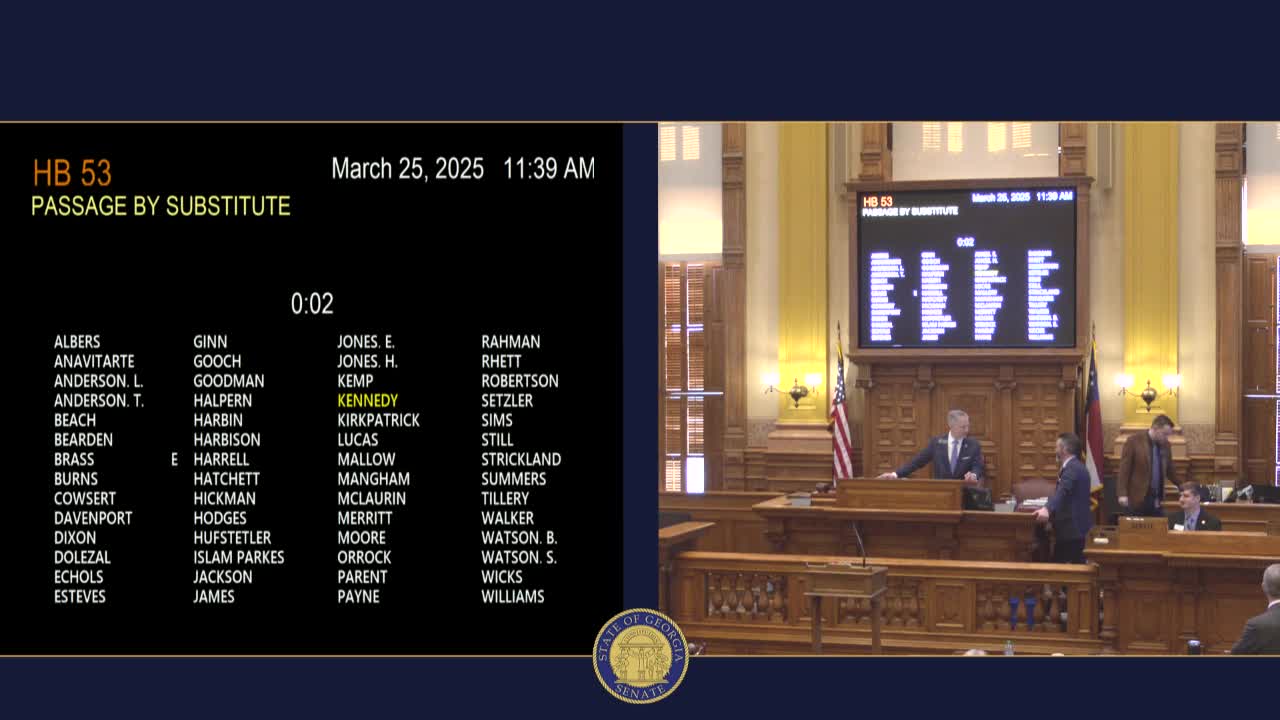
Vote and procedural action The Senate recorded 52 yeas and 2 nays on passage. After passage the Senate granted unanimous consent to immediately transmit House Bill 92 to the House.
Ending Legislative sponsors described the bill as technical corrections intended to stabilize local implementation and reduce inadvertent tax consequences for counties and small cities.