Get Full Government Meeting Transcripts, Videos, & Alerts Forever!
Get email alerts on the School Budget topic
No spam. Unsubscribe anytime.
Methuen preliminary FY26 budget centers on rising special-education costs, staffing and state funding shortfalls
Summary
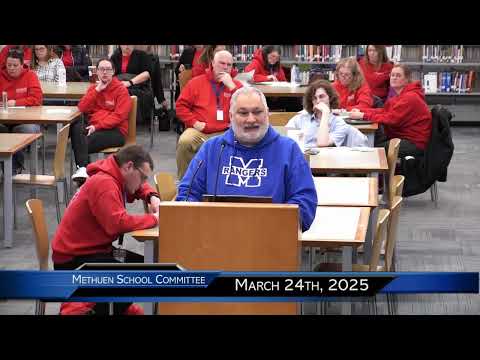
Superintendent Quang presented a preliminary FY26 budget March 24 that preserves class sizes while seeking dozens of new positions and warning that special-education and transportation costs are driving a large portion of the request amid uncertain state and federal funding.
Superintendent Quang presented Methuen Public Schools’ preliminary fiscal 2026 budget at a March 24 workshop, saying the plan aims to preserve class-size goals while responding to what she described as sharply rising special-education, transportation and contracted-service costs.
The presentation put special-education spending at about $53.2 million — roughly 42 percent of the budget the district is proposing — and showed a package of staffing additions the administration says are needed to serve students with increasingly complex needs. Quang told the committee the budget also relies on two federal grant awards that had not been confirmed by the meeting.
Quang emphasized enrollment trends and the changing student profile. “The continual increase of our English learners … has almost doubled in five years,” she said, and the district’s “high‑needs” cohort — students who are English learners, low‑income or students with disabilities — now represents about 65 percent of enrollment. The superintendent said the district is trying to protect class-size targets — 18–22 in grammar schools, a target kindergarten range of 15–20 — while adjusting staffing to match student needs.
Why it matters: Methuen leaders said the district’s spending pressures come from multiple directions that state formulas and one‑time local reserves do not fully cover. The presentation explained how the Student Opportunity Act (SOA, state education funding reform passed in 2019) and Chapter 70 aid interact with special‑education reimbursements (the “circuit breaker”) and local tax limits. Committee members and staff warned that the current state foundation formula and the phased implementation of SOA have not kept pace with inflation and rising service costs.
Key details and numbers presented - Special education: Quang placed total special‑education spending at about $53.2 million (in‑district and out‑of‑district tuition, related services and transportation). The administration said special‑education is one of the largest and fastest‑growing drivers of district costs. - Circuit breaker: FY25 threshold noted in the presentation was $52,419; the circuit‑breaker program reimburses a district for a portion of extraordinary special‑education tuition above that threshold. The district described the statutory reimbursement as 75% at present and noted active legislation that would raise it toward 90%. - Contracted services: The budget shows a roughly $9 million increase in contracted services year‑over‑year, including a $2.4 million proposed contract to expand an in‑district program for students with autism (see separate article on the proposed Constellations contract). - Transportation: The administration reported a transportation cost increase incorporated into the FY26 request (non‑net transportation shown in the presentation rose by about $2.58 million). The district noted DESE recently reimbursed roughly 44% of special‑education transportation costs in the most recent year.
Committee members pressed for clarity on which costs are legally required (IEP obligations, transportation and out‑of‑district tuition) and which are discretionary. Member Ouellette and others urged outreach to the legislative delegation in Boston, arguing that state funding rules and the pace of SOA implementation are central to long‑term solvency. Member Keegan and others said the committee must also make realistic local budget choices before the request reaches city government.
Next steps: Quang said the administration will continue to meet weekly with the city’s chief administrative and finance officers to establish the city contribution number and requested at least one or two more budget‑workshop meetings in April. The presentation included a “net‑zero” scenario that would remove roughly 40 full‑time positions (about $2.9 million) as an example of how the district could reduce the budget if required.
The school committee did not take a final vote on the budget at the March 24 workshop; members scheduled further budget workshops and said they will continue to seek details on state grant prospects, federal awards and the city’s funding commitment.