Get Full Government Meeting Transcripts, Videos, & Alerts Forever!
Get email alerts on the Prescription Drug Affordability topic
No spam. Unsubscribe anytime.
Committee advances bill to ban programs that divert patient assistance from deductibles
Summary
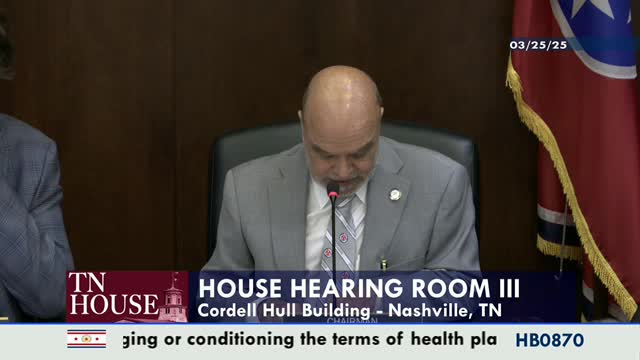
The Tennessee House Insurance Committee advanced House Bill 870 on a unanimous voice vote after extended testimony and legal explanation on how so‑called alternative funding programs (AFPs) affect patients’ access to specialty drugs.
The Tennessee House Insurance Committee advanced House Bill 870 on a unanimous voice vote after extended testimony and legal explanation on how so‑called alternative funding programs (AFPs) affect patients’ access to specialty drugs.
HB 870, sponsored in committee by Representative Lehi Rudder, would prohibit entities from using programs — described in testimony as “maximizers,” “optimizers,” “accumulators” or AFPs — in any way that prevents manufacturer patient assistance funds from counting toward a patient’s deductible or out‑of‑pocket maximums. An Office of Legal Services attorney told the committee the bill also includes a provision intended to avoid making certain health savings account (HSA)‑qualified plans ineligible under federal Internal Revenue Code section 223.
The bill’s sponsor told the committee the measure is intended to close recurring legal and programmatic workarounds that deny patients credit for assistance that should reduce their cost‑sharing obligations. “No entity should be permitted to engage in any activity which permits, prohibits, or restricts patients’ assistant funds from being applied to the patients’ deductible and out of pocket expenses,” Representative Lehi Rudder said.
Two witnesses described harms they attribute to AFPs. Patrick Nichols, a specialty pharmacist from Nashville, told the committee his health system documented more than 100 patients enrolled in AFPs in 2024 and cited delays and disruptions: “The average time it takes for a patient enrolled in an AFP to get medication from the time their doctor decides to treat them is almost 2 months … 20 percent of our patients enrolled in AFPs experienced a gap in therapy,” Nichols said. He said 36 percent of those patients were directed to international pharmacies and 30 percent to manufacturers’ patient assistance programs, which he said were designed for uninsured patients.
Brian Duvall, a Vanderbilt University Master of Public Health student who lives with severe hemophilia A, urged a ban on AFPs. “AFP must be banned and HB 870 is a step in the right direction for my community,” Duvall told lawmakers, arguing AFPs shift people with employer coverage into charity or foreign‑sourced supplies and create long waits for critical medicines.
Levin Middleton of the Office of Legal Services offered a technical explanation of the bill’s HSA language, saying the new text narrows the prior calculation requirement so it will not render HSA‑qualified plans ineligible under IRC section 223. Middleton explained the existing statute requires including all amounts paid on behalf of an enrollee when calculating out‑of‑pocket contributions, and the new language limits that requirement for HSA‑qualified high‑deductible plans until the plan deductible’s minimum is satisfied, except for preventive services.
After discussion and questions from members, the committee voted to advance HB 870 to the calendar and rules committee. The clerk announced the tally as 17 ayes, 0 nays.
Supporters said the bill protects patients from delayed care and preserves manufacturer assistance for those lacking other coverage; opponents were not recorded in committee testimony. The bill now moves to the next stage of the legislative process.