Get Full Government Meeting Transcripts, Videos, & Alerts Forever!
Get email alerts on the Turf Seed Contracts topic
No spam. Unsubscribe anytime.
House committee hears bill to set standards for turfgrass seed contracts
Summary
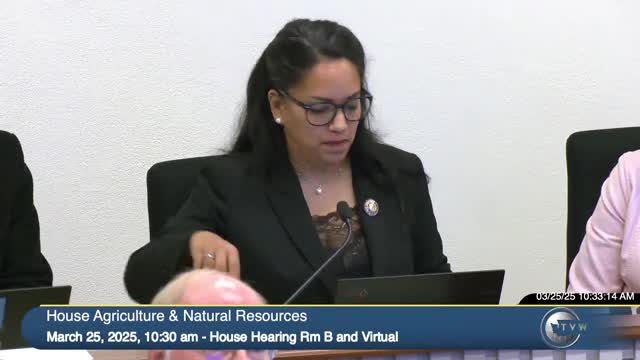
The House Agriculture and Natural Resources Committee opened a public hearing on Substitute Senate Bill 5074, which would add contract standards for turfgrass seed production and give the Department of Agriculture specific enforcement tools to address delinquent payments to seed growers.
The House Agriculture and Natural Resources Committee opened a public hearing Tuesday on Substitute Senate Bill 5074, a measure that would create specific contract standards for turfgrass seed production and give the Washington State Department of Agriculture more direct enforcement authority over delinquent seed payments.
Lily Smith, staff to the committee, told members the bill “creates more specific standards specifically for turf seed production and purchase contracts,” including required contract elements such as estimated delivery dates, the amount and type of seed, payment due dates, and procedures if seed fails to meet contract standards.
The nut graf: proponents say the measure aims to speed payment to seed growers and reduce the financial risk that producers face under the current system, which relies on general commercial contract law and the Commission Merchants Act as a backdrop. The bill would authorize the Department of Agriculture to charge interest on late payments, suspend dealer licenses for delinquency, require financial assurance from dealers, and offer mediation services for disputes.
Senator Behnke, the bill sponsor, described the problem in practical terms: “Really what came to me with our seed growers were not getting paid,” and said the bill aligns Washington with standards used in Oregon and Idaho to help growers “speed up that process” and reduce market risk. He said standardization would help Washington remain competitive in the turf seed market.
Staff explained technical limits in the current law. “The testing provisions in the bill apply to turf seed production contracts, not purchase contracts,” Lily Smith said, describing that production contracts are entered before seed is grown and that, after harvest and a clean-out process, the purchaser determines whether seed meets contract terms. Smith said the bill “expedites that process” to allow a grower to seek other buyers if a purchaser will not complete the transaction.
Representatives asked about equity and local impacts. Senator Behnke said the bill would benefit largely Latino workforces in production areas such as the Pasco Tri-Cities region, saying the measure “is gonna lift up a lot of our Latino communities right off the bat.” Representative Orcutt questioned why testing provisions would matter if purchasers could be buying seed that did not meet contract standards; staff clarified the testing language applies to production contracts and the subsequent sorting and clean-out determine compliance.
The Washington State Department of Agriculture told the committee the bill, as amended, addressed earlier agency concerns. Allison Halper, representing the department, said the original version “was well intended, but it needed a little bit more work,” and that agency subject-matter experts supported the revised language and felt it would be practicable to implement.
Committee members also asked procedural questions about jurisdiction and enforcement. Allison Halper confirmed the department’s Commission Merchants program and agricultural investigations would have authority to work on delinquent turfgrass seed contract payments and related mitigation.
The public hearing on Substitute Senate Bill 5074 closed without a committee vote; committee staff noted the bill would be taken up later in executive session. A fiscal note was available to members in the committee’s bill packet.
Looking ahead, committee members were reminded that amendments must be routed to staff by Friday morning if members intend to propose changes prior to the planned executive session.