Get Full Government Meeting Transcripts, Videos, & Alerts Forever!
Get email alerts on the Property Tax Exemption topic
No spam. Unsubscribe anytime.
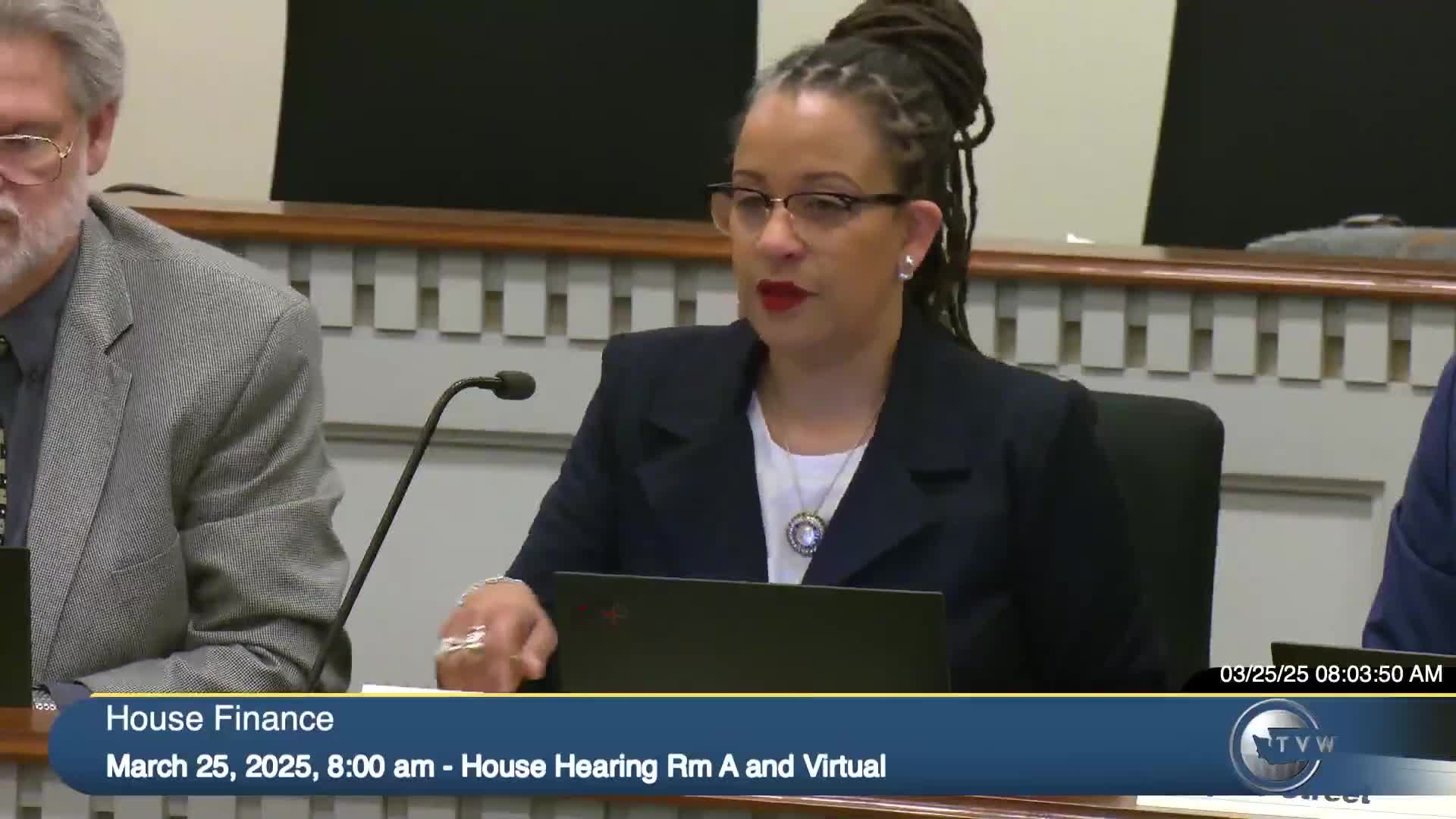
House Finance committee hears homestead exemption proposal to exempt a portion of primary residences from state property tax
Summary
The Washington State House Finance Committee on March 25 held a public hearing on House Bill 2024 and House Joint Resolution 4204, a pair of measures that would allow the Legislature to exempt a portion of a homeowner’s principal residence from state property taxation and establish the program’s implementing rules if voters approve a constitutional amendment.
The Washington State House Finance Committee on March 25 held a public hearing on House Bill 2024 and House Joint Resolution 4204, a pair of measures that would allow the Legislature to exempt a portion of a homeowner’s principal residence from state property taxation and establish the program’s implementing rules if voters approve a constitutional amendment.
Tracy Taylor, staff to the committee, told members that HJR 4204 would amend the state constitution to permit the Legislature to “provide a property tax exemption for the principal place of residence,” and that HB 2024 would implement the exemption if voters approve the amendment. Taylor said the exemption amount in the draft bill is the greater of $100,000 or 60% of the county median home value as published by the Department of Revenue, rounded to the nearest $1,000. She also said the Department of Revenue must reduce the exempted percentage if state school levy parts 1 or 2 are expected to exceed the combined statutory maximum of $3.60 per $1,000 of market value.
The bill text would limit the exemption to a single residential parcel per claimant, require the claimant to occupy the residence at least 184 days in the calendar year for which the exemption is claimed, and exclude the exemption from local property tax levies. Taylor said the exemption would apply to single-family homes, residential parcels with fewer than five dwelling units, mobile homes fixed in location, residential floating homes, cooperative housing where the exemption passes through to the claimant, and certain life estates. The exemption would remain until sale, transfer or a change of use; the claimant must notify the county assessor of status changes on forms approved by the Department of Revenue.
Taylor described an application process administered by the Department of Revenue and interactions with county assessors. The bill would create a Primary Residence Property Tax Exemption Administration Account, funded by legislative appropriation and distributed to counties to offset administration costs; counties would receive $10 per initial-year application and $5 for subsequent-year applications and must segregate those state funds for assessor administration. Taylor said the act would be exempt from a tax preference performance statement, JLARC review and the automatic 10-year expiration that otherwise can apply to tax preferences.
Representative April, the bill’s prime sponsor (for the record name given as April), told the committee she has sponsored or cosponsored homestead-exemption proposals in each of her five years in the Legislature and framed this measure as non-means-tested relief. “All Washingtonians would be able to take advantage that a portion of their property would not be subject to state taxation,” she said, adding that the proposal is intended to help homeowners build wealth through homeownership.
Public testimony for the two measures included support from Mia Shigemura of the Washington State Budget and Policy Center, who said treating a primary home differently than investment property is “common sense” and urged a yes vote on the resolution. Opposition testimony came from multifamily and manufactured-housing representatives including Brad Tower of Commonwealth Real Estate Services, who warned the tax shift could raise costs for residents of manufactured-housing communities, and from Jonathan Manheim of NAHOP, who said shifting roughly $1 billion per year of tax burden to other property owners could increase rent pressure and strain the economics of rental housing.
Taylor summarized fiscal notes in the committee packet. She said the Office of the Secretary of State estimated costs for the 2025 ballot measure of about $2.2 million in fiscal 2026, including roughly $418,000 for the voters’ pamphlet and about $1.8 million for statewide election costs. The Department of Revenue’s fiscal note, Taylor said, projects a major shift in the state property tax levy, with estimated impacts to other taxpayers of about $750 million in fiscal 2030 and about $1.4 billion in fiscal 2031; the department also listed administrative expenditures across early implementation years. The Office of the State Treasurer and other fiscal offices flagged indeterminate effects on earnings credited to the general fund. Taylor said the constitutional amendment would be placed on the November 2025 ballot if it passes the Legislature, and — if adopted by voters — the exemption would apply to state property taxes levied for collections in calendar year 2028 and thereafter.
No committee action or vote occurred during the hearing; leaders closed public testimony and moved on to other bills.
The committee record contains the staff briefings and fiscal notes cited in testimony, and written testimony submitted by supporters and opponents is in the bill packet.