Get Full Government Meeting Transcripts, Videos, & Alerts Forever!
Get email alerts on the Chronic Absenteeism topic
No spam. Unsubscribe anytime.
OSPI, courts and ESDs outline strategies to curb chronic absenteeism in Washington schools
Summary
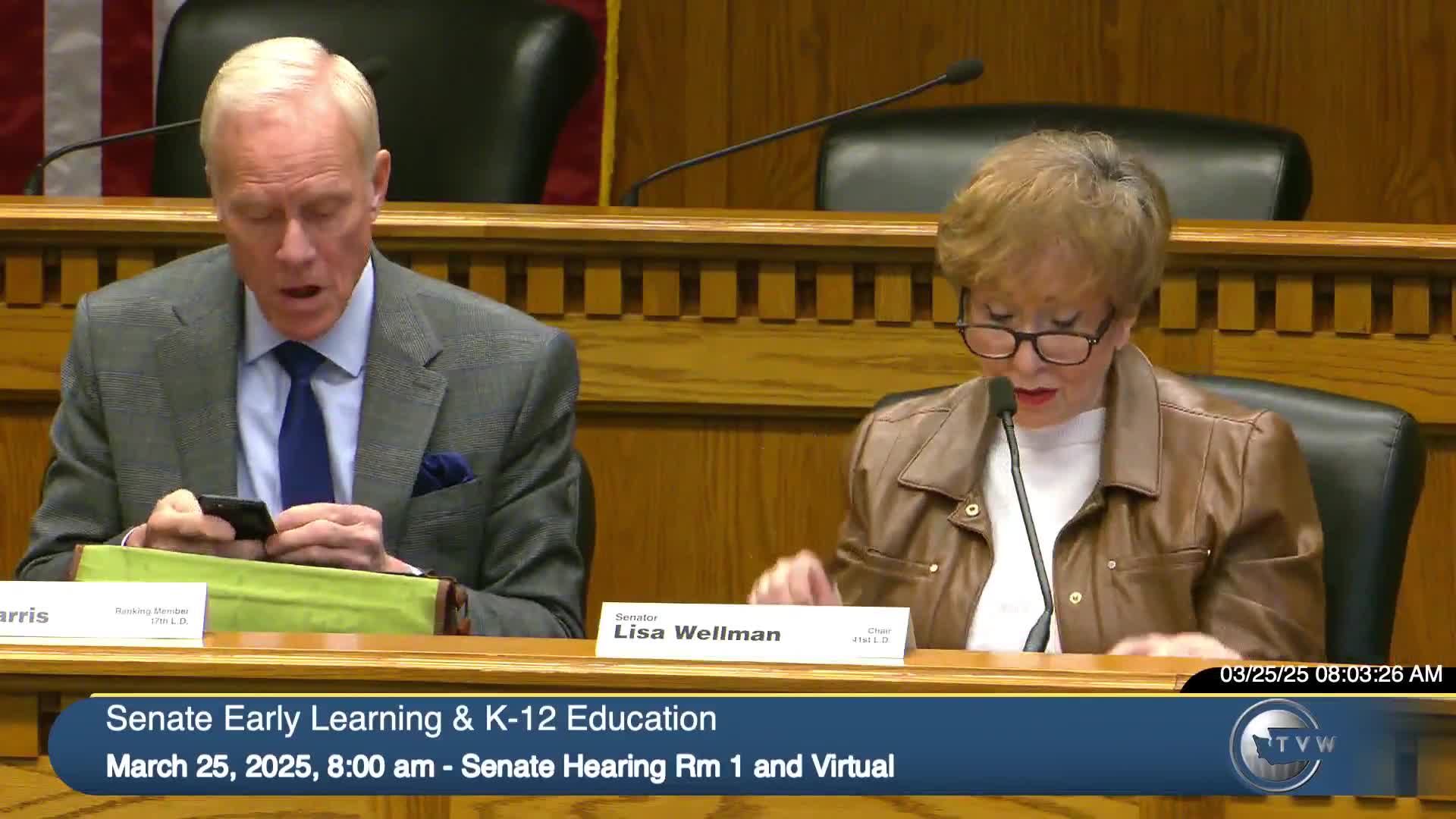
OSPI Assistant Director of Attendance and Engagement Chrissy Johnson and OSPI Senior Policy Analyst Mitra Tranisky told the Early Learning & K‑12 Education Committee that attendance is foundational to learning and that early, supportive interventions should precede court involvement.
OSPI Assistant Director of Attendance and Engagement Chrissy Johnson and OSPI Senior Policy Analyst Mitra Tranisky told the Early Learning & K‑12 Education Committee that attendance is foundational to learning and that early, supportive interventions should precede court involvement.
OSPI described chronic absence — missing 10% or more of school days, about 18 days in a typical year, counting excused and unexcused absences — as an “early warning indicator” and said Washington had about 73% of students attending 90% or more of days last year (the inverse implies roughly 27% of students were chronically absent). The office also said truancy, defined in the state by thresholds of seven unexcused absences in a month and 15 in a year, triggers required district interventions and — only after those interventions — a petition to juvenile court.
OSPI outlined recent work to build capacity in districts and ESDs, including an ESSER attendance and reengagement project that worked with more than 80 districts, every Educational Service District (ESD), and several state schools. The effort funded regional coordinators, coaching on MTSS (multi‑tiered systems of support) practices and one‑to‑one outreach for students who had disengaged. “Attendance is foundational to student learning,” Johnson said, adding that relationships with trusted adults and a safe, supportive school environment are critical for keeping students in class.
The agency summarized findings from its Reenvisioning Truancy Project, a 2023 effort with the American Institutes for Research and an advisory group that included juvenile court administrators and community partners. OSPI said listening sessions and interviews showed common underlying causes of absences: mental‑health challenges, bullying, sleep hygiene, family responsibilities (including caring for siblings or contributing income), medical issues and pandemic‑era disengagement. OSPI also said some community engagement boards succeed when they focus on root causes in a culturally sensitive way, but can be counterproductive when implemented punitively.
Claire Pearson Walker, manager of Attendance & Reengagement at ESD 112, described a regional model that emphasizes early intervention and direct family support. In Clark County during the 2022–23 school year ESD 112 reported 428 students with open truancy petitions; 215 families attended a collaborative truancy workshop and 362 students were referred for direct services, while only 26 cases required court intervention. “Out of the 428 petitions filed, 362 were referred for direct services,” Pearson Walker said, noting the program’s emphasis on diversion and reengagement.
Juvenile court commissioners who handle truancy calendars told the committee the court system often sees truancy as the first step on a longer path that can lead to delinquency, dependency and other matters. Ian Johnson, Commissioner, Snohomish County Superior Court, said RCW 28A, 225.09 authorizes a court’s response in truancy cases but leaves limited options for holding parents accountable beyond a sanction of about $25 per day; courts typically lack mechanisms to collect or enforce such judgments. “When it gets to us…and the school district is kind of out of ideas as far as interventions, we are limited in terms of what we can do in terms of holding parents accountable,” Johnson said.
Speakers emphasized the need for timely, trust‑building communication from districts to families; the use of automated daily absence notifications (robocalls, texts, emails); and stronger capacity for early intervention before cases escalate. OSPI said it is producing community engagement board guidance and training, maintaining an advisory work group, and disseminating evidence‑based communication practices and MTSS supports through regional networks, newsletters and an open community of practice.
Jeremy Chiappetta, a senior adviser to the Rhode Island governor, described an outside‑in, communitywide model used in Rhode Island: a public, nightly‑updated attendance dashboard, sustained community messaging from mayors, business and faith leaders, targeted social‑media campaigns and events celebrating improved schools. “Students who are chronically absent dramatically underperform on assessments that matter,” Chiappetta told the committee, arguing that public data and broad community engagement changed local conversation and priorities in Rhode Island.
Committee members and presenters repeatedly flagged funding and staffing as constraining factors: schools and ESDs cited limited capacity for early, individualized outreach, while ESDs and courts noted that many local staff assigned to truancy work are part‑time and lack legal training. Presenters urged continued investment in regional coordinators, community‑focused interventions, and training for districts implementing community engagement boards.
No formal votes were taken during the work session. OSPI, ESDs and juvenile court representatives said they would continue to provide information to the legislature and the committee, and OSPI said its reenvisioning advisory group will continue meeting to refine implementation options.
Context and next steps: OSPI has committed to producing guidance and training on community engagement boards, continuing its regional networks and sharing evaluation results from the ESSER attendance and reengagement project. ESD 112 asked the legislature to consider ongoing funding to sustain direct‑service and coaching work begun with ESSER funds; juvenile court officials urged clearer coordination among schools, courts and family services to address parent‑level barriers to attendance.