Get Full Government Meeting Transcripts, Videos, & Alerts Forever!
Get email alerts on the Agriculture Land Taxation topic
No spam. Unsubscribe anytime.
Joint revenue committee hears support for amendment to let small parcels qualify as farmland for tax purposes
Summary
At a joint hearing of the Massachusetts General Court’s Joint Committee on Revenue, House Chair Adrian Madrow and Senate Co‑Chair Sen. Jamie Eldridge heard testimony supporting S.11 and H.71, constitutional amendments to Article 99 that would end a five‑acre minimum for farmland tax treatment.
At a joint hearing of the Massachusetts General Court’s Joint Committee on Revenue, House Chair Adrian Madrow and Senate Co‑Chair Sen. Jamie Eldridge heard testimony supporting S.11 and H.71, constitutional amendments to Article 99 that would end a five‑acre minimum for farmland tax treatment and allow parcels of any size used for agricultural or horticultural purposes to be taxed at agricultural rates.
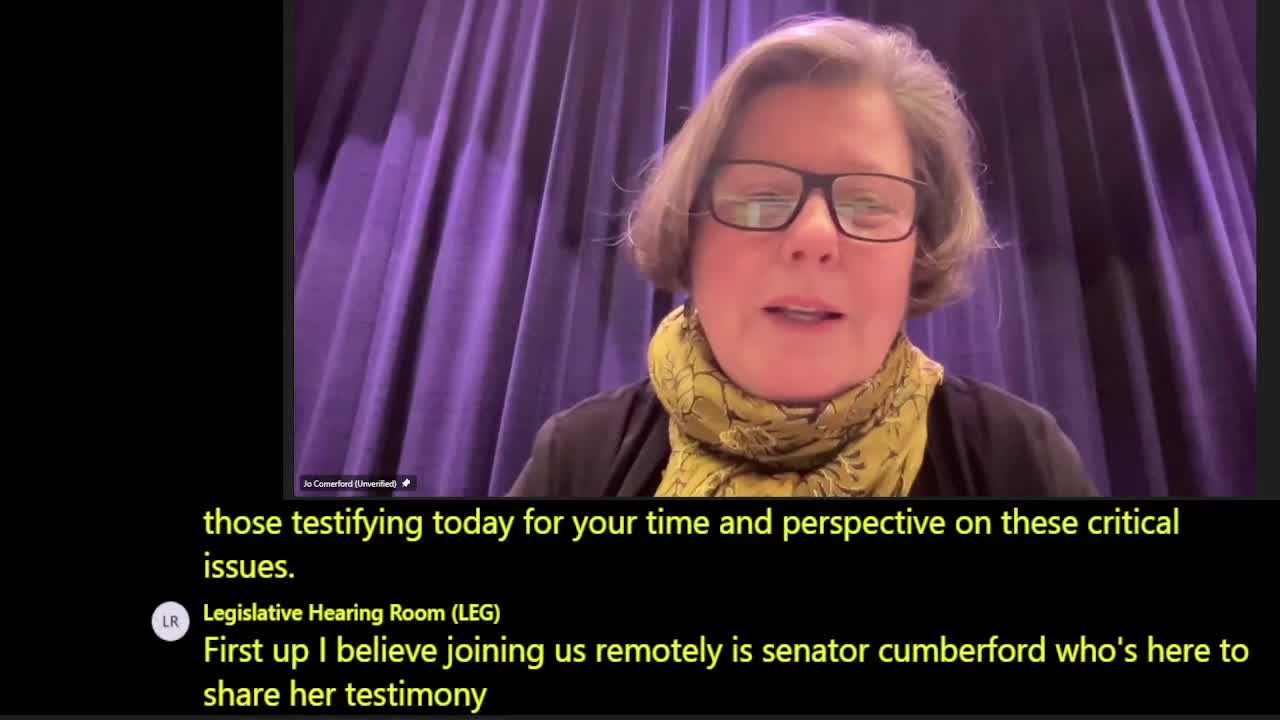
The amendment matters, testifiers said, because Massachusetts is losing farmland and small or urban farms are disproportionately affected. “Article 99 has an archaic limitation. Only farms of five acres or more are eligible for this tax treatment,” said Senator Commerford, who testified remotely in support of S.11 and H.71. “We found that Massachusetts lost 27,000 acres of farmland in the last five‑year agricultural census. We cannot afford to lose more.”
The amendment would alter how municipal tax classification applies to parcels used for farming. Rebecca Miller, policy director at the Massachusetts Food System Collaborative, told the committee that Chapter 61A is the municipal program used today to enroll parcels for reduced tax rates and that municipalities perform annual certification. “There is a process to certify that,” Miller said, adding that the bill would also require land be in production for two years before receiving the preferential rate.
Representative Natalie Blay, a sponsor of H.71, said the change is necessary to make farmland financially viable and to support entry by new farmers. “Massachusetts is third in the country for percentage of farmland projected to be lost by 2040,” Blay said. She also told the committee that 30% of farms in the Commonwealth are under nine acres and said the five‑acre restriction limits the ability of new and urban farmers to enter agriculture.
Committee members asked about safeguards to prevent abuse of the tax classification. A committee member raised the question of how municipalities would verify that properties receiving the preferential rate were genuinely used for farming rather than being reclassified to reduce taxes. Miller and other witnesses pointed to existing state and municipal verification systems: Chapter 61A enrollment at the municipal level and tools used by the Department of Agricultural Resources for other land programs such as APR (Agricultural Preservation Restriction) land. Miller also noted the bill’s two‑year production requirement as a statutory safeguard.
Witnesses cited economic pressures on farms. Senator Commerford and others said farmers often earn little margin — testimony cited figures that farmers on average keep approximately $0.94–$0.95 for every dollar spent — and that high land and housing values raise costs for new farmers. Miller cited a recent USDA figure that fair market value of farmland in the state was about $14,000 per acre.
No formal committee vote on the bills was taken at the hearing. The chairs reminded the public that proposals to amend the state constitution follow the process described at the start of the session: a proposed amendment must be approved by majorities of the House and Senate in two successive legislative sessions (or meet a 25% threshold through the initiative process) before it can be placed on the ballot for ratification by voters. Committee staff also noted procedural deadlines: written testimony could be submitted by 5 p.m. on Wednesday, April 23, to jointcommittee.revenue@malegislature.gov, and proposals for constitutional amendments must be reported on by April 30, 2025.
The hearing concluded after three public testifiers and committee questions; a motion to adjourn was made and accepted.