Get Full Government Meeting Transcripts, Videos, & Alerts Forever!
Get email alerts on the Public Safety Budget topic
No spam. Unsubscribe anytime.
Senate finance panel reviews Department of Public Safety budget as OMV faces emergency order and system outages
Summary
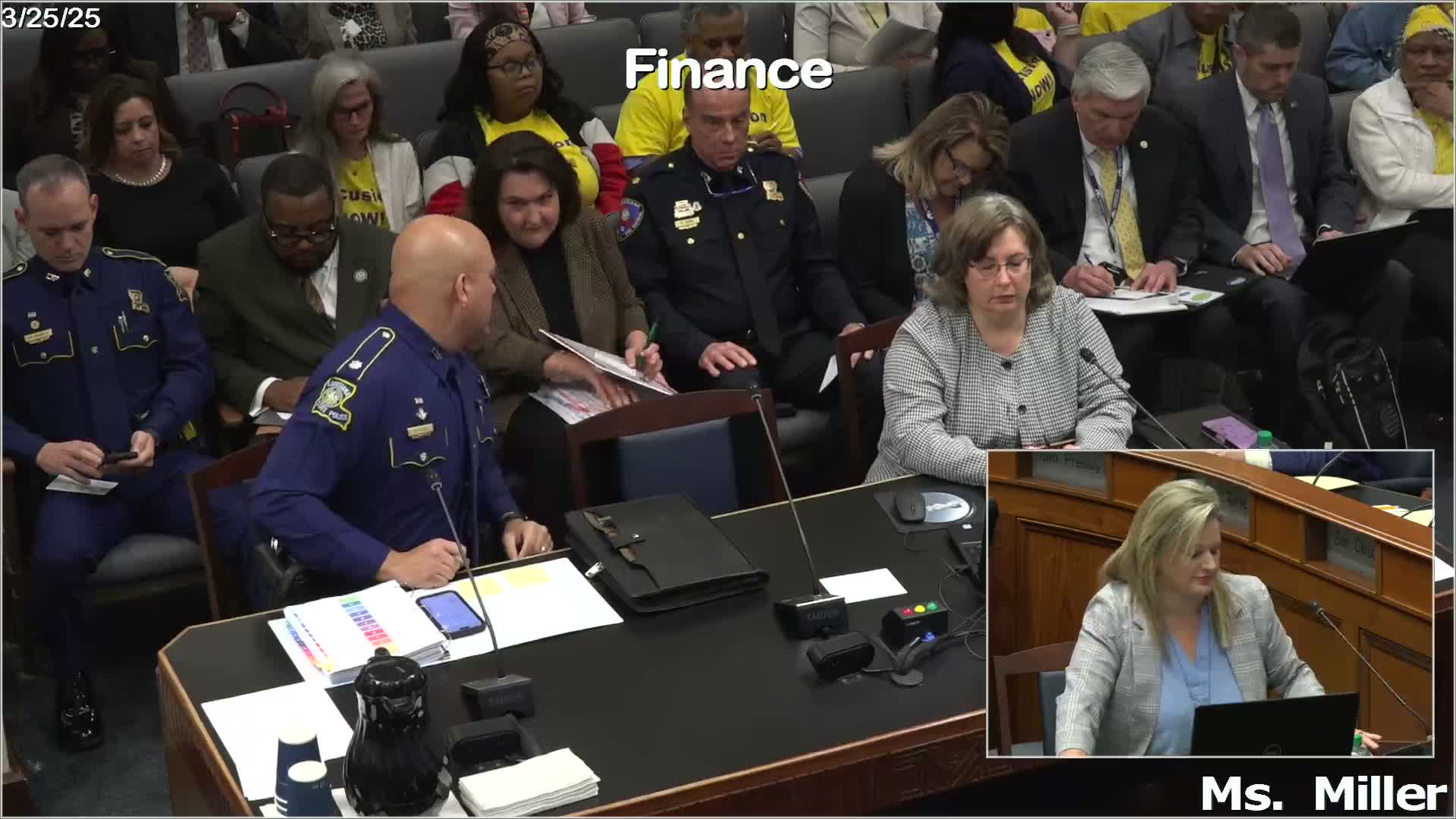
The Senate Finance Committee on March 25 continued its FY26 budget hearings with a detailed presentation from Department of Public Safety and Corrections staff and follow-up questions from senators about motor vehicle system outages, state police staffing and agency-specific budget adjustments.
The Senate Finance Committee on March 25 continued its FY26 budget hearings with a detailed presentation from Department of Public Safety and Corrections staff and follow-up questions from senators about motor vehicle system outages, state police staffing and agency-specific budget adjustments.
Committee members heard that Public Safety’s FY26 recommended budget is roughly $620.8 million with 2,716 total positions (TO). The department’s budget presentation flagged statewide reductions, a $41.5 million nonrecurring carryforward reduction and several agency-level adjustments that net to an approximate $15 million reduction (about 2 percent) from the prior recommended level.
Why it matters: Committee members pressed department leaders on two immediate operational matters — outages in the Office of Motor Vehicles’ computer system that prompted a governor’s emergency order, and staffing and operational pressures on State Police after multiple emergencies this fiscal year. Both the outages and the staffing shortfalls affect daily services for drivers and the state’s public-safety response capacity.
Budget highlights and agency adjustments
- The department briefed senators on the means of finance for Public Safety: State General Fund is about 23 percent of the department budget, fees and self-generated revenue about 43 percent, dedicated funds about 20 percent, and federal and interagency transfers roughly 7 percent each. Dedicated funds for FY26 were estimated at about $125.9 million.
- State Police represents the largest share of the department budget (about 72 percent, roughly $445 million) and holds the lion’s share of TO positions (about 1,808). Motor Vehicles is roughly 14 percent of the department budget (about $83 million); the State Fire Marshal and Management & Finance are smaller shares.
- Agency-specific adjustments called out by budget staff included a roughly $50.7 million “MOF swap” where State General Fund would replace self-generated motor-vehicle fee revenue that REC (the Revenue Estimating Conference) projects will decline; a separate $3.6 million shortfall in the concealed-handgun-permit dedicated fund; and a roughly $5.3 million federal grant/grants to increase commercial-vehicle awareness of human trafficking.
Office of Motor Vehicles, outages and executive order
Committee members focused significant attention on the Office of Motor Vehicles (OMV) after the governor issued an emergency executive order that temporarily suspends provisions of the procurement code and state law imposing late fees on driver’s-license renewals. Commissioner Dan Casey told senators OMV and the Office of Technology Services (OTS) are investigating intermittent outages affecting license, registration and reinstatement services.
Casey said the agency and OTS traced some recent changes to a network upgrade and are now examining the OMV mainframe and its database structure. He described a large, legacy mainframe and said the department bought a new mainframe last year but the database and the way transactions are processed appear to be stressing the system. The agency reported a short-term programmatic fix implemented for conviction data, and said additional changes to the system’s page allocation may reduce the number of transactions that cause timeouts.
Casey and Deputy Commissioner Stacy Poor told senators the current mainframe maintenance cost averages about $3.5 million, and that the five-year purchase made last year required an upfront payment of roughly $17 million. They also said procuring a modern replacement for driver and vehicle systems could take roughly 18 months for driver licensing and another 18 months for vehicle registration; the most-proven commercial software packages the agency has examined could cost in the tens of millions annually when measured over a 10-year life-cycle.
The governor’s executive order, Commissioner Casey said, will run through April 19 and waives late fees while OMV implements mitigations and seeks a more stable solution; the administration also announced that qualifying travelers may use expired class E licenses for up to a year for federal travel purposes. OMV asked noncritical customers to delay in-person visits during peak times so the office can serve commercial drivers and others with urgent credentialing needs.
State Police staffing, recruiting and major incidents
Lieutenant Colonel Robert Burns, newly appointed to the State Police legislative team, told senators the agency has graduated three academy classes this fiscal year and expects cadet classes 107 and 108 in coming months. Burns said the department had about 300 funded-but-not-filled positions in February and that TO counts cover both sworn trooper and civilian, noncommissioned positions. He described competition in the region for recruits and cited recent pay differences with neighboring states such as Texas and Tennessee as a recruitment challenge.
Other agency updates and oversight questions
- The Office of the State Fire Marshal reported that plan-review delays have been reduced from several weeks to about a week after workflow changes and outreach to local chiefs.
- Christopher Abare, chairman of the Louisiana Gaming Control Board, gave a short update on gaming regulation, recent property rebrands and sports-wagering revenues; he noted the board’s enforcement work is supported by State Police investigators and the attorney general’s office.
- Senators asked about the department’s large payments to the Office of Technology Services (OTS). Burns and other officials said the department spent about $61 million on OTS services in FY25 and voiced concerns about transparency of OTS billing and the need for clearer project cost estimates. Burns said staff had a scheduled meeting with OTS leadership to discuss those issues.
What the committee directed or discussed
- Senators asked the department for additional detail on the $50.7 million motor-vehicle fee revenue shortfall and asked LFO and the Office of Planning and Budget to confirm which fees and forecasts gave rise to the MOF swap.
- Senators pressed OMV leadership for timeline details on the mainframe changes and on the planned replacement project; Commissioner Casey said he would provide a follow-up on projected implementation schedules and cost estimates.
- Several senators asked for metrics and reporting on State Police vehicle replacement policy, citing trooper-safety concerns for vehicles over 160,000–200,000 miles; Colonel Burns offered to provide a detailed vehicle-replacement metric by troop.
Ending note
Committee members thanked department leaders for the presentation and asked for follow-up documents on the OMV technical fixes, the REC fee forecast that generated the $50.7 million adjustment, and detailed metrics on State Police fleet turnover and vacancy trends.
Speakers quoted or referenced in this report were recorded at the March 25 Senate Finance Committee hearing and appear verbatim in the transcript excerpts provided to the committee. Where transcript numbers or figures were inconsistent in testimony, the article makes that inconsistency explicit rather than reconciling figures not clearly reconciled on the record.