Get Full Government Meeting Transcripts, Videos, & Alerts Forever!
Get email alerts on the Broadband Infrastructure topic
No spam. Unsubscribe anytime.
Alaska Broadband Office outlines BEAD grant timeline, tribal review issues and digital equity funding
Summary
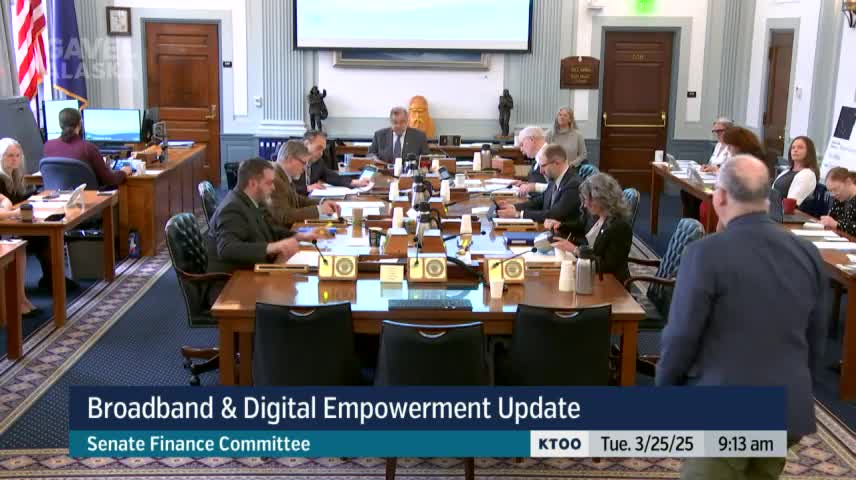
Thomas Lochner, director of the Alaska Broadband Office, told the Senate Finance Committee the office is managing the state’s BEAD and Digital Equity grant programs and described mapping delays, tribal‑land coordination issues, expected awards and next steps.
Thomas Lochner, director of the Alaska Broadband Office, told the Senate Finance Committee the office is managing two federally funded programs — the BEAD (Broadband Equity, Access, and Deployment) grant program and the Digital Equity/empowerment grants — and described progress, delays and next steps.
Lochner said Alaska’s BEAD allocation is "just over a billion dollars," and that the state anticipates distributing slightly more than $990 million for infrastructure projects. He explained two primary reasons for a protracted federal approval and mapping timeline: first, a BEAD NOFO footnote (footnote 70) had required 51% tribal‑region approval to assign a project on tribal lands, which the state’s tribal liaison and the Department of Law determined conflicted with the Alaska Native Claims Settlement Act (ANCSA). After negotiation with NTIA, Lochner said the compromise restores land‑owner authority over permits and easements while requiring applicants to show a “very strong and good faith effort” to contact tribes in the region.
Second, Lochner said the state deliberately delayed finalizing its mapping submission while a separate, federally led program affecting a large Alaska region remained uncertain; the state waited for that program to stabilize before finalizing its BEAD mapping to avoid losing the ability to include certain broadband serviceable locations (BSLs). He said Alaska launched its public review after NTIA approval on Oct. 10, opened the BEAD grant opportunity Dec. 16 and initially expected to close the application period April 14, but placed a 30‑day pause to review the potential impacts of executive orders and federal leadership changes on program rules and affordability scoring.
Lochner described how the office organized grant evaluation and procurement to meet the NTIA’s 365‑day shot clock for completing evaluations and recommended awards after receipt of the BEAD award. He said the office published its proposed contract language in advance — reviewed by the Department of Law — to speed post‑award contracting, and has contracted or is contracting professional engineers and NEPA consultants to assist with technical and environmental review.
On mapping and coverage, Lochner said the office’s public map lists every broadband serviceable location in proposed project areas, and defines "unserved" as locations that cannot receive 25 Mbps download / 3 Mbps upload and "underserved" as those that cannot reach 100 Mbps download / 20 Mbps upload. He said high‑cost, extremely remote locations will likely need satellite (low‑Earth‑orbit, LEO) solutions; Lochner contrasted capacity expectations, saying that a LEO provider under low load can deliver a few hundred megabits, whereas fiber can deliver orders of magnitude more capacity.
Lochner said Alaska has also begun running the Digital Equity/empowerment grants. He said the state contracted the Rasmussen Foundation to help draft a statewide digital equity plan and that the state has been awarded just under $600,000 for planning and capacity work. He said the office expects roughly $1.8 million in 2025 and another $1.8 million in 2026 in program funding for digital empowerment activities; that funding, he said, is intended to begin training, cybersecurity and basic device‑use support but will not fully meet all needs.
Committee members asked about organizational responsibilities between state partner agencies, the federal pause or sequestration on BEAD funds (Lochner said none of Alaska’s allocation is sequestered), mapping and coverage expectations (Lochner pointed committee members to an interactive map on the Alaska Broadband Office website), and how applicants must show a sustainability model and demonstrate scale to support operations. Lochner said the office built tools to let applicants test sustainability at the community or predetermined project area level and that some extremely remote sites will remain high‑cost and likely require satellite solutions.
Lochner gave a tentative timeline: the administration review and the NTIA review periods will follow the application evaluation; he said the office expects a mid‑December award cycle (subject to NTIA review timing) and program starts early the following year. He also said the office will provide the committee with comparative coverage information for Alaska versus the lower 48.
Lochner closed by thanking the committee for its time; the committee recessed to other business after the presentation.