Get Full Government Meeting Transcripts, Videos, & Alerts Forever!
Get email alerts on the Board Of Fisheries Membership topic
No spam. Unsubscribe anytime.
House fisheries committee hears wide public support and concerns for bill to rebalance Board of Fisheries
Summary
Representative Neli Jimmy, sponsor of House Bill 125, told the House Special Committee on Fisheries on March 25 that the bill would create “two subsistence, two commercial, and two sport, and one scientist” seats on the Alaska Board of Fisheries to give subsistence users a stronger voice.
Representative Neli Jimmy, sponsor of House Bill 125, told the House Special Committee on Fisheries on March 25 that the bill would create “two subsistence, two commercial, and two sport, and one scientist” seats on the Alaska Board of Fisheries to give subsistence users a stronger voice.
The bill, introduced as a step toward “balance” on the Board of Fisheries, drew extensive public testimony from commercial fishermen, tribal organizations and regional coalitions who said current board membership underrepresents subsistence users — particularly in river systems such as the Yukon, Kuskokwim, Copper River and Cook Inlet — while other commenters said the bill omits or weakens representation for personal-use fishers and may introduce new political risks.
Why it matters: Testifiers said board membership affects how salmon and other anadromous fisheries are managed across Alaska, with direct implications for food security in rural communities. Brian Ridley of the Tanana Chiefs Conference noted a subsistence priority in state law and said wild food is “the food for rural Alaska.” The Alaska Regional Coalition told the committee it represents 109 communities and about 70,000 people and “enthusiastically supports” the change because it would create explicit subsistence representation and include science.
Supporters and rural representatives
John Manley, a commercial fisherman from Kenai, said the current board is “grossly in imbalance” and that board members who act to “eliminate one user group” should not serve. Several other commercial and subsistence fishers, including Russell Clark (Cook Inlet commercial fisherman) and Don Hernandez (Point Baker resident), said HB 125 would equalize user-group representation and protect subsistence access.
Doreen Levitt, director of natural resources and tribal council secretary for the Inupiaq Community of the Arctic Slope, and Alaska Regional Coalition representatives urged the committee to include indigenous knowledge in the scientific voice and to prohibit subsistence appointees from also qualifying as sport or commercial representatives.
Concerns raised by personal-use and sport-fishing groups
Testimony from Charles (Chuck) Derrick of the Dipnetters Association and representatives of sport-fishing organizations highlighted gaps for personal-use fishers. Derrick said personal-use harvesters — about 40,000 participants in certain dipnet fisheries — are not represented under the bill as written and urged a path to representation.
Shannon Martin, executive director of the Kenai River Sport Fishing Association, and other sport interests urged removal of a provision that would seat a NOAA Fisheries (federal) scientist on the board. Martin said Alaskans worked to keep fishery management at the state level and expressed “grave concerns about re‑injecting the federal government into the management of our fisheries.” Several testifiers suggested the committee consider state scientists or University of Alaska faculty instead.
Process and next steps
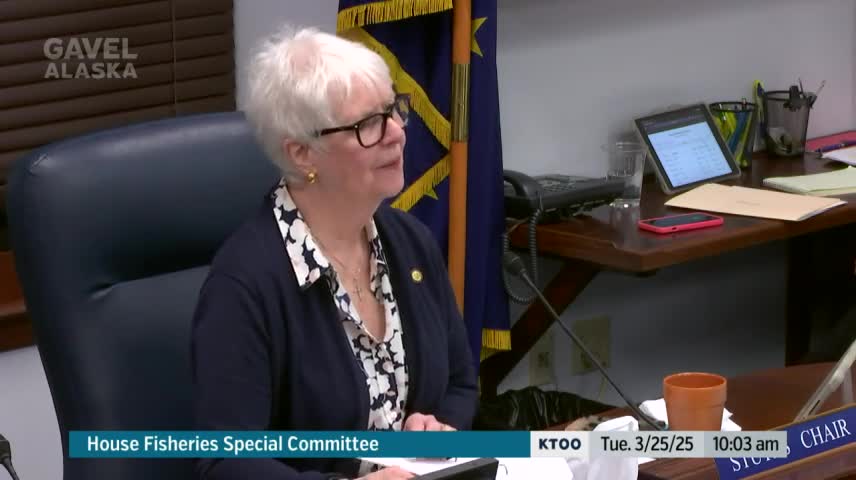
The committee’s chair, Representative Stutes, set an amendment deadline of Thursday, April 3 at 5:00 p.m. to her office and said the legislation would be set aside while the committee considers changes. Committee members asked the Department of Fish and Game legislative liaison, Joe Feckel, to provide the number of fisheries biologists on state staff to inform whether a state scientist could serve in lieu of a NOAA nominee.
Discussion points that emerged for possible amendment included tightening definitions (what qualifies as sport, commercial, subsistence and personal use), whether subsistence seats should be river-focused, how nominees are proposed for subsistence seats (Tribes, Alaska Federation of Natives, other organizations), and whether the scientific seat should be appointed from NOAA, University of Alaska, or be an ex‑officio state scientist.
Quotes
"What this bill would do is give a voice to subsistence users…for the Kuskokwim River, but hopefully the rest of Alaska," Representative Neli Jimmy said when introducing the bill.
"No one should be able to be on the Board of Fish who has an agenda to eliminate one user group," said John Manley, a commercial fisherman from Kenai.
Next steps
The committee will accept amendments through April 3 at 5:00 p.m. and has set the bill aside pending staff follow-up on technical questions about scientist appointment options and definitions of user groups. No formal vote on the bill occurred at the March 25 hearing.