Get Full Government Meeting Transcripts, Videos, & Alerts Forever!
Get email alerts on the Civil Rights Higher Education topic
No spam. Unsubscribe anytime.
Senate OKs framework to name Title VI coordinators, adopt IHRA working definition for antisemitism
Summary
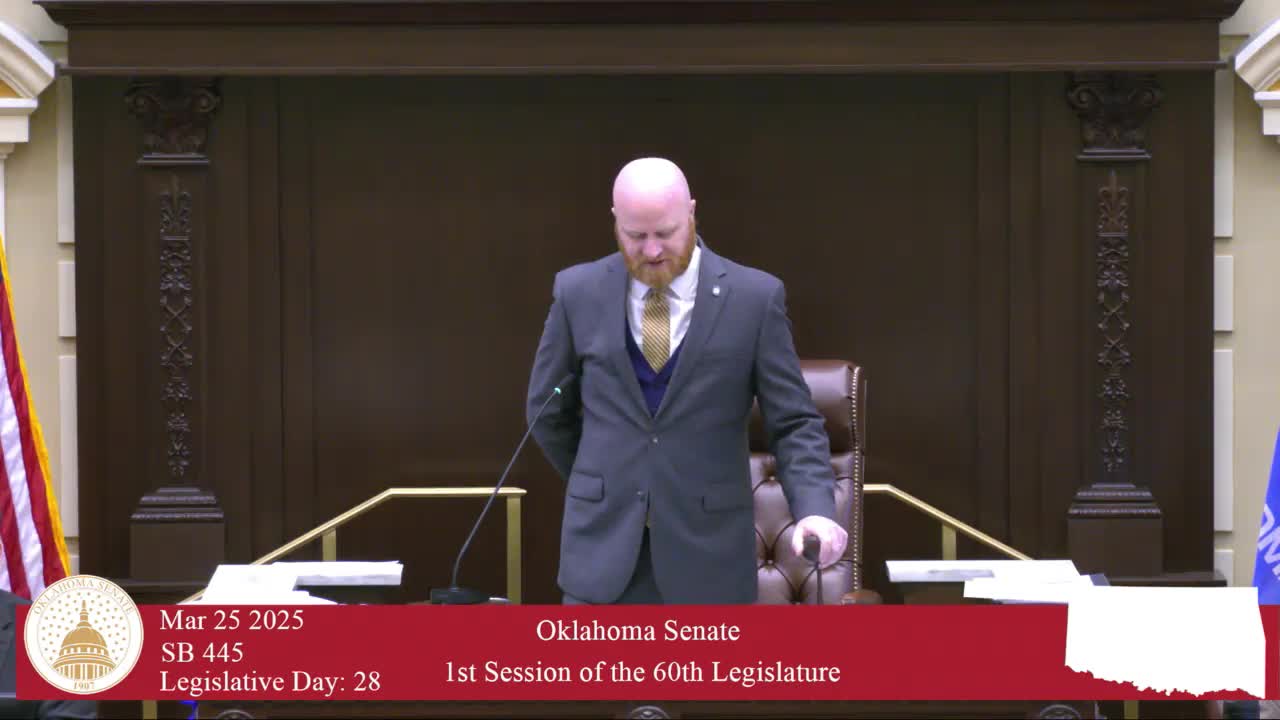
The Oklahoma Senate passed Senate Bill 9-42, creating Title VI coordinators in public schools and public colleges and adopting the International Holocaust Remembrance Alliance (IHRA) working definition of antisemitism as a non‑legally binding reference for investigations.
The Oklahoma Senate on March 20 passed Senate Bill 9-42, a bill that creates dedicated Title VI coordinators in public K‑12 schools and public institutions of higher education to receive and track complaints of discrimination and harassment and that adopts the International Holocaust Remembrance Alliance (IHRA) working definition of antisemitism as a non‑legally binding reference.
Senator Allison Thompson, the bill’s author, told colleagues the measure is "a proactive framework, to prohibit discrimination on the basis of race, ethnicity, national origin, ***, disability, religion, or marital status against a student or employee" and that it creates "Title VI coordinators, at the State Regents and the State Department of Education." Thompson said the IHRA working definition adopted in the bill is a reference point and is not legally binding.
The bill requires public institutions to designate a coordinator charged with monitoring complaints, reporting incidents electronically to a central harassment coordinator, and, when necessary, referring matters to law enforcement. Under language added on the floor, if a public school does not take necessary action on a complaint within 30 days, the Department of Education must report its findings to the U.S. Department of Education and the U.S. Department of Justice by filing a Title VI complaint.
Senators debated definitions and scope for much of the discussion. Senator Jason Bullard questioned reliance on the IHRA examples, and Thompson responded that the IHRA definition (adopted by IHRA in 2016) is a non‑legally binding working definition that lists contemporary examples intended as illustrations. Senator Mary Devers and others raised concerns that the IHRA examples could, depending on context, sweep in religious or political speech; Thompson repeatedly reiterated the definition is a starting point for investigations, not a criminal code.
Other exchanges clarified scope: the author said public institutions under the State Regents and public K‑12 schools are covered; private institutions such as the University of Tulsa are not included. Senator Born and others pressed whether private institutions receiving public dollars (for example, via scholarship programs) would be covered; the author said the bill focuses on public institutions.
Floor amendments included a tribal‑clarity amendment inserted to ensure the bill does not limit Indian education programs; that amendment (Amendment 1) was explained by Thompson and adopted without recorded opposition.
Senate leadership said the bill imposes reporting and investigatory duties; Thompson asserted there is no fiscal impact because she expects existing staff who handle harassment and discrimination matters would be designated as coordinators. Critics disputed that conclusion during debate, saying the bill creates new mandatory reporting duties ("shall" language) that could have resource implications.
The bill advanced to third reading and final passage and was adopted as an emergency measure. The clerk recorded the final count on the emergency as 32 aye, 14 nay. The Senate earlier recorded an initial third‑reading tally of 31 aye, 15 nay before the emergency‑designation vote.
Discussion points on the floor ranged from support for a clear reference tool to protect Jewish students and staff, to objections that the IHRA examples were too broad or politically charged, and to concern that private institutions that receive some public funds were not covered by the measure.
Votes at a glance: Senate Bill 9-42 — passed; final emergency vote 32‑14. Amendment 1 (tribal/Indian education clarification) — adopted.
The measure now moves to the House or, if already transmitted, to administrative implementation steps at the State Regents and Department of Education as outlined in the bill.