Get Full Government Meeting Transcripts, Videos, & Alerts Forever!
Get email alerts on the Economic Development Film Music topic
No spam. Unsubscribe anytime.
Committee advances amended HB 14 after removing post‑production tax credit; music office and procurement language retained
Summary
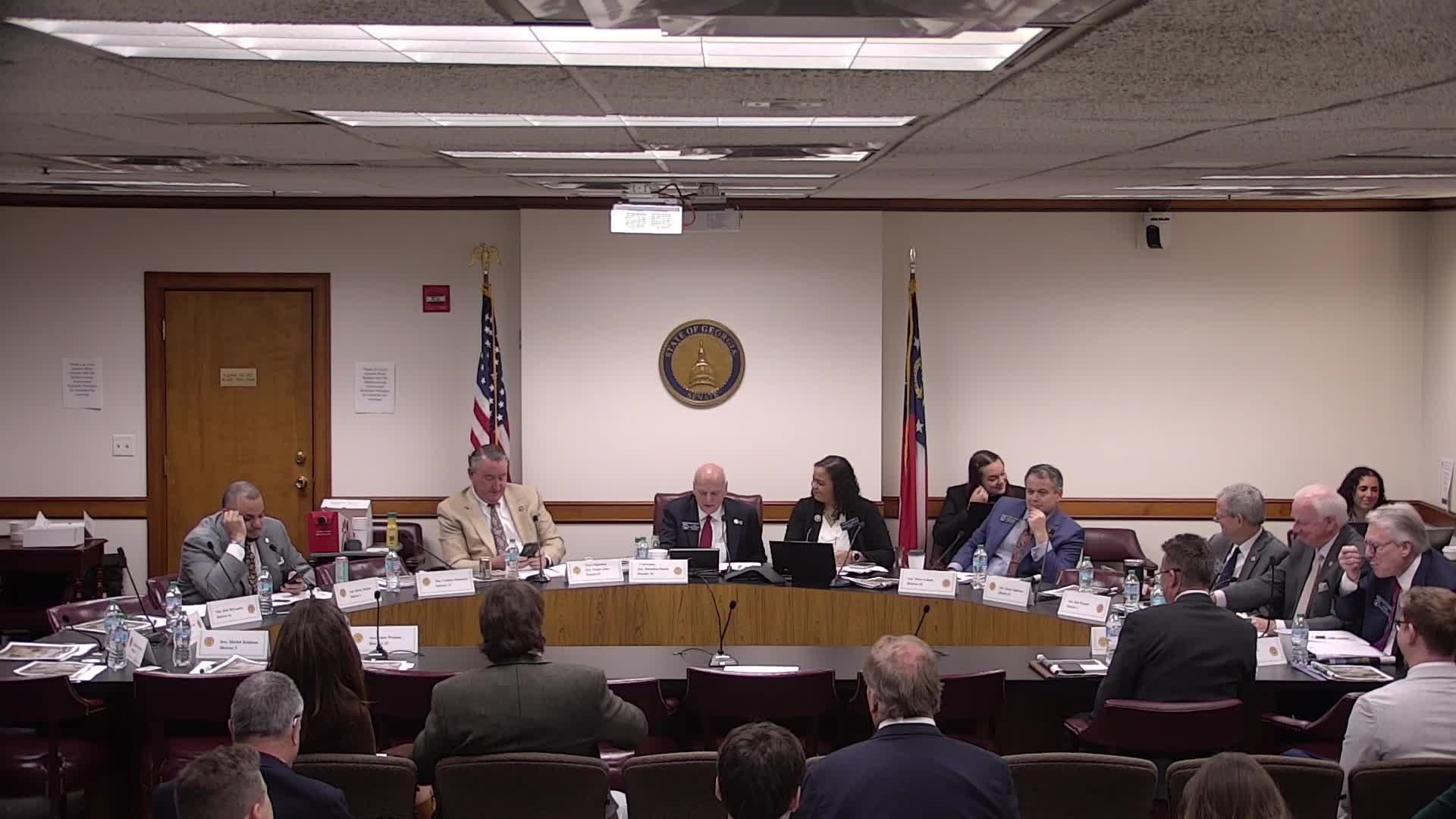
The Senate Economic Development and Tourism Committee amended and approved House Bill 14 (LC 590163S), removing standalone post‑production tax-credit language while retaining measures to create a state music office and to tighten procurement rules related to foreign adversaries.
The Senate Economic Development and Tourism Committee considered House Bill 14 (LC 590163S), a multipart measure that would change film incentives, create a central music office and tighten procurement restrictions related to foreign adversaries.
Matt Campbell, a film-industry representative, described post production as a growing segment of the entertainment industry and said it can produce year-round jobs across Georgia. Hani Korngold of South Georgia Studios said Georgia’s film industry has contracted since COVID and recent labor disruptions, and urged lawmakers to restore a post-production incentive that expired in 2022 to retain and recruit work to the state. Korngold told the committee post production represents “30% of the budget of a film” and that a revived credit could bring work — including visual-effects editing — to rural parts of the state.
Committee members questioned specific provisions in the substitute. One question addressed newly added language expanding the definition of “qualified production” to include certain user-generated content distributed on social platforms; sponsors said the intent was not to open the credit to typical social-media creators but to modernize and reinstate a post-production-targeted incentive that previously existed. Members also questioned a brief statutory provision that would have tied an additional 5% credit to counties under a population-and-poverty threshold; legal counsel advised stripping population-based language and, during amendments, the committee removed the population-specific limit and directed staff to consider alternative rural-designation language.
Witnesses and sponsors discussed the structure of the film credit: the bill layered an existing base credit (described in committee as 20%) with uplifts — including a 10% rural uplift in certain circumstances and an additional 5% targeted uplift discussed during debate. The bill in its earlier form included an overall program cap; sponsors said the draft cap was $60,000,000 per year.
The committee considered and enacted two amendments. First, a committee member moved to remove the standalone post‑production tax credit language; that amendment passed on a recorded voice/hand vote, 6 in favor and 4 opposed. Second, the committee voted unanimously to strike additional title language and a separate section (struck lines were described during the meeting) so the retained measure would house film and music policy under the Department of Community Affairs and keep procurement language tightening third‑party vendor rules concerning foreign adversaries. After the amendments the committee voted to approve the bill as amended; the committee recorded the final vote as unanimous.
Brian Hudson of the Hudson Group described procurement language that would close a loophole and prevent entities substantially owned or funded by a listed foreign adversary from state contracts, and sponsors said the music-office provisions would create a centralized hub in the Department of Community Affairs to promote music as economic development.
Committee leadership and staff said they would follow up with counsel on precise rural designations and other technical clarifications before the bill proceeds to the full chamber.