Get Full Government Meeting Transcripts, Videos, & Alerts Forever!
Get email alerts on the Public Access Rivers topic
No spam. Unsubscribe anytime.
Advocates press state committee for clearer river-access rules, citing lost public passage and business impacts
Summary
Paddle-Georgia coordinator Joe Cook told the Senate committee that inconsistent judicial decisions and unclear statutory definitions have left Georgians uncertain which streams are open for recreational boating, urging the legislature to act to protect passage and outdoor recreation businesses.
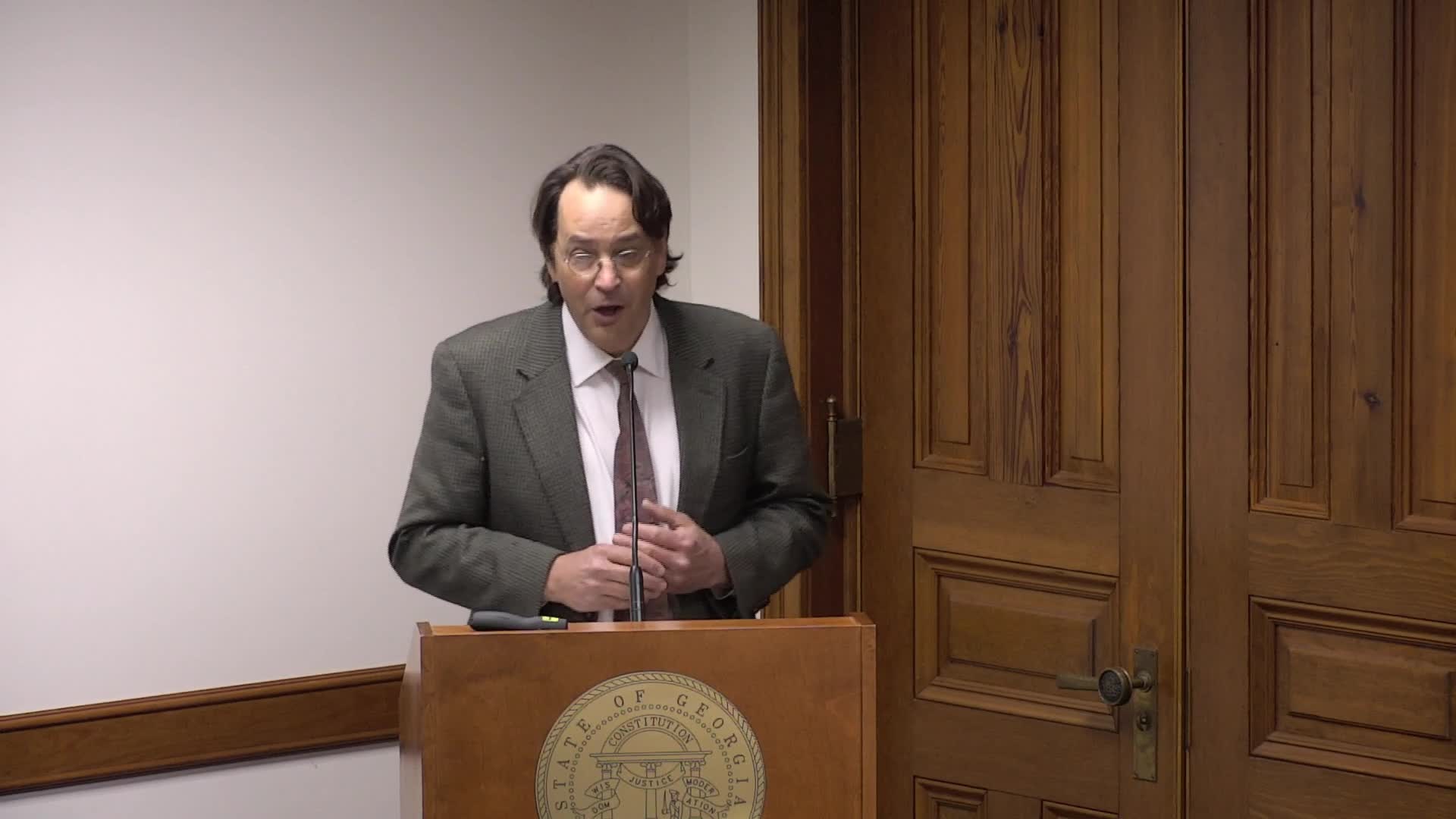
Joe Cook, paddle Georgia coordinator with Georgia Rivers, told the Senate Economic Development and Tourism Committee that state law and court decisions have left uncertainty about where the public may legally float, fish and hunt on Georgia streams.
Cook traced the issue to 19th-century and later case law, and said the current uncertainty follows the 2023 passage of Senate Bill 115, which affirmed a right to boat, hunt and fish on “navigable streams” but left the meaning of “navigable” unresolved. Cook said the House ultimately formed a study committee that recommended against creating a fixed list of navigable streams and suggested no change in law, leaving boaters and outfitters without clarity.
Cook said the legal history includes Young v. Harrison (1849), a Georgia Supreme Court decision that recognized public passage on many streams, and later cases, including the Givens case involving Itchaway Notchaway Creek, that narrowed access in practice. He said the Givens litigation resulted in a ruling that particular stream was not navigable despite long-standing local use, and that the case’s outcome has led to more stream closures.
Cook asked legislators to consider whether a single riparian landowner should be able to close a stream that has been used for generations, and warned that outfitters and tourism businesses depend on passable waterways. “Is it sound state policy on river and stream access and passage best serving the interest of Georgia’s tourism industry if outdoor recreation tourists in neighboring states do not visit our state for fear of being harassed or even arrested when traveling on Georgia streams?” Cook asked, saying he has received letters from out-of-state clubs expressing that concern.
Members of the committee asked questions about comparative law in neighboring states. Cook said Florida, South Carolina, North Carolina and Tennessee have policies that allow passage where one can float a boat, though he did not claim states’ ownership of river bottoms. Committee members and other speakers discussed the difference between floating in the waterway (which Cook said should not be treated as trespass) and stepping onto private land alongside the channel (which can be trespassing and is governed by trespass law).
The committee did not adopt new rules during the meeting; members asked staff and counsel to research comparative law and statutory options for clarifying navigability and access.