
Florida 4‑H youth present program impact and request PECO support for camp revitalization
Get AI-powered insights, summaries, and transcripts
Sign Up Free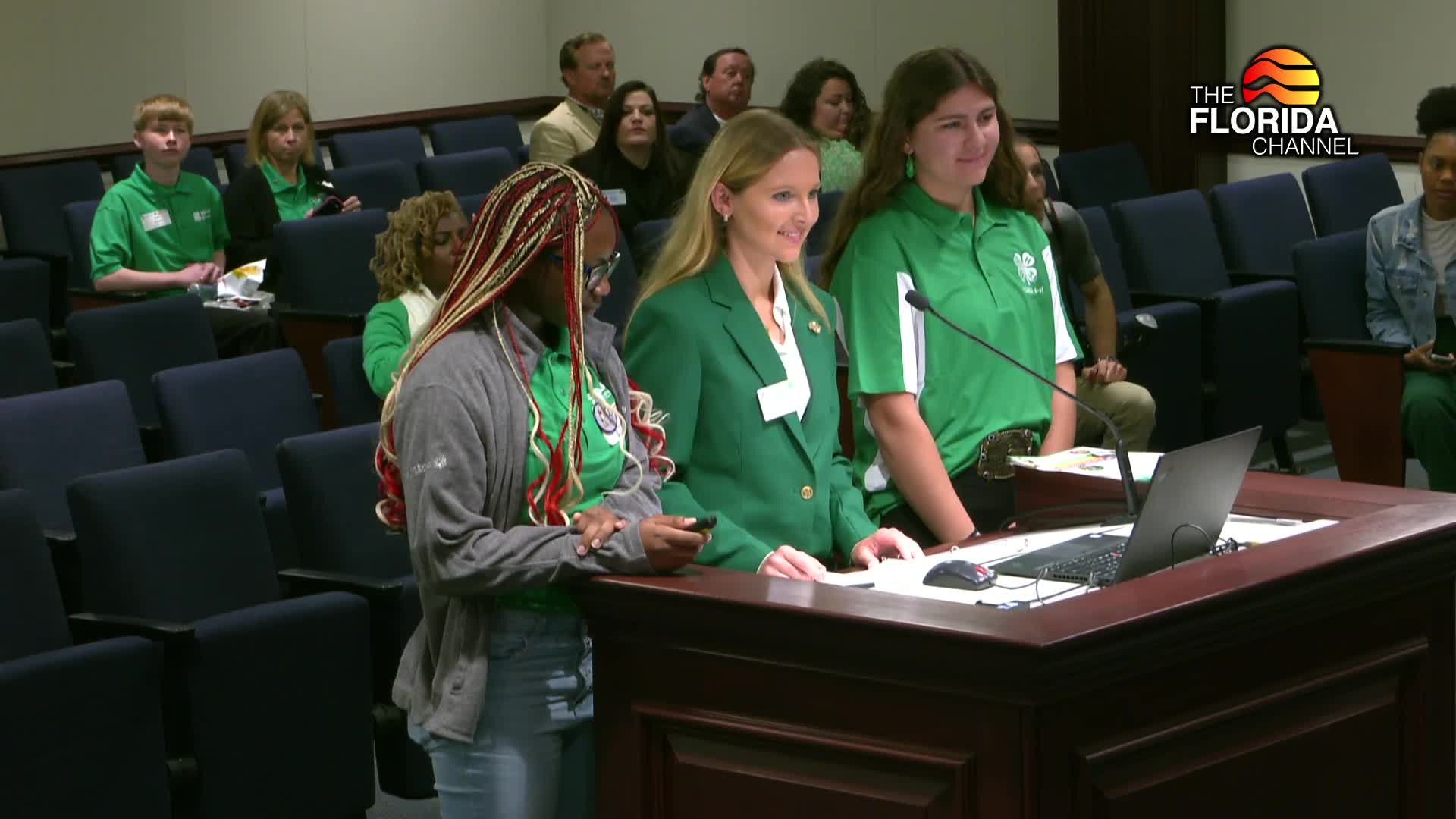
Summary
Florida 4‑H state officers presented the program's youth‑development impacts and outlined a $13.4 million campaign to revitalize Camp Cherry Lake, including a $5.6 million PECO request that has ranked second on the Board of Governors statewide list; presenters said $2 million in federal, private and university funds are already committed.
Three Florida 4‑H youth—Summer Wayne, Cheyenne Hunter and Tucker Padgett—addressed the Senate Agriculture Committee to describe 4‑H programming, youth outcomes and a multi‑year campaign to modernize residential camps used for agriculture and environmental education.
Summer Wayne, Florida 4‑H state council reporter from St. Lucie County, and fellow ambassadors Cheyenne Hunter (Gadsden County) and Tucker Paget (Escambia County) said 4‑H reaches hundreds of thousands of Florida youth through clubs, camps and classroom programs administered through the University of Florida Institute of Food and Agricultural Sciences and Florida A&M University in partnership with county governments.
The presenters said 4‑H focuses on citizenship and leadership, agriculture, STEM and healthy living and highlighted research‑backed outcomes: 4‑H participants report higher confidence, public‑speaking ability and interest in community service. The youth outlined three priorities: expand 4‑H reach to 300,000 Florida youth, continue workforce‑readiness programming and invest in 4‑H residential camps as year‑round learning laboratories.
They described a $13.4 million campaign to revitalize Camp Cherry Lake in Madison County, including a $5.6 million university PECO request that the presenters said has ranked second on the Board of Governors statewide list, $2 million in committed federal, private and university funds, and roughly $1 million previously secured in private and state support. Presenters asked senators to support continuing investments in 4‑H infrastructure that they said would strengthen workforce‑readiness and agricultural education.
Committee members asked for sponsors; presenters said the PECO request had a House sponsor, Representative Allison Tant, and that the Board of Governors had been identified as the PECO sponsor in the university process. Senator Rouson asked whether the Senate had a sponsor for the request; the presenters said not at the time of the hearing. Senators praised the young presenters and noted 4‑H’s long history in Florida.
No formal committee action followed the presentation. Committee members thanked the youth for their testimony and encouraged continued outreach to lawmakers on behalf of the camp revitalization campaign.