Get Full Government Meeting Transcripts, Videos, & Alerts Forever!
Get email alerts on the Appropriations topic
No spam. Unsubscribe anytime.
Judicial branch asks Senate for ongoing funds to operate statewide case management system
Summary
At a Senate appropriations subcommittee hearing, the State Court Administrative Office outlined progress on a statewide case management system and requested $7.2 million in ongoing funding to maintain and staff the system, while also seeking permanent staff for court support programs and grants management.
Chief Justice Clement told the Michigan Senate Appropriations Subcommittee on Corrections and Judiciary that the State Court Administrative Office (SCAO) needs additional ongoing funding to operate and maintain a statewide case management system.
The request comes after a 2022 one-time appropriation of $150,000,000 to build the technology needed for a single statewide case management system. Chief Justice Clement said the judiciary has spent or obligated about $65,000,000 of that appropriation and expects to use the remaining $85,000,000 to bring the largest, most complex courts onto the statewide Judicial Information System (JIS). She asked the subcommittee to provide $7,200,000 in ongoing annual funding so SCAO can staff, maintain, and support the system as it scales.
A statewide case management system, SCAO says, will standardize data collection across more than 300 trial courts, reduce duplicative licensing and local IT costs, improve online services for the public and litigants, and enable integration with other justice partners such as law enforcement and the secretary of state. Chief Justice Clement said, “Having all courts linked through one case management system will increase the consistency and reliability of data gathering and reporting for improved decision making at both the state and local level.”
SCAO reported that 250 of 302 courts already use the JIS CMS (69 circuit courts, 107 district courts and 74 probate courts). The remaining courts include some of the largest and most complex jurisdictions, which SCAO said pose the greatest data-migration and local-resource challenges. Chief Justice Clement described two persistent hurdles: messy historical data during migration and underestimating local court effort and staffing needed for onboarding. To mitigate those barriers, SCAO said it is reimbursing local funding units for overtime and temporary staff costs devoted to migration.
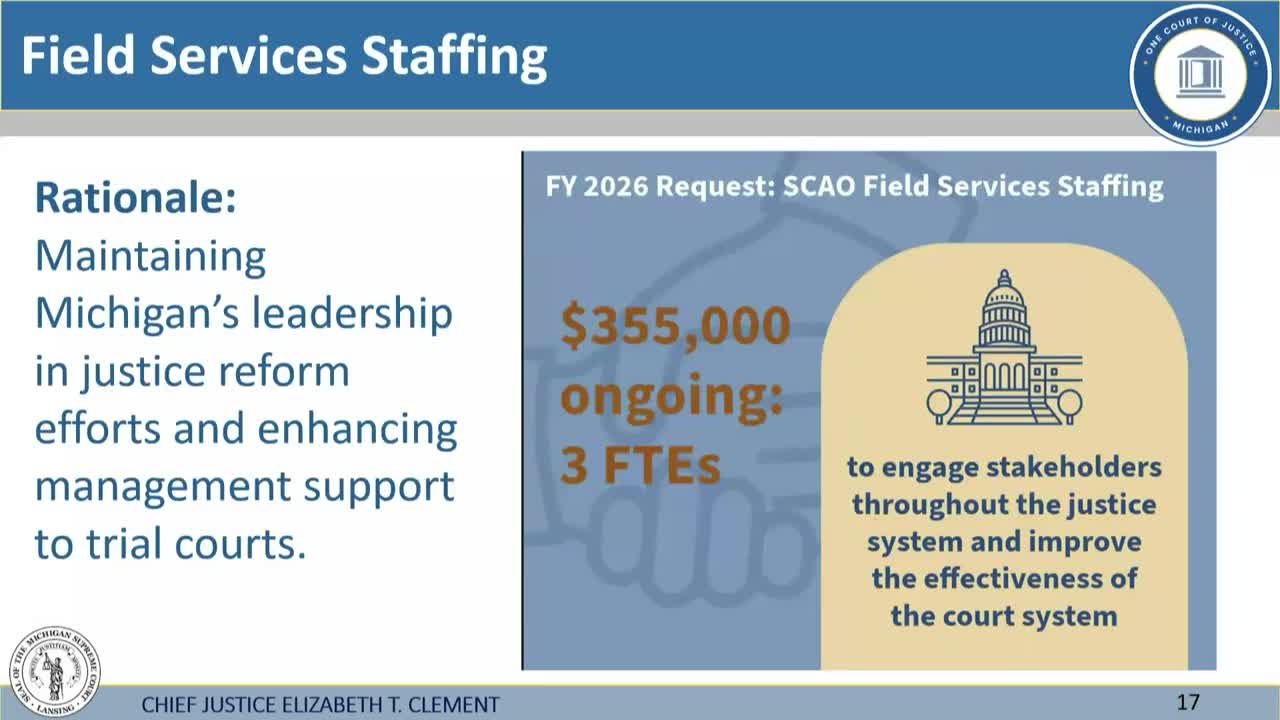
SCAO provided a cost-savings example based on three mid-to-large counties that moved from private vendors to JIS: annual savings of more than $700,000. The office also asked for several capacity-building positions and programs that it says are necessary to support the statewide rollout and court operations, including: three field-services FTEs to help rewrite plain-language court forms and expand diversion programs; additional finance and HR staff to support an auditing schedule of roughly 61 audits per year; an additional legal editor to reduce opinion publication backlogs; a permanent grants officer to manage federal grant compliance; and expanded support for Michigan Legal Help and problem-solving courts.
Chief Justice Clement highlighted Michigan Legal Help as one of the nation’s leading legal self-help platforms: the site received more than 3,000,000 visitors last fiscal year, more than 80% of whom self‑reported incomes at or below 200% of the federal poverty level. According to SCAO, more than 50,000 users completed do‑it‑yourself court forms on the platform last year, including nearly 40,000 personal protection orders.
On problem-solving courts, SCAO said it expects applications from roughly 15 new programs this year and noted research showing program graduates are “between 2 and 4 times less likely to commit another crime.” Chief Justice Clement said these programs “save lives” and asked continued legislative support.
On judicial safety, SCAO reported it used a current‑year appropriation of $475,000 to secure a contract for services to protect judges and their families and noted the Judicial Protection Act passed the Senate the day before the hearing.
The subcommittee did not take a formal vote on SCAO’s requests at this hearing. Chief Justice Clement said SCAO will return with additional requests if it does not receive full ongoing funding and offered to provide one-on-one briefings and written updates about work projects such as eviction diversion and driver privilege restoration.
SCAO presentation materials included a history of the project and detailed difference between one‑time and ongoing costs; Clement said the office will continue to bring annual requests until the branch receives the full ongoing support it originally requested in 2022. The subcommittee approved the meeting minutes at the start of the hearing without objection.
SCAO staff present at the hearing included Deputy Legal Counsel Trevor Van Dyke, Budget Officer Casey Herold, State Court Administrator Tom Boyd, General Counsel Alicia Moon and Chief Justice‑elect Megan Kavanaugh, who attended to observe the budget process.