Get Full Government Meeting Transcripts, Videos, & Alerts Forever!
Get email alerts on the Short Term Rentals topic
No spam. Unsubscribe anytime.
Fredericksburg ZBA deadlocks on special-exception request for short-term rental at 209 South Elk
Summary
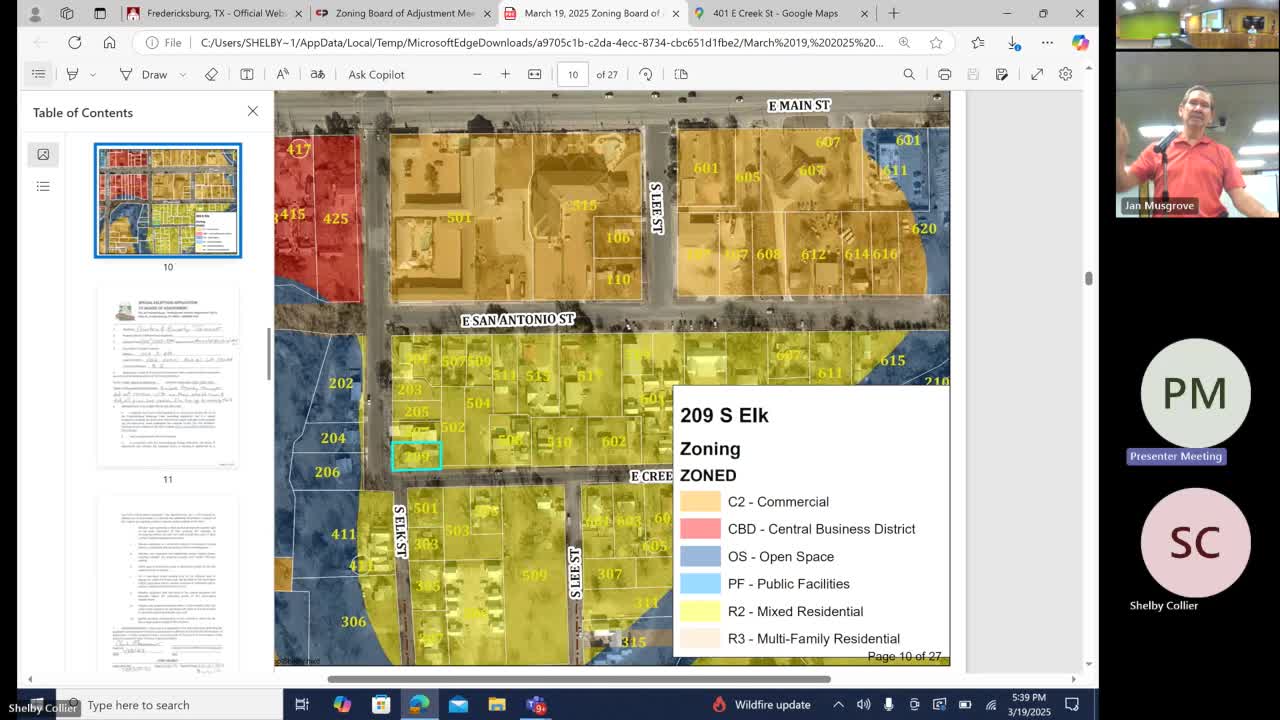
The Zoning Board of Adjustment split 2-2 on a request for a special-exception short-term rental (STR) permit for a two-bedroom property the applicant identified as 209 South Elk; staff recommended denial after finding evidence the property operated after its permit expired.
The Zoning Board of Adjustment for the City of Fredericksburg failed to approve a special-exception request for a short-term rental unoccupied permit for a property the applicant identified as 209 South Elk after a 2-2 vote that did not meet the board's required affirmative threshold.
City staff told the board the property's STR permit expired Aug. 15, 2023, and was determined to be lost on Nov. 15, 2023, after a 90-day grace period in the nonconforming ordinance. Staff said it found evidence of ongoing rentals after expiration, including active listings and 22 reviews dating from Oct. 23, 2023, to Feb. 11, 2025, and recommended denial.
Applicant testimony and staff findings
The property owner, identified in the hearing as Mr. Tanner, told the board: “This is in a property at 209 South Elk. I bought it in 2017,” and said he and his wife purchased the house to supplement income while retiring. Tanner said a local management company had historically handled permit renewals and that he was unaware the property's STR permit had lapsed: “Every year, [the management company] told me they were taking care of it.”
Staff (Heather Denish and other city staff) presented a packet showing the lot is 7,500 square feet, the house is about 1,300 square feet and a two‑bedroom unit with an advertised occupancy of six. Staff also reported that, within 200 feet of the subject property, it identified 10 properties operating as STRs (13 units total) and noted the subject property sits amid a mix of residences, STRs and commercial uses. Staff concluded the property had been “illegally operating as an STR” after permit expiration and recommended denial.
Management and enforcement explanations
A representative of the property management company now operating the unit, Fredericksburg Stays, told the board the business had changed hands and that records from previous owners were incomplete; the company said it took back operations April 1, 2024, and that when staff showed a grayed-out permit in the new software, they learned the permit had expired in August 2023. The management representative described efforts to block bookings and coordinate with counsel once the lapse was discovered.
City staff described changes to STR administration: the 2024 STR ordinance and a new permitting software were intended to improve permitting transparency, they said, but staff acknowledged the department's current software does not include a compliance tool and that earlier systems in 2023 did not send the same automated alerts. The city also said hotel-occupancy-tax (HOT) payments are tracked by a separate HOT specialist and that the city began a more active cross-checking process in 2024.
Board deliberations and legal threshold
Board members expressed differing views. Some argued the owner was ultimately responsible for maintaining permits and that operating without a permit is serious; others said the failures appeared to be shared among the owner, the management company and the city, and suggested leniency. One board member noted the potential for municipal enforcement actions and civil court cases for long-running violations.
The chair reminded the board that “Under Texas law, the affirmative votes of at least 75% of the Board members present are necessary to approve any application request.” The board took two motions: an initial motion to deny (which failed for lack of a second), and a later motion to approve the special exception that received a 2-2 recorded vote and therefore did not meet the required affirmative threshold. The board announced the motion failed and the special exception was not approved.
Next steps
Staff told the applicant the available options are to reapply for the special exception at a later date or to submit an STR permit application that staff would deny and then appeal that denial to City Council. The city also said it would follow up by email with specific instructions about the two paths.
Why it matters
The case highlights enforcement and administrative gaps the city is working to close: staff described software and process changes introduced in 2024 meant to centralize permitting and HOT tracking, but acknowledged the compliance and cross-checking tools remain incomplete. The outcome leaves the property without an STR permit; the applicant may reapply through the special-exception process or pursue an appeal to the City Council.