Get Full Government Meeting Transcripts, Videos, & Alerts Forever!
Get email alerts on the Land Use Park Development topic
No spam. Unsubscribe anytime.
Developers outline ‘Selah’ plan for West Travis: park, collector street and asks from city spark council caution
Summary
A developer presented conceptual plans to annex about 42 acres at West Travis for a neighborhood centered on a proposed five‑acre park; council expressed interest but balked at waiving impact fees and large city contributions.
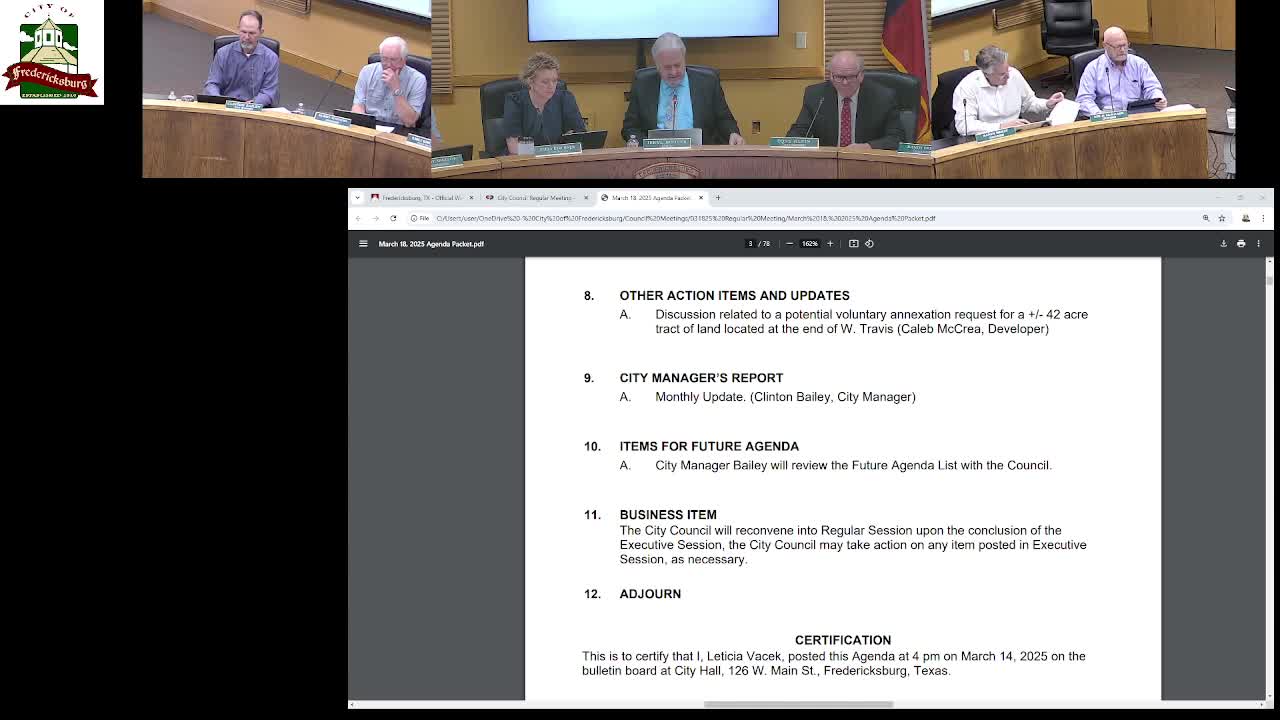
Fredericksburg — Developers seeking a voluntary annexation for roughly 42 acres at the end of West Travis presented a concept called “Selah” on March 18 that would include a neighborhood of roughly 60–70 lots in phase one, a proposed five‑acre community park, and a collector‑street connection (Moore Street) that planners say could link to larger future road projects.
Why it matters: City staff and several council members described the developer’s requests — which include asking the city to contribute roughly $1.5 million toward half the park cost, pave and curb an extension of Moore Street, extend water/sewer/electric utilities, and waive impact fees — as substantial. Several council members said they were not prepared to approve those financial concessions at this early conceptual stage but were open to continued discussion.
Details of the proposal: Developer representatives Caleb McCree and partners described an intent for a walkable neighborhood with native landscaping, drought‑tolerant design and a civic core: a five‑acre public park they suggested the city maintain. The developers offered $30,000 upfront for park planning and suggested a future per‑lot contribution (they proposed $5,000 per lot in an initial phase) to help fund maintenance.
Staff figures and cost estimates: City staff told council the typical single‑family impact fee is about $7,000 per unit and estimated waiving those fees for the full project would amount to roughly $833,000 (staff estimate based on the number of lots under discussion). The developer asked the city to consider matching funds and to build or share in public infrastructure work including the Moore Street connector.
Council response and concerns: Several council members praised the park concept and the developers’ intent to emphasize water‑wise landscaping but said they had three large concerns: (1) the fiscal cost to the city of building and maintaining the park and extending utilities; (2) long‑term maintenance obligations; and (3) water supply and traffic impacts, especially if the Moore intersection or additional road connections are not constructed concurrently. Council members said they want to see more detail on phasing, unit pricing, traffic modeling and precise utility costs before considering city funding commitments.
Next steps: Council gave staff and the developer permission to continue discussions and asked staff to return with more detailed cost estimates, traffic modeling and alternatives to full fee waivers. There was no vote or formal commitment. One council member summarized the prevailing stance: willing to keep the conversation open but not to waive major impact fees or commit large capital dollars without firmer data.
Ending: Developers and staff agreed to keep working on concept details and to return to council with a clearer scope of public costs and possible mitigation strategies before any annexation or incentives would be considered.
(Notes: Cost figures and the developer’s proposed per‑lot contributions were discussed as preliminary; staff and council confirmed no binding city commitments were made on March 18.)