Get Full Government Meeting Transcripts, Videos, & Alerts Forever!
Get email alerts on the Annexation topic
No spam. Unsubscribe anytime.
Fredericksburg staff outline annexation limits, petition rules and rising housing proposals
Summary
City staff reviewed recent state law changes that limit involuntary annexation, explained current voluntary-annexation procedures and cautioned council that zoning cannot be guaranteed in development agreements. Staff also presented updated housing counts showing hundreds of lots and multifamily units proposed or under construction.
Fredericksburg City staff told the council Wednesday that recent state-level changes have sharply restricted cities’ ability to annex land without property-owner consent and explained how the city is handling a wave of voluntary annexation requests.
The discussion matters because staff said many developers are asking to bring land into the city and the rules around contiguity, extraterritorial jurisdiction and development agreements will determine which proposals are eligible and how services would be phased.
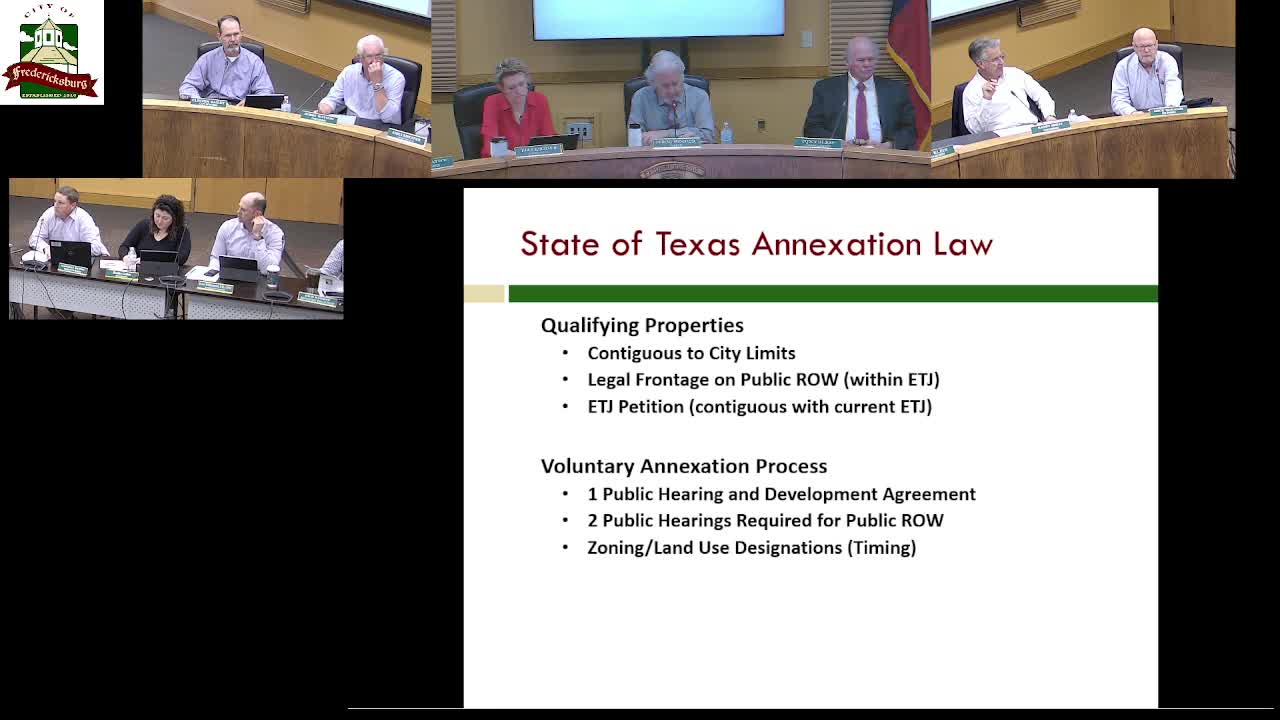
City staff member Mick summarized the legal landscape: “In the past, home rule cities in Texas such as Fredericksburg have had the ability to engage in involuntary annexations. Those, that is, annexations with or without the consent of the property owners involved. And, recently, we — that power was taken away.” He said the change means property must now be brought in voluntarily, usually via a petition by the owner, and must be contiguous to the city’s limits and lie inside the city’s extraterritorial jurisdiction (ETJ) under current law.
Mick told the council the Legislature also adopted a provision allowing individual property owners to remove their land from an ETJ without city approval, and he warned the council that the Legislature may move to eliminate ETJs entirely. “I think a very good chance that this current legislature will eliminate Texas ETJs,” he said. That, he said, would change the city’s ability to regulate development outside the corporate limits.
Staff explained how the statutory contiguity rule has been adjusted: under a new right-of-way option, property that abuts a public right of way that connects to the corporate limits can be eligible for voluntary annexation even if the parcel does not touch the corporate-limit line directly. Mick cautioned, though, that the property must front the right-of-way — “No. That’s not enough. That’s property legal frontage. Has to be contiguous to the right way,” he said when asked about driveways that merely touch a road.
Staff also emphasized limits on what can be promised during annexation negotiations. “We cannot agree to a particular zoning in any property that’s brought into the city,” Mick said. He explained that zoning is a purely legislative action that must come after annexation, following Planning & Zoning review and ordinance adoption. “Contract zoning is prohibited and void,” he added. Staff said development agreements can, however, address timing and municipal services and can reflect the comprehensive plan in general terms without guaranteeing zoning.
Procedurally, city staff described a multi-step voluntary-annexation process: a developer typically attends a pre-application meeting, submits a petition and a draft development agreement plus surveys and documentation, then staff schedules required public hearings before the council considers an annexation ordinance. Staff noted that the process produces significant front-end cost for both the city and the developer and told the council a more efficient early-check step might spare wasted expense.
Council and planning representatives broadly supported the idea of a nonbinding, early-stage concept review. “No formal action, just direction,” said Holly Rickard, vice chair of Planning & Zoning, describing how P&Z could receive conceptual presentations early in project planning so developers get feedback before incurring engineering costs.
Staff also presented updated housing and multifamily counts to illustrate development demand inside and near the city limits. Garrett and staff provided these figures: for single-family residential, 532 lots were described as complete or nearing completion, 233 lots are available, and 955 lots are proposed (pending approvals). For multifamily, staff listed 580 units recently released for leasing, 473 pending, and another 506 proposed — a total of 1,409 available or proposed multifamily units and an overall multifamily occupancy rate adjusted to 81.1%. Garrett told council that a March agenda package would include a 28-acre development proposing 547 residential lots that falls within the pending/proposed totals.
Council members pressed staff for more information on resident composition (homestead vs. investment property) and for regular staff briefings when changes to ETJ or annexation law occur. Several council members said they favored pursuing infill and redevelopment as a complement to voluntary annexation to protect city character and limit infrastructure costs. “I’m generally for infill,” one member said, while advising staff to provide return-on-investment modeling and service-cost estimates so the council can compare infill versus new annexation.
The council did not take formal votes on policy changes at the workshop. Staff said they will continue to brief the council, produce an updated development-agreement draft and bring early-concept intake options to Planning & Zoning and the council for direction.