Get Full Government Meeting Transcripts, Videos, & Alerts Forever!
Get email alerts on the Group Homes Ordinance topic
No spam. Unsubscribe anytime.
Fredericksburg council adopts ordinance to regulate unlicensed group homes and sober living facilities
Summary
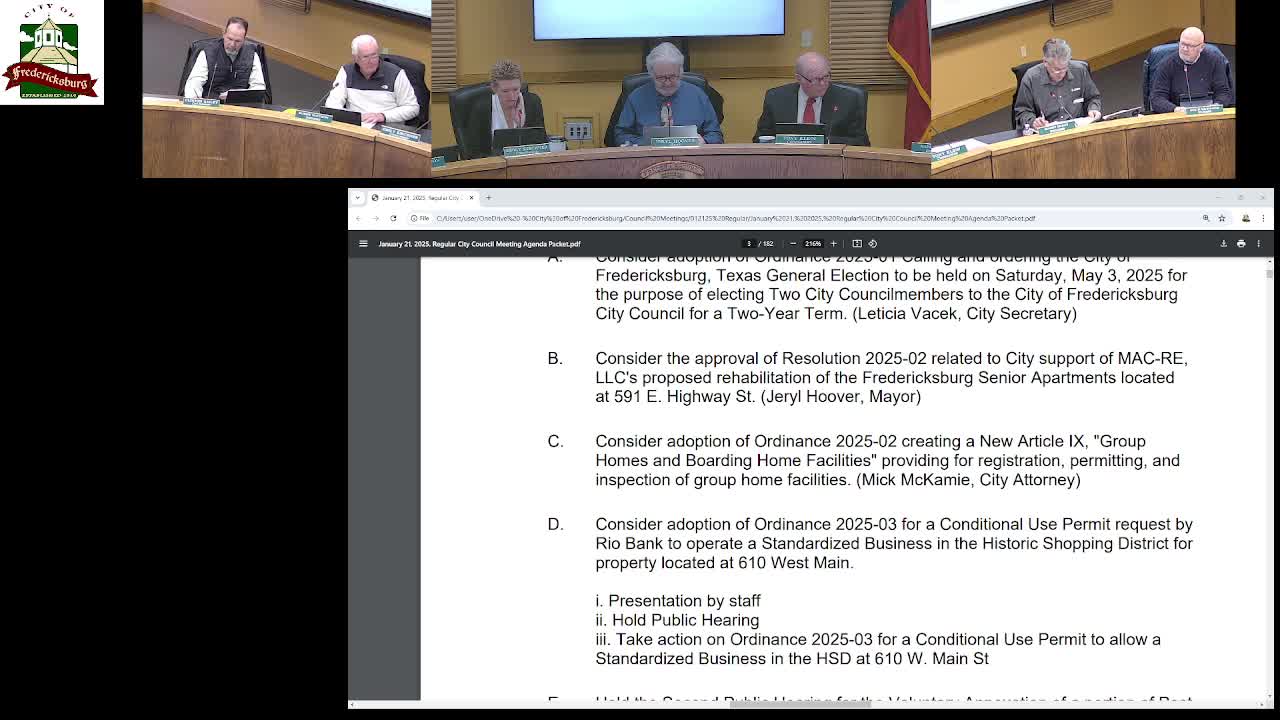
Fredericksburg City Council on Tuesday adopted an ordinance creating a new Article 9 of the city code to register and, in some cases, permit group homes and boarding-home facilities used as sober-living residences.
Fredericksburg City Council on Tuesday adopted an ordinance creating a new Article 9 of the city code to register and, in some cases, permit group homes and boarding-home facilities used as sober-living residences.
The ordinance applies only to boarding homes and sober-home operations that are not required to hold a state license; facilities that are licensed by state or federal authorities remain regulated by those agencies and are exempt. Mick, the attorney who presented the proposal, said, "The ordinance also covers any type of boarding home facility that's not required to be licensed by the state of Texas."
The measure requires registration for group residences so emergency services and city staff can know where such facilities are located. It also requires permitting, background checks and operational oversight specifically for sober-home operators. The ordinance includes limits on the number of residents at a facility and locational separation requirements intended to prevent concentration of unregulated facilities in a single neighborhood.
Council members asked whether the city could require additional separation from schools or day-care centers. Mick said federal law constrains some local zoning restrictions for residential treatment models, and that case law and the Fair Housing Act limit the city’s ability to prohibit sober homes from locating in residential districts. He told the council that the separation radius in the ordinance—set at roughly a half-mile between covered facilities—was designed to reduce clustering while remaining compatible with federal requirements.
Council discussion also clarified that managers of permitted sober homes would be subjected to background checks for disqualifying offenses, and that individual residents who are registered sex offenders would not be eligible to live in a registered facility under the city rule.
A motion to adopt Ordinance 2025-O2 carried on a voice vote; the council recorded the motion, a second and voice approval in the meeting minutes. The ordinance takes effect as provided in the city code; the city clerk will publish the ordinance text as required.
The ordinance was presented by the city attorney and discussed by multiple council members during the agenda item; no litigation or specific enforcement actions were announced at the meeting.