Get Full Government Meeting Transcripts, Videos, & Alerts Forever!
Get email alerts on the Water Supply Conservation topic
No spam. Unsubscribe anytime.
Punta Gorda reports reduced use after once‑per‑week watering ordinance; enforcement remains educational
Summary
Utilities staff reported February water use and reservoir levels, cited regional drought, and updated the board on a council-approved emergency ordinance limiting outdoor irrigation to one day per week. Code enforcement is currently providing education; staff are exploring utility assistance and possible fines for repeat violations.
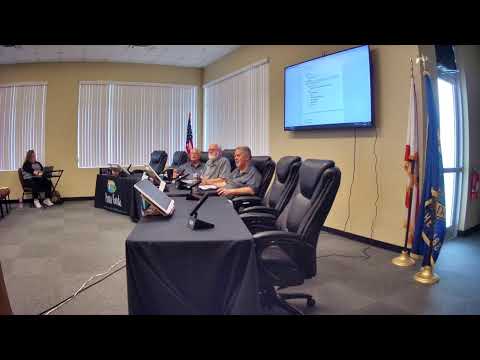
Punta Gorda — Utilities Director Tom Spencer briefed the Utility Advisory Board on March 24 about water supply, reservoir levels and recent conservation measures after the City Council approved a once-per-week outdoor watering emergency ordinance.
Spencer reported February figures and current system capacity: average daily treated water to town in February was about 6,500,000 gallons, with a peak day of about 7,800,000 gallons. He said the combined surface-water and reverse-osmosis production capacity is roughly 8,220,000 gallons and that available withdrawal from Shoal Creek Reservoir while in the current restriction block is about 4,220,000 gallons. He also noted that rainfall was below historical averages and that a portion of Charlotte County is in moderate drought conditions according to drought.gov.
Why it matters: Those metrics show why council enacted emergency, once-per-week outdoor-watering restrictions and why the city is emphasizing conservation. Board members asked how enforcement will work and whether billing or fines will follow education.
Spencer said the ordinance was passed by City Council and that enforcement is being handled initially by code enforcement staff as an educational program; officers are not yet conducting proactive drive-by enforcement. "If they do see people watering outside of their normal time, I do believe they're just providing education at this point," Spencer told the board. He said staff are exploring having utility personnel assist with enforcement and that the city could escalate to citations if education does not reduce violations.
Spencer and the board also discussed requests to clarify which seasonal restrictions or permitted grass types might be included in a broader code update. He said staff plan a more comprehensive review of Chapter 17 of the city code (utility regulations) to add or clarify conservation rules, define reservation of capacity, and set responsibilities for service connections and lateral repairs.
On funding for water-supply improvements, Spencer reported that the city applied for a reverse-osmosis expansion grant that requires a 25% local match; he said council approved the application and staff had spoken with state officials who called the project a good fit but cautioned that federal/state funding is competitive.
What’s next: Staff will continue public education on the ordinance, explore assistance by utility personnel for enforcement and refine proposed code changes for council consideration. The board asked staff to return with recommended enforcement steps and any changes to watering schedules or allowable plantings as part of the Chapter 17 update.