Get Full Government Meeting Transcripts, Videos, & Alerts Forever!
Get email alerts on the Land Use topic
No spam. Unsubscribe anytime.
Resident asks what counts as ‘substantial commencement’ in PUD sunset clause; city manager, planning staff explain process
Summary
A resident asked the commission to clarify the PUD sunset clause and what qualifies as 'substantial commencement.' City staff said a PUD is not final until a development order/platting occurs and that entitlements, including water and sewer, typically extend for two years beyond a PUD sunset only after those steps are complete.
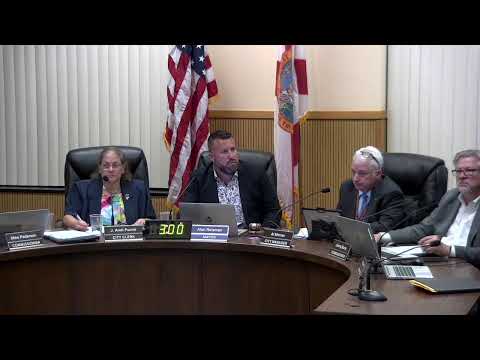
A Leesburg resident asked the City Commission on March 24 to clarify what constitutes “substantial commencement” under the city’s planned unit development (PUD) sunset clause and whether minimal site activity could preserve PUD zoning.
Resident Mario Napa said the phrase “substantial commencement” was vague and could allow a developer to indefinitely delay meaningful construction while keeping PUD zoning in place.
City staff responded that a PUD approval is not the same as a final development order. Staff said that a PUD alone does not trigger the protections that come with a development order and that municipalities look to subsequent steps — notably platting and construction permits — to determine whether a project has advanced beyond conceptual approval.
“The development order is a step of several things, mostly the final plat,” the city manager said. He explained that when a final plat and other required permits are secured, the property then typically gains the entitlements — including water and sewer capacity — that remain in place for a limited period beyond the PUD sunset.
City staff also said that, by code, developers who have reached the final‑plat stage generally receive a period (staff cited two years) during which the entitlement remains available even if the original PUD sunset date passes. Staff emphasized that specific triggers are described in the city’s land‑development code and that a PUD that has not advanced to a development order remains subject to the city’s sunset language.
Why it matters: ambiguous sunset language can affect neighbors and the public by allowing extended delays before development begins or by creating uncertainty about when municipal infrastructure (water, sewer, roads) will be required. Residents asked staff to clarify the standard that will be applied when a PUD comes up against its sunset date.
What’s next: staff suggested clarifying the city’s public documents and returning to the commission or city attorney for more detailed legal language if commissioners want the code or PUD templates tightened. No legal change was adopted at the March 24 meeting.
Ending: Napa thanked staff for the response; staff said residents who want a formal legal interpretation should follow up with the city attorney’s office for written guidance.