Get Full Government Meeting Transcripts, Videos, & Alerts Forever!
Get email alerts on the Red Smith Pud topic
No spam. Unsubscribe anytime.
Council holds 168-acre Red Smith-area planned-unit development after hours of testimony
Summary
The council held a first-reading vote on a 168-acre planned unit development near Red Smith School that would add single-family lots, duplexes, commercial space and about 160 multifamily units; after nearly three hours of public testimony and alder questions, the council voted 7–5 to hold the item for further work and return on April 15.
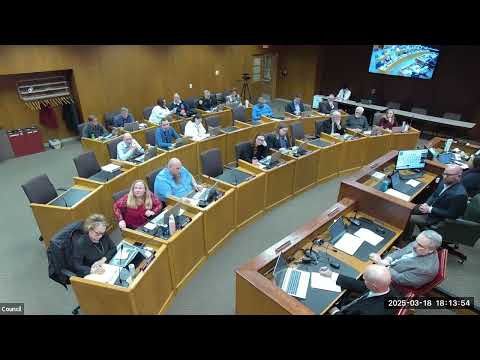
The Green Bay Common Council on March 18 voted 7–5 to hold action on a proposed 168-acre planned unit development (PUD) on land bounded roughly by Algoma Road, Sussex Road, Church Road and Bay Settlement Road after extensive public testimony and questions from alderpersons.
Developer presentation and proposal: Brad Reimer, representing the development team, described the project as a mixed residential PUD. He said the proposal covers approximately 168 acres and includes about 15 acres designated for single-family housing, roughly 17 acres for multifamily, about 6 acres for commercial uses, and roughly 30 acres of dedicated open space, including stormwater facilities.
Reimer told the council the plan envisions about 227 single-family lots, nine duplex lots and roughly 160 multifamily units (depicted as ten 2-story, 16-unit buildings in the PUD draft). He said the overall proposal yields about 400 units in total and that the project’s developed density would be roughly 2.4 units per acre on the developable acreage (the developer said the site’s developable acreage is about 107 acres after wetlands and constrained areas are excluded). The developer said the proposal includes reduced lot frontages in some areas (60- and 70-foot lots) and that multifamily buildings would be two stories (about 30 feet tall).
Public comment and concerns: More than two dozen residents and area stakeholders spoke during the hearing. Major concerns raised by neighbors included traffic and school impacts at Red Smith School, existing and exacerbated stormwater and basement flooding in nearby properties, protection of the Niagara Escarpment and wetland habitat, and the perceived mismatch between the neighborhood’s existing single-family character and the proposed multifamily buildings.
Supporters and housing-supply arguments: Jennifer Sundstrom of the Realtors Association of Northeast Wisconsin urged approval, saying the region faces a housing shortage across price points and that the development’s mix of housing types would help meet local demand. Several speakers representing the developer and the Kosmoski family (property owners and local multifamily managers) described the apartments as market-rate units with on-site management.
Staff, technical and legal context: City planning staff and the developer discussed the legal and technical limits on changing parcel boundaries. Director Renier Wigg said the property is one legal parcel, and the city cannot split it without the owner preparing a legal description; a parcel split would enable different zoning on separate pieces. City attorney Joanne Bunkert told the council that a negative vote on an ordinance change would kill that ordinance (an up-or-down vote is required for zoning ordinances) and that changing a zoning designation in the midst of a second reading would require re-notice and procedure, including plan commission review and the required separation between readings for zoning amendments.
Stormwater and school capacity: The developer and engineering staff said the project reduces impervious area compared with some historical development scenarios for the site and proposed to oversize ponds and explore routing additional off-site water to new stormwater facilities; the developer said it typically builds stormwater ponds in phase as each portion of the site is developed. The Red Smith School superintendent provided staff correspondence noting the school’s enrollment was 887 with capacity for 1,061 students and projected a decline over the next decade; nevertheless councilors and residents questioned long-term school capacity and traffic impacts at drop-off and pick-up.
Outcome and next steps: After nearly three hours of public testimony and extended council discussion, Alder Grant moved to hold the PUD; the motion carried 7–5. The item will return to the Common Council on April 15. City staff and the developer were encouraged to continue talks with neighbors and to explore technical fixes for traffic and stormwater. No zoning ordinance was adopted at the March 18 meeting.
What this means: The hold preserves the PUD as a live item while staff, the developer and alderpersons work on revisions and mitigation measures. It also preserves the procedural path the PUD would follow if the developer and council reach agreement, because the first-reading action was deferred rather than denied.