Get Full Government Meeting Transcripts, Videos, & Alerts Forever!
Get email alerts on the Blight Demolition And Facilities Budget topic
No spam. Unsubscribe anytime.
Detroit council hears Construction & Demolition budget request as department outlines pipeline, stabilization and facilities work
Summary
City officials briefed the Detroit City Council on demolition totals, remaining residential pipeline, vacant-property stabilization and a facilities funding request; council members pressed staff on Land Bank coordination, resident notice, fire-escrow reimbursements and secured vacant schools. Two items were added to executive session.
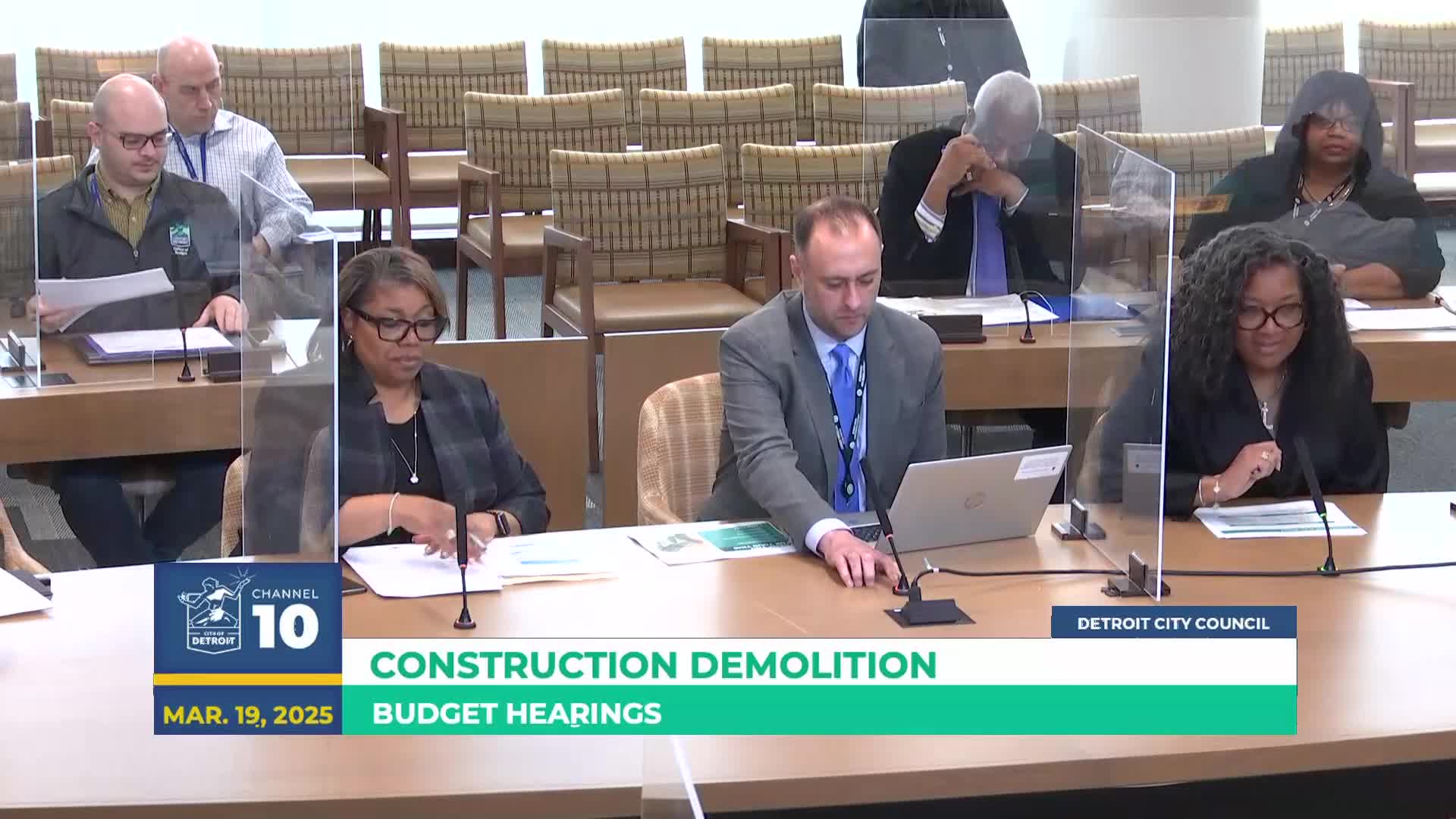
The Detroit City Council on Monday received an overview of the Construction and Demolition Department’s recent work, its remaining demolition pipeline and a fiscal 2026 budget request that shifts funding among city accounts while reducing head count.
Group Executive Luan Counts and Tim Palazzolo, director of the Construction and Demolition Department, told the council the department is “approaching our 8,000th demolition” and outlined a pipeline of residential properties the department plans to finish in coming years. Regina Greer, deputy city CFO for the Office of Departmental Financial Services, provided budget context and earlier transfers from the Fire Insurance Escrow fund.
The presentation matters because demolition and vacant-property stabilization affect public safety, neighborhood investment and the city’s operating budget. Council members asked whether the department is protecting properties that can be rehabilitated, notifying neighbors before demolitions, recouping demolition costs from insurance escrows and securing large vacant buildings such as former school properties.
Palazzolo said the department currently shows 979 residential properties in the demolition pipeline and that the city has funding for 829 of those. For fiscal 2026 the department projects roughly 300 residential emergency demolitions, about 10 commercial emergency demolitions and 125 planned residential demolitions; staff cautioned that some planned demolitions can convert to emergencies as structural conditions change. The department also said it has increased commercial demolitions in recent years after receiving ARPA (American Rescue Plan Act) funds for some projects.
Palazzolo described how the department coordinates with partner agencies. “We work with our partner agencies, primarily the Detroit Land Bank Authority, to identify properties for the pipeline,” Palazzolo said. He said the Land Bank assigns many properties and the department inspects them; if an inspection finds evidence of active rehabilitation, the property is returned to the Land Bank for reconsideration.
Council members raised multiple concerns about communication with property buyers and with neighbors near demolition sites. Palazzolo said contractors must distribute door hangers to every surrounding property within 400 feet of a target site and must supply date- and time-stamped photos of those door hangers; field staff then verify distribution. “Contractors are required to distribute door hangers to every surrounding property within 400 feet of a target site,” Palazzolo said.
Several council members described cases in which buyers who had invested in Land Bank properties later faced demolition orders. Counts said the department “should have made a different judgment call” in a recent instance where a buyer had invested in rehabilitation; he told the council the department used that case as an on‑site training opportunity and said staff would strengthen customer-service practices while still executing standing demolition orders issued by the city’s building inspection unit.
On funding and staffing, Greer said the city transferred roughly $6,000,000 from the Fire Insurance Escrow fund to demolition for fiscal 2025 and that the Construction and Demolition total budget increase for fiscal 2026 is about $11,000,000. Greer said roughly $10,000,000 of that increase is in the Blight Fund to support abatements, board-ups, field inspections and environmental expenses; another portion covers additional facilities costs. The department requested $7,300,000 in non‑personnel facilities funding for FY26, which staff said averages about $51,000 per asset when spread across the city's portfolio of facilities.
Council members also pressed for data the department said it has prepared: overall production shows an increase in tracked work orders from about 1,100 in 2022 to roughly 4,100 in 2023 and about 5,500 in 2024; the department reported about 4,900 work orders so far in the current fiscal year and expects to trend higher with seasonal activity. Staff said the department now manages more than 140 city assets and recently assumed responsibility for some DDOT facilities, offset by an estimated $2,900,000 in revenue from the transportation fund.
Council questions covered several additional items: how many Land Bank properties already had demolition orders from Buildings and Safety at the time of sale (staff said many do and offered to provide the percentage), whether the department verifies contractors’ door‑hanger distribution (staff said field teams verify and escalate noncompliance), and whether stabilization work is ARPA‑funded (staff said stabilization is supported by general fund dollars with some offsets possible from other city funds).
Council member Mary Waters asked why emergency demolitions are usually cheaper than planned demolitions; Palazzolo explained emergency demolitions typically are not abated prior to demolition because the structure is unsafe to enter, which reduces abatement time and cost. Waters and others also asked whether the Detroit Land Bank Authority could assume more of the cost for stabilizing land‑banked vacant properties; staff said such arrangements could be discussed but argued the department can perform stabilization work faster and at lower cost than many outside contractors.
Members discussed vacant school buildings. Staff said the city currently owns 19 former school properties that remain in the city’s demolition/stabilization pipeline while Detroit Public Schools Community District (DPSCD) owns additional properties; the department said it is securing many of the city‑owned locations and working with DPSCD on others.
On the Coleman A. Young Recreation Center project, staff said demolition and construction work is nearly complete. “We are estimating being completed with all of our work and having our inspections and acceptance by the end of this month,” Palazzolo said; he added the department will turn the location back to the Recreation Department in April, and the Recreation Department will schedule the public reopening.
Council member Coleman A. Young II asked about automated demolition equipment and other technologies. Palazzolo said some mechanized demolition equipment exists but is most practical in open sites and that the department’s work is often in tight residential lots; he said most city demolitions remain contract work and that high‑cost specialized equipment would likely be used only in limited situations.
Two motions during the hearing were added to the council’s executive session: a motion to add certain budget matters to executive session and a separate motion to send the automated‑demolition discussion to executive session. In both cases the chair asked for objections and, hearing none, said the items would be added to executive session.
Council members said they intend to submit follow‑up questions in writing and asked staff to provide specific counts and financial reconciliations (for example, the exact amount recouped to date from the Fire Insurance Escrow fund versus demolition costs). Staff agreed to provide the requested data.
The session left multiple items for follow‑up: a breakdown of how many Land Bank properties had standing demolition orders at sale; the percentage of board‑up and stabilization requests still open and the funding sources used for them; detailed accounting of insurance‑escrow reimbursements versus demolition costs; and a list of city‑owned former school buildings with current status and plans.
Council members also praised the department’s work in engaging returning citizens on demolition projects and in removing long‑vacant hazardous structures. “When I first came in here, there was a building… and one of the first buildings I saw come down, working together with you, director Counts, was that building, and it brought a lot of closure to that family,” Council member Fred Durhall III said during the hearing.
The department provided multiple slide data points during the briefing and promised written follow‑up on counts and funding details requested by council members. The council’s budget committee will incorporate the department’s requests and provided clarifications into further budget deliberations.