Get Full Government Meeting Transcripts, Videos, & Alerts Forever!
Get email alerts on the Budget And Equity Programs topic
No spam. Unsubscribe anytime.
Detroit council reviews Civil Rights, Inclusion and Opportunity FY2026 request; multiple items sent to executive session
Summary
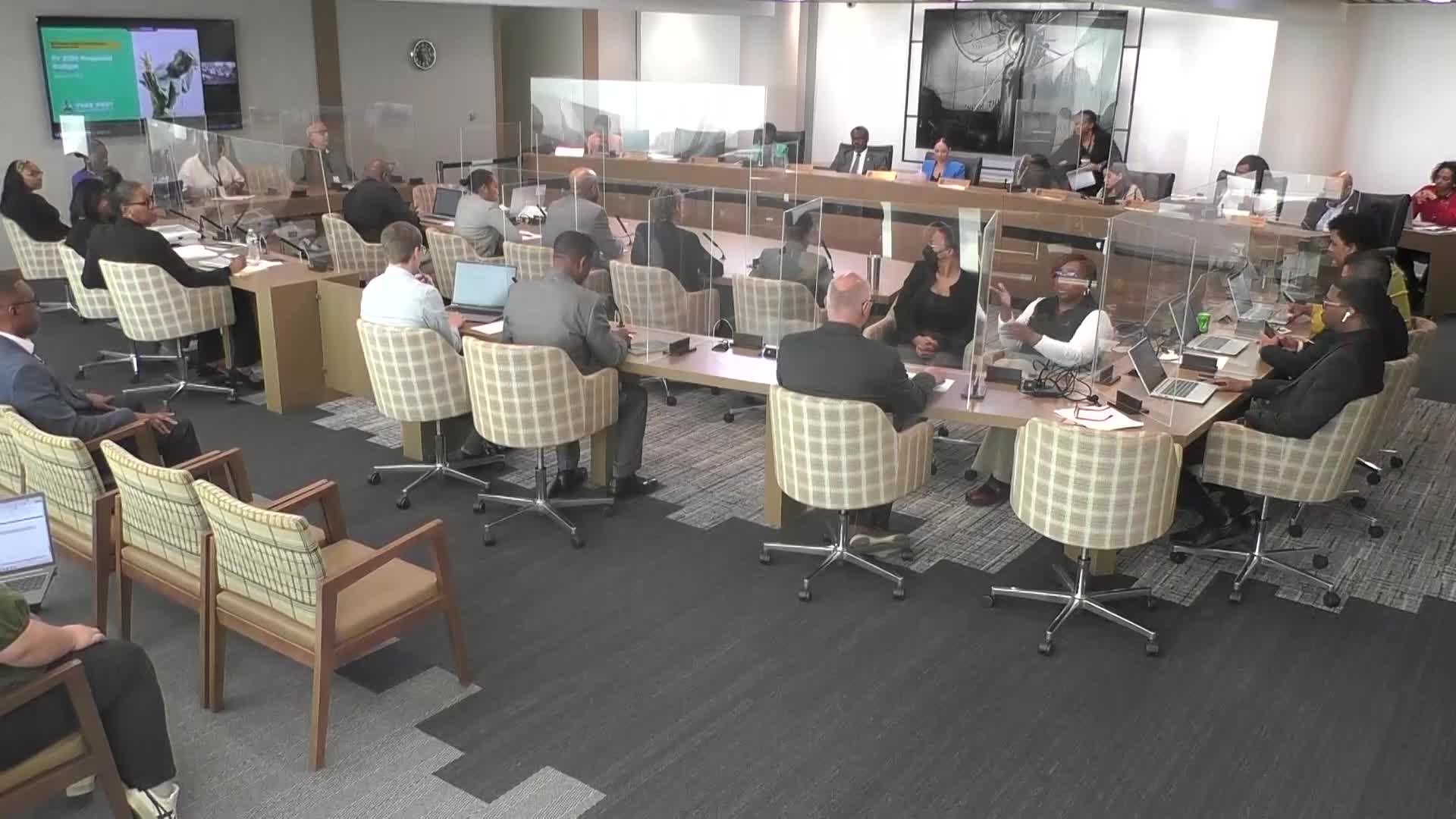
Anthony Zander, director of the City of Detroit Department of Civil Rights, Inclusion and Opportunity, presented the department’s FY2026 budget request and program updates to the Detroit City Council, saying the request falls to $7.4 million from an FY2025 adopted $8.4 million and attributing roughly $1 million of the change to state cannabis funding adjustments.
Anthony Zander, director of the City of Detroit Department of Civil Rights, Inclusion and Opportunity, presented the department’s FY2026 budget request and program updates to the Detroit City Council, saying the department’s request is $7.4 million compared with an FY2025 adopted total of $8.4 million and that most of the $1 million difference reflects changes in state funding for cannabis-related programs.
Zander said the department oversees fair and equitable housing enforcement, anti-discrimination enforcement, a language access hotline, workforce inclusion and construction compliance monitoring, Detroit business certification work, the Office of Disability Affairs, and the Office of Cannabis Affairs. He highlighted a rise in requests for language services—5,817 hotline calls last fiscal year—and said outreach and training activity has increased across disability and workforce programs.
The presentation prompted council questions on several specific items, and members made a series of unanimous-consent motions to move related budget and program matters into executive session for further discussion. Councilors emphasized three recurring concerns: (1) a $350,000 disparity study that the council approved in 2023 but that CREO says was never initiated; (2) implementation details for the city’s human‑trafficking placard ordinance for hotels and motels; and (3) support and staffing for recently created veterans and disability offices.
On the disparity study, Council Member Callaway said the council approved $350,000 in 2023 for a CREO disparity study and that CREO never started it; she moved to place that item in executive session. Zander said staff had the issue of scope to resolve and that unspent one-time funds reverted to the general fund. Callaway said she intends to work with CREO to ensure the study proceeds.
On human‑trafficking placards, Callaway said the signs required by the council’s ordinance have not been posted in hotels and motels and asked whether CREO needs funds or operational help to get placards printed and placed. Zander responded that the ordinance does not specify who produces and posts the signs; CREO has been coordinating with law, Buildings & Safety (BC), and Detroit Police Department (DPD) and plans to incorporate checks into inspection workflows and to pursue a public-awareness push with Visit Detroit. He told the council CREO will report back within 48 hours on when placards will be printed and placed.
Council members also questioned program oversight for compliance fees and workforce development funding administered through DESC (Detroit Employment Solutions Corporation). Zander said CREO receives reports from DESC and reviews quarterly metrics before releasing workforce-development funds; CREO’s construction and compliance staff also work directly with projects and contractors to monitor hiring and compliance provisions.
On cannabis, Kim James, director of the Office of Cannabis Affairs, described program outcomes the office tracks: roughly half of retail licenses have at least one Detroit or majority-Detroiter owner, some grows and retail operations are majority black-owned and Detroit resident–owned, and the office is working to help licensees with predatory partnerships, security issues, and other business assistance. She said licensees have donated community investment dollars (reported at $234,000 to 36 nonprofits) and social-equity contributions (reported at $117,000). Council members moved by unanimous consent to reassign 96% of cannabis revenue-sharing to CREO cannabis programming and to allocate $1,000,000 to a Homegrown Legacy Fund, with 4% retained for substance-abuse outreach through the Health Department as discussed on the floor.
Members asked about enforcement gaps for illegal sales and the lag time when the state must provide lab testing; councilors signaled interest in local testing kits and asked the police department to discuss options in executive session.
Councilors pressed CREO on veterans services after Zander outlined a new Veterans Affairs manager post. Member Waters moved to place veterans affairs funding and staffing into executive session and asked that CREO add two positions—one community-outreach person and one technical-support person—to the staffing plan; the motions were approved by unanimous consent. Zander said the office will do a listening tour, meet veteran groups, assess needs, and coordinate with federal and state partners as appropriate.
Several council members asked about language access capacity. Zander said CREO has one staff member dedicated to language access and uses additional staff and contractors as needed; Council Member Santiago moved to add $200,000 and an additional FTE for language access implementation to executive session for further consideration; that motion was approved.
On disability services, Council Member Durhall recalled prior council commitments to raise Office of Disability Affairs funding and moved to add $400,000 to that office’s budget for executive-session discussion; the motion carried by unanimous consent.
Council members said they will submit follow-up questions in writing. Zander told the council CREO would provide requested reports or answers (including a listing of recent housing-related complaints and a response to written questions) within 24–48 hours.
Votes at a glance (motions taken on the floor; outcomes recorded as unanimous consent unless noted): - Place the previously authorized $350,000 disparity study into executive session for further discussion — Motion by Council Member Callaway; outcome: approved by unanimous consent; note: CREO stated funds reverted to general fund when not allocated. - Add Veterans Affairs budget and staffing items to executive session; add two positions (community outreach and technical support) — Mover: Member Waters; outcome: approved by unanimous consent. - Move Office of Immigrant Affairs budget item to executive session — Mover: Pro Tem Tate; outcome: approved by unanimous consent. - Reassign 96% of adult‑marijuana revenue‑sharing to CREO cannabis programming and allocate $1,000,000 to Homegrown Legacy Fund (4% to Health Department substance-abuse outreach) — Mover: not specified on the record; outcome: approved by unanimous consent. - Add $200,000 and an additional FTE for language access implementation to executive session — Mover: Council Member Santiago; outcome: approved by unanimous consent. - Place CREO’s full budget into executive session for further review — Mover: Member Durhall; outcome: approved by unanimous consent. - Add $400,000 for the Office of Disability Affairs to executive session — Mover: Member Durhall; outcome: approved by unanimous consent.
What happened next: Councilors directed CREO to provide written answers and reports on several items (the disparity-study status, placard timeline and responsibilities, quarterly DESC reports and workforce metrics, and a list of housing‑related complaints submitted to CREO). Several items will be discussed further in executive session per motions recorded on the floor.
Why it matters: CREO’s budget request and program details cover services that affect many Detroit residents—language access, disability services, workforce inclusion on development projects, oversight of certification and contracting programs, and cannabis social-equity implementation. Councilors signaled concern about implementation gaps and accountability where council appropriations or ordinances intend benefits for Detroit businesses and disadvantaged residents.
Closing note: Council members used unanimous consent repeatedly to move multiple sensitive operational and personnel items into executive session for more detailed review; CREO committed to follow up with requested reports within 24–48 hours.