Get Full Government Meeting Transcripts, Videos, & Alerts Forever!
Get email alerts on the City Planning Master Plan topic
No spam. Unsubscribe anytime.
Planning Department previews FY26, advances master plan policy phase and CBO education
Summary
City Planning and Development Department officials laid out fiscal 2026 priorities including the master plan policy phase (Plan Detroit), neighborhood framework plans, a new historic preservation plan, and an education push for the Community Benefits Ordinance (CBO). Council members pressed staff on corridor strategy, incentives and outreach.
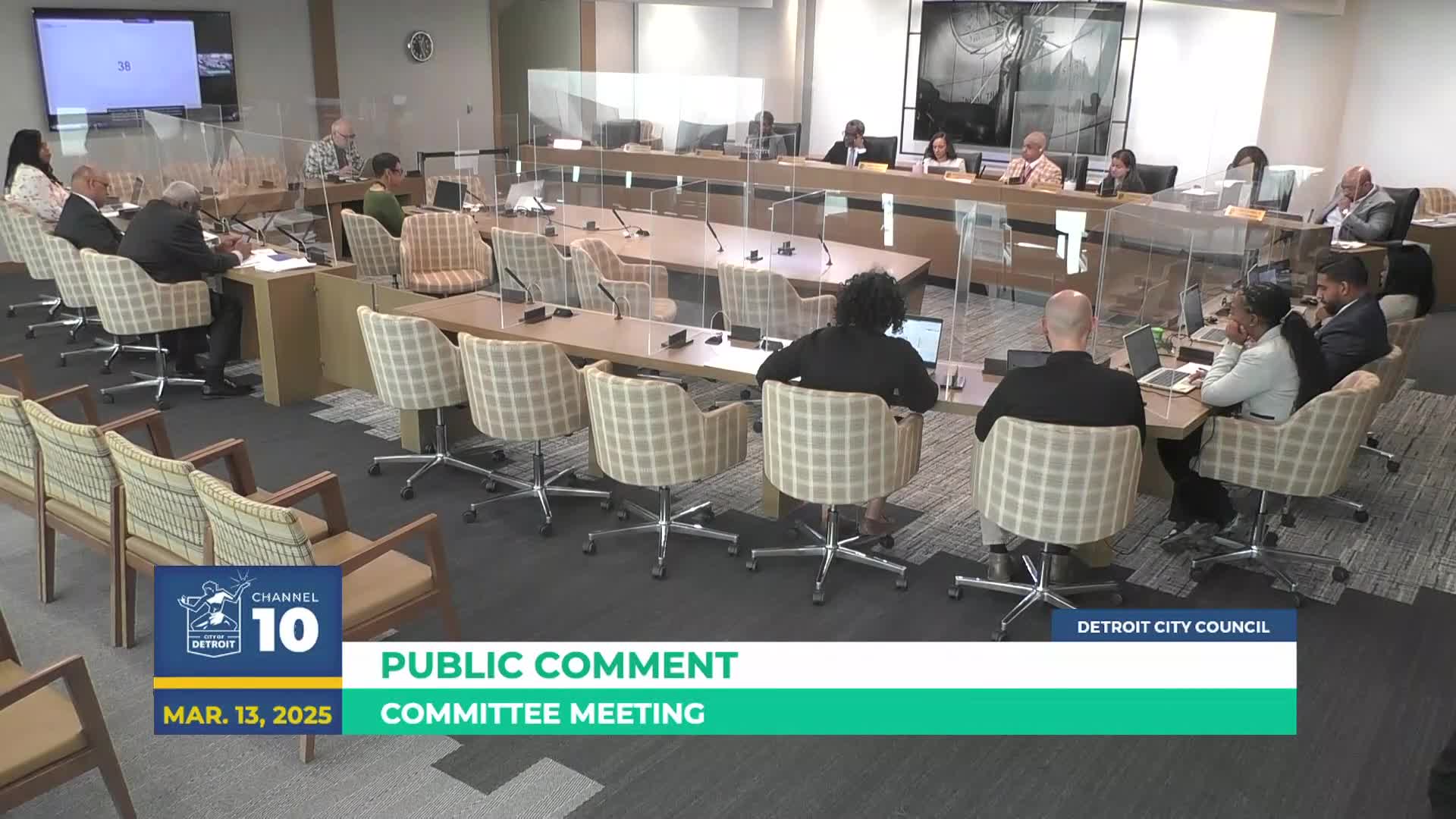
The Detroit Planning and Development Department on March 13 presented its fiscal 2026 priorities to the City Council, highlighting the next phase of a citywide master plan update, several neighborhood framework plans, a new historic-preservation initiative and a planned education series around the Community Benefits Ordinance.
Department director Alexa Bush told the council the master plan “policy” phase is starting and that staff will return to the public with more outreach in April. She said planning has completed the “analysis envisioning phase” and will carry the master-plan work through the fiscal year and into the next calendar year.
“Beginning next month in April, we'll be going back out with our next round of public outreach,” Director Alexa Bush said. “We were recently before City Planning Commission, and I believe next week we'll be in front of this body with another update.”
Why it matters: the master plan shapes future land use, zoning recommendations and public investments across Detroit. Council members said they want clearer implementation commitments—timelines, short-term actions and protections against displacement—before plans move from vision to construction.
Department priorities and recent accomplishments
Bush summarized major planning projects now underway or near completion: draft framework and corridor action plans for Brightmoor, Griggsdale Farms and the Fenkell corridor; a Denby–Whittier framework plan (consultant selection underway); an I‑375 framework plan focused on land use for roughly a mile of land that could be created if the freeway is converted; and the city’s first citywide historic-preservation plan.
“We did just launch earlier this year the historic preservation plan,” Bush said. “This is really us trying to be much more proactive about the historic assets we have across the city.”
Bush also reported regulatory workload and review activity: the department reviewed “over 600” historic‑district applications in the past year and the design‑review team reviewed “over 70 different projects in ’24.” She said planning continues to manage the Community Benefits Ordinance and related neighborhood advisory committees.
Community Benefits Ordinance and education
Council members pressed staff about how the CBO is working on the ground and how residents can better understand development incentives. Deputy Director Dara O'Byrne and planning staff said the department is focusing on implementation and an education series in FY26 rather than immediate legislative changes.
Edwina King, who manages CBO outreach, said the education work will include clarifying the differences between tier 1 and tier 2 projects, explaining the role and responsibilities of neighborhood advisory committees and encouraging NACs to request additional meetings or technical support.
“What is a CBO? What qualifies for a tier 1 versus a tier 2?” King said, explaining the planned orientation and negotiation support for NAC members. She also said the department is discussing stronger ethics orientations and suggested NAC members sign an affidavit about ethics obligations.
Council concerns and next steps
Council members raised several recurring points: more upstream help for small businesses and developers (pre‑plan review); clearer public explanations of tax abatements and subsidies; better outreach in districts that have not participated in NACs; and short‑term corridor fixes (façade programs, cleanups) to catalyze reinvestment before large-scale development.
Bush said the final master‑plan document typically includes an implementation matrix that distinguishes near‑term (one-to-three year) actions from longer‑term ideas and noted that the department will try to be transparent about which items have identified funding and which are aspirational.
Ending
Department staff said they will return with updates to the council as the policy phase begins in April and that they will follow up with written answers where staff did not have immediate figures, including a commitment to provide data on workforce investments tied to CBO projects.