Get Full Government Meeting Transcripts, Videos, & Alerts Forever!
Get email alerts on the Municipal Budget Revenue topic
No spam. Unsubscribe anytime.
Detroit budget committee hears brighter revenue outlook, receives six‑month financial report and schedules follow‑ups
Summary
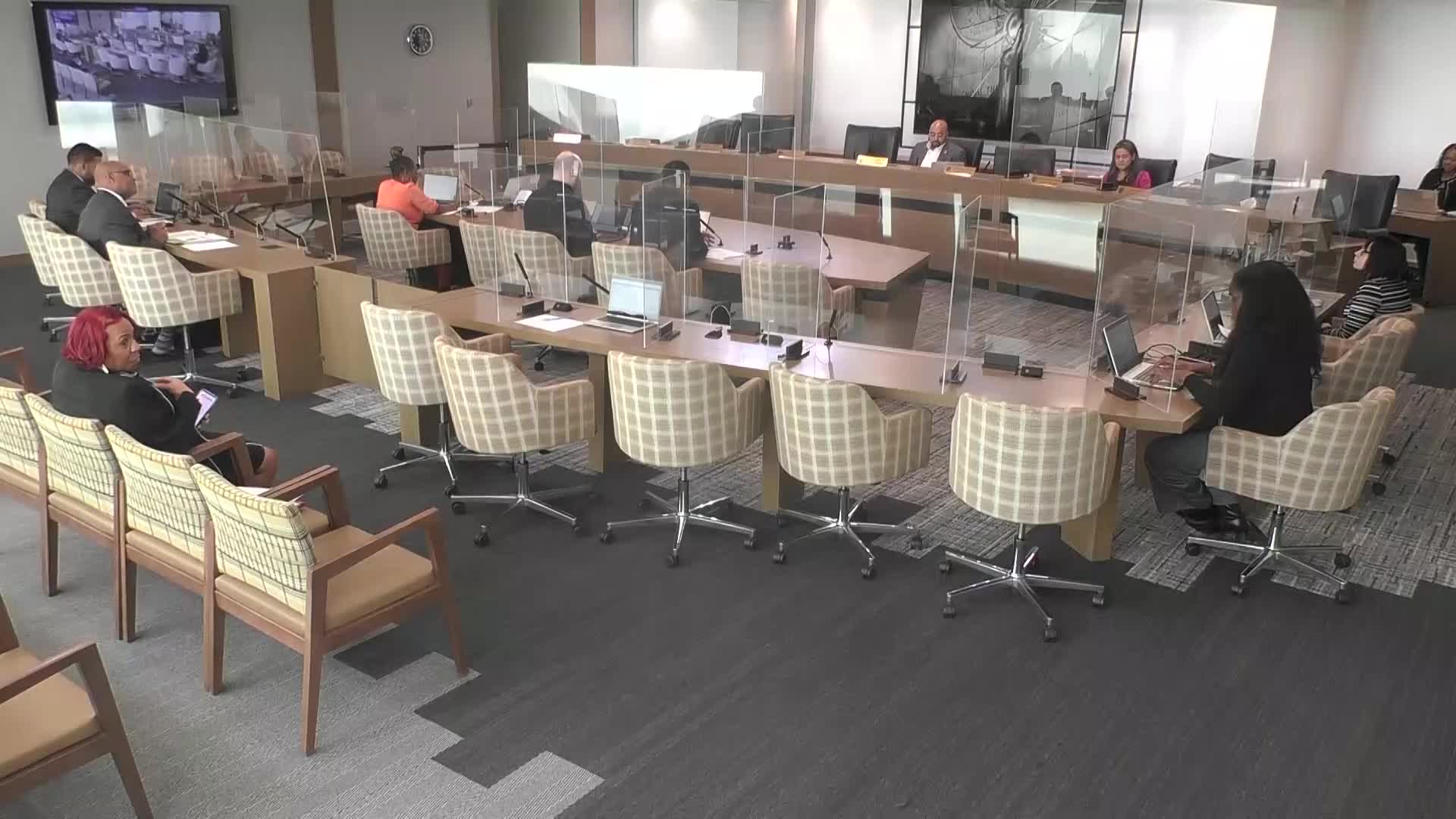
The Detroit City Council Budget, Finance and Audit Standing Committee on Wednesday received an updated revenue forecast and a six‑month financial report showing stronger‑than‑expected revenues and asked staff for follow‑ups before finalizing the fiscal 2026 budget.
The Detroit City Council Budget, Finance and Audit Standing Committee on Wednesday received an updated revenue forecast and a six‑month financial report showing stronger‑than‑expected revenues and asked staff for follow‑ups before finalizing the fiscal 2026 budget. Committee members approved a slate of "bring‑back" dates for items needing more work and voted to receive and file the two reports.
City Deputy Chief Financial Officer and Treasurer Nikhil Patel summarized the revenue outlook from the February revenue estimating conference: "the fiscal year 26 projection is a little bit over $1,400,000,000 primarily driven by growth, in projected corporate income tax revenues while withholding and individual remains steady, along with a large growth, continued growth in wagering taxes." He told the committee that wagering growth is being driven in part by Internet gaming and that the office will monitor whether that behavior continues.
The revenue update and the six‑month financial report together give the administration and council more flexibility ahead of final budget decisions. Donnie Johnson, the city's deputy budget director, presented the six‑month report and noted operating variances through Dec. 31, 2024: the city had collected about $35.6 million more in revenues than expected and was about $25.1 million under budget on expenditures, which Johnson said provides "a little bit of cushion" for operations.
Why this matters: The committee and staff framed the new revenue figures as a key input to the FY26 budget and to several proposed amendments. Officials said the upside gives the city one‑time capacity to consider additions in the current fiscal year while reminding members that some revenue streams carry uncertainty.
Details from the presentations and committee discussion
- Revenue outlook: Patel said the change from the September forecast reflects corporate profit growth and stronger wagering receipts; he cautioned the Internet gaming piece is relatively new and requires close monitoring. He listed downside risks including federal macroeconomic shifts and the possibility that employment growth diverges from forecast.
- Employment and wages: Patel showed that job growth in Detroit is being driven mainly by lower‑wage service positions and that resident wage rates remain materially below the average for jobs in Detroit. "The wages for residents, in the city of Detroit, are almost, a little less than 50% lower than the average wages total for jobs in Detroit," he said, and noted the gap has been narrowing since 2019.
- Property values and tax caps: The six‑month report projects assessed property values increased by an average of about 19% for tax year 2024 and noted that Michigan law caps the annual taxable value increase (absent uncapping) at roughly 3.1% for 2025; the presentation referenced the Headlee Amendment and Proposal B in that context.
- Cash position and pension contributions: The treasurer's slides showed a year‑over‑year cash decline of roughly $440 million driven in part by large legacy pension payments, including a June 2024 contribution of $79.1 million and two quarterly payments of roughly $18.3 million.
- Debt and financing moves: Staff reported the city refinanced 2014 LTGO bonds in October, changed the structure of certain intercepts so income tax flows are simplified, and activated a master installment purchase agreement for vehicle financing. The supplemental installment purchase authorization is $55 million; the first supplemental purchase order was roughly $12 million, officials said.
- Solid‑waste fund and county chargebacks: Councilmember Corley raised a pending budget amendment that would add $14 million to the solid‑waste fund and asked whether higher Wayne County chargebacks were the primary driver. Patel explained chargebacks reflect older delinquencies and a multi‑year collection cadence at the county; he said it may take two to three years for that pipeline to normalize.
Committee members asked follow‑ups on possible policy responses: Councilmember Gabriela Santiago Romero urged engagement with large local employers such as arena operators about wages for Detroit residents; Vice Chair Councilmember Coleman A. Young II asked about the revenue impact of potential tax rate changes and about regulatory burdens on small businesses. Patel said some analyses are underway and that certain items (for example, the income tax timing and corporate tax base effects) require more study before firm revenue estimates could be offered.
Public comment: The virtual public comment period included callers who raised procedural concerns about appeal records at the Board of Zoning Appeals, objections to how ARPA funds are being prioritized, and calls for replacing the city's outside auditor. Those remarks were part of the record but did not result in committee action.
Votes at a glance
- Line item 5.1 (Council President Pro Tem memorandum on earned interest on ARPA funds): motion to bring back in 2 weeks — approved (no objections).
- Line item 5.2 (Councilmember Fred Durhal memorandum requesting additional appropriation for community violence intervention initiatives, FY2026): motion to bring back in 2 weeks — approved (no objections).
- Line items 5.3 (OCFO February 2025 revenue estimating conference report) and 5.6 (financial report for six months ended 12/31/2024): motion to receive and file both reports — approved (motion, no objections).
- Line item 5.4 (OCFO large events reporting): motion to bring back in 1 week — approved (no objections).
- Line item 5.5 (Councilmember Leticia Johnson memorandum on capital agenda questions): motion to bring back in 1 week — approved (no objections).
- Line item 5.7 (Councilmember Scott Benson request for legal opinion on general fund use for wills and estate planning services): motion to bring back in 1 week — approved (no objections).
- Line item 6.1 (Legislative Policy Division resolution establishing a proportional funding formula for oversight agent agencies): motion to bring back in 2 weeks and direct LPD and the Office of the Chief Financial Officer to draft a fiscal impact study — approved (no objections).
What comes next
Committee members asked staff for more granular analyses — including deeper exploration of wagering revenues, corporate tax drivers, the effect of nonresident remote work on income tax allocations, and a fiscal impact study on the proportional funding resolution — to be delivered before final FY26 budget votes. Several items were scheduled for return to the committee in one to two weeks for additional review.
Ending
The committee adjourned after completing the agenda; members were reminded that expanded budget, finance and audit deliberations with counsel were scheduled to resume at 2 p.m.