Get Full Government Meeting Transcripts, Videos, & Alerts Forever!
Get email alerts on the Museum Funding Capex topic
No spam. Unsubscribe anytime.
Detroit Historical Society warns of collection risks as millage stalls; council adds CapEx and budget items to executive session
Summary
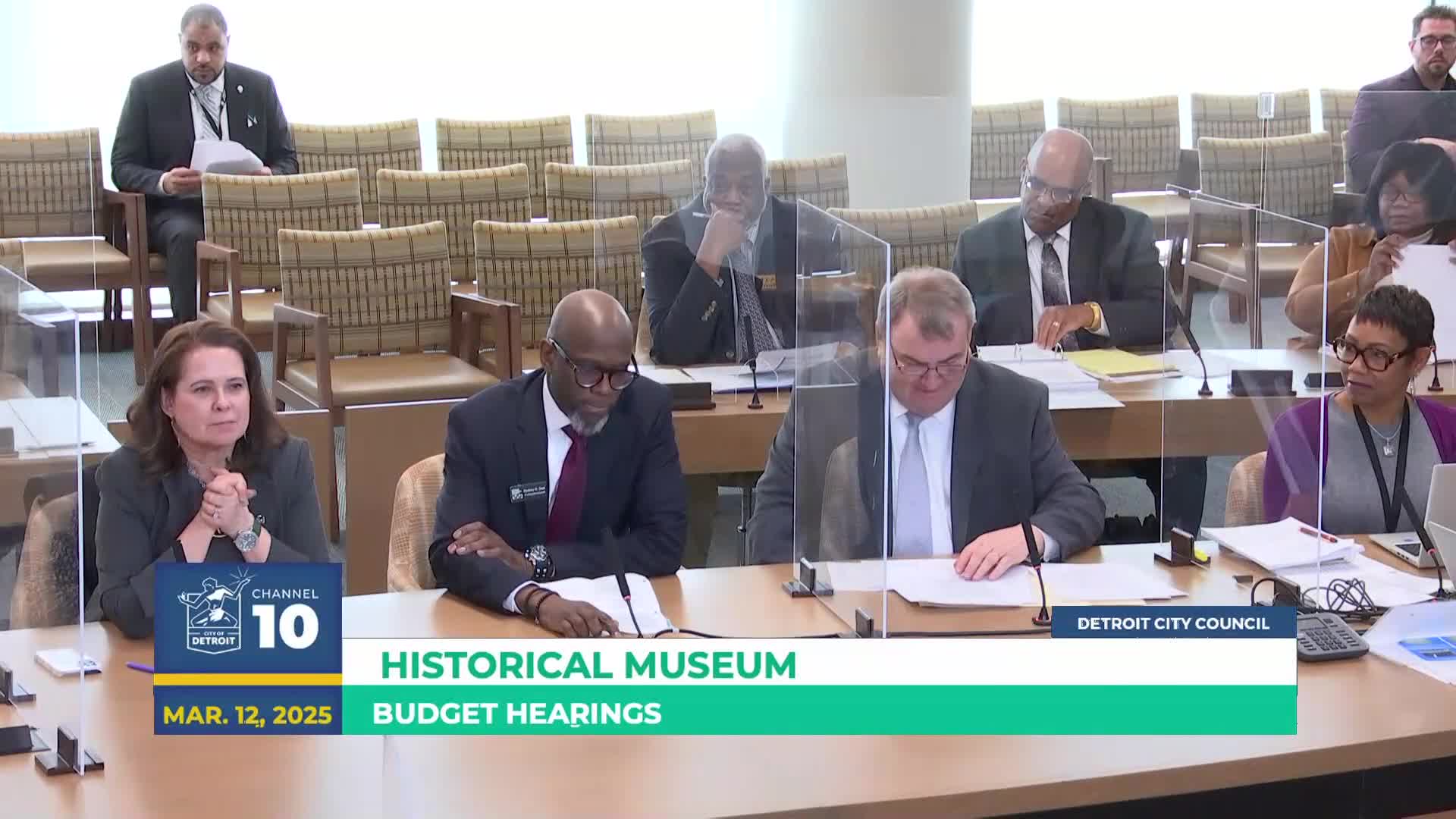
At a Detroit City Council budget hearing, Detroit Historical Society leaders described imminent risks to the city's archival collections, sought interim city support while a proposed millage remains delayed, and had two budget requests added to the council's executive session by unanimous consent.
The Detroit Historical Society told the Detroit City Council that it faces a precarious funding gap while a proposed millage is delayed, and warned that the Collections Resource Center at Historic Fort Wayne is "one flood or power outage away from disaster." Ilana Roo, president and CEO of the Detroit Historical Society, asked the council for capital and operational support at a budget presentation and said the society will press ahead with a millage campaign when allowed to go before voters.
The museum chief said the society has pursued a millage for five years and that those bills had passed the state House and Senate but were stalled by a clerical issue and a hold from the speaker of the Michigan House. "We're still not quite there," Roo said, adding that the organization remains "optimistic" about placing the measure before voters next August and that polling supports the effort.
Roo and Matt Greenough, the society's chief financial officer, outlined current finances and near-term needs. Greenough said earned revenue is trending upward and the society expects to reach at least $1 million in earned revenue in the next budget cycle, up from roughly $600,000 in fiscal 2019. He also said a prior round of state transitional funding helped restore reserves and avoid staff cuts but that no additional transitional funding has been earmarked for the coming year.
Roo urged council action to protect the society's three buildings, which she said house nearly 300,000 artifacts across about 250,000 square feet. She highlighted the Collections Resource Centerat Historic Fort Wayne, built in 1942, as the most urgent concern and said the society received a federal climate-change grant and an assessment from consultants concluding the buildings are decaying and that shoring up electrical systems and other work will be costly. "We are frankly one flood or power outage away from disaster," Roo said.
Greenough and Roo noted specific capital items and prior allocations: an ARPA-funded project of $1.2 million intended to replace 1951 windows at the Detroit Historical Museum; an earlier unspent capital allocation (roughly $600,000 of $1 million from fiscal 2024) delayed by payment timing; and a new request the society submitted for $975,000 in one-time CapEx funding to address capital needs. Greenough said the ARPA window project will likely use nearly the full $1.2 million award.
Council members pressed for details on contingency plans if the millage fails. Roo said the society has begun modeling reductions and that, absent the millage, staff restructuring, reduced hours and program cuts are possible. She said a successful millage (she referenced modeling at 0.2 mills in both Wayne and Oakland counties) could generate materially larger annual revenue for the society, but that county leaders have said millage proceeds should primarily support operations and programming rather than capital.
During the hearing two motions relating to the society's request were made and accepted without objection. A motion to add the society's $975,000 one-time CapEx request to the council's executive session was made and, after the presiding officer said "hearing no objections," the item was added. Separately, Council Member Vincent moved to place the entire museum budget discussion into executive session; the presiding officer again said "hearing no objections," and that addition was approved.
Council members repeatedly flagged the Collections Resource Center's deferred maintenance and the high cost and complexity of moving or replacing 300,000 artifacts. Roo said consultants presented options ranging from continued repairs to building a new adjacent facility or relocating the collection entirely, a move she described as "tens of millions of dollars" and requiring a new roughly 250,000-square-foot facility. She asked the council to identify city contacts to review consultant recommendations and to consider capital support.
Roo also credited prior city assistance and partners for recent operational improvements: transitional state funding that permitted a compensation study and improved staff retention, and a Honeywell assessment that she said helped the society realize more than $30,000 in utility savings. Greenough said the society currently employs about 70 people, 20 of whom live in the city of Detroit; he called staffing the largest operating expense and said health-care premium increases (about 13% this year) now represent nearly $500,000 annually.
The council accepted the society's request to discuss the items in executive session later in the day. Roo and staff also offered to host council members at the Collections Resource Center so they could see the scale and condition of the collection and buildings firsthand.
Votes at a glance
- Motion to add $975,000 one-time CapEx request to executive session: approved by unanimous consent (no roll-call vote recorded). - Motion to add the entire Detroit Historical Society budget to executive session: moved by Council Member Vincent; approved by unanimous consent (no roll-call vote recorded).