Senate Banking Committee advances Genius Act after heated markup over consumer and national security safeguards
Get AI-powered insights, summaries, and transcripts
SubscribeSummary
The Senate Banking Committee voted to report the Genius Act (S.919) to the full Senate after adopting a managerspackage and rejecting a series of amendments focused on national security, consumer protections and reserve rules.
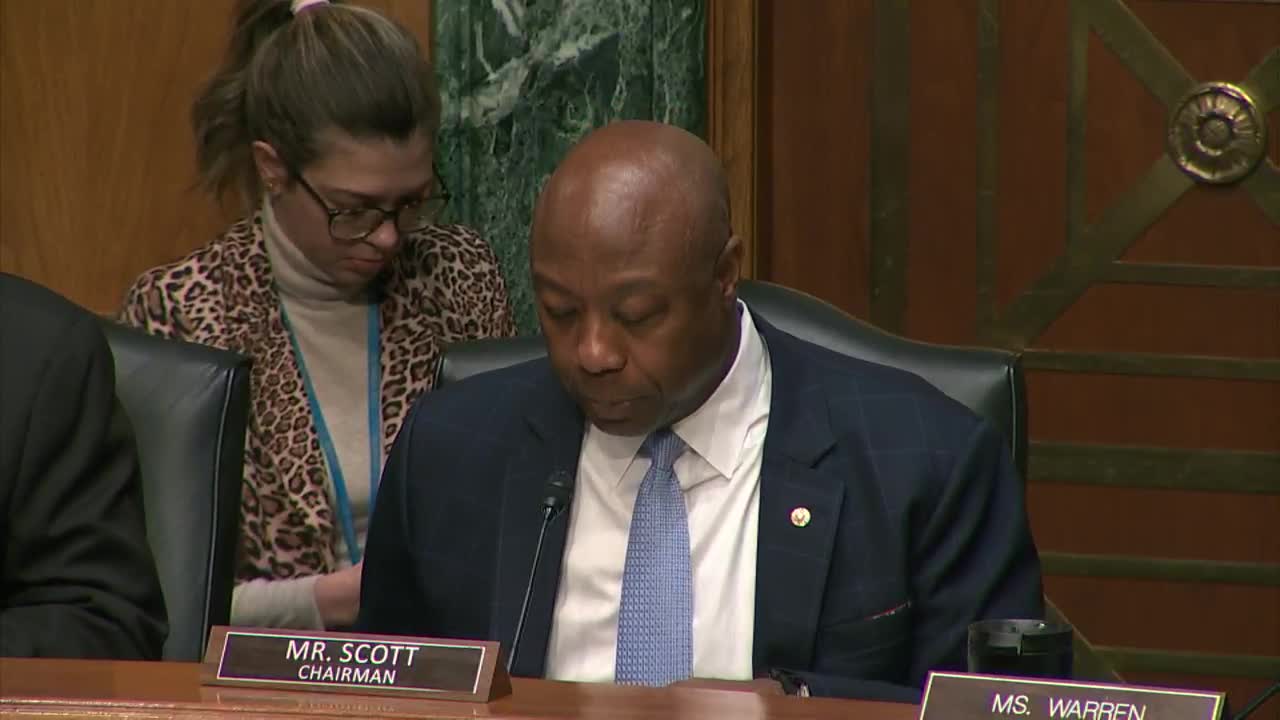
Senate Banking Committee Chairman Scott said the committee would "return to regular order" as members met in executive session and moved to mark up the Genius Act, a bipartisan framework to regulate payment stablecoins.
The committee reported the bill as amended to the full Senate, with the committee approving the managerspackage and voting 18-6 to send S.919 to the floor. Committee debate centered on whether the bill provides enough consumer protections and anti-money-laundering safeguards while also preserving innovation and U.S. leadership in payment systems.
The managers' package adopted at the start of the markup bundled a series of bipartisan provisions meant to clarify supervision and consumer protections. The package text cited in the hearing included amendments that (1) clarified treatment of non-permitted payment stablecoins, (2) required regulators to consider the competence and integrity of key leaders at applicant companies, (3) prohibited deceptive issuer names, (4) preserved the status quo on Federal Reserve master account access, (5) gave stablecoin customers a super-priority in bankruptcy, and (6) clarified reserve and transparency requirements.
Senate Ranking Member Warren said the bill as written "doesn't do any of that," urging added consumer safeguards, stricter national-security checks and tighter limits on issuer investments. Warren repeatedly proposed amendments that would have barred persons convicted of serious financial crimes from owning stablecoin firms, required checks to prevent sanctions evasion, and restricted the types of assets that could back stablecoins; a number of those amendments failed on 13-11 roll calls.
Supporters including Senator Haggerty and Senator Lummis argued the bill strikes a balance between consumer protection and fostering responsible innovation. As Senator Haggerty said during debate, "As the world modernizes its payment system, the United States can't be left behind." Backers pointed to new compliance steps in the managers' package, including classifying payment-stablecoin issuers for some AML/BSA purposes and requiring technical capabilities to comply with lawful freezes or forfeiture orders.
Lawmakers pressed specific points throughout the markup. Senator Reed and others urged narrower reserve investments after pointing to prior industry failures; Senator Reed noted the role of uninsured deposits at Silicon Valley Bank in a 2023 stablecoin incident. Senator Cortez Masto and others proposed limits on issuer activities and additional transparency; those efforts were considered but did not carry. Multiple roll-call votes recorded a steady pattern: a majority of committee Republicans voted to advance the managers' package while a caucus of Democrats pressed for stricter safeguards and repeatedly fell short on close votes.
The committee clerk announced the final tally on S.919 as "18 in favor, 6 opposed." Following the vote, Chairman Scott asked unanimous consent for technical changes and the bill was ordered reported as amended to the full Senate.
The committee transcript records extensive back-and-forth on national security, AML, consumer redemptions, and the proper scope of federal oversight for payment stablecoins. Several senators said they would continue negotiations as the bill moves to the Senate floor and as a separate market-structure package is drafted.
Upcoming steps: the committee reported S.919 as amended to the Senate. Sponsors and critics said they expect additional floor amendments and further work on market-structure matters after committee passage.