Get Full Government Meeting Transcripts, Videos, & Alerts Forever!
Get email alerts on the Biosolids Agricultural Use topic
No spam. Unsubscribe anytime.
Committee advances bill limiting state‑land restrictions on biosolids; agencies and county officials seek clarifications
Summary
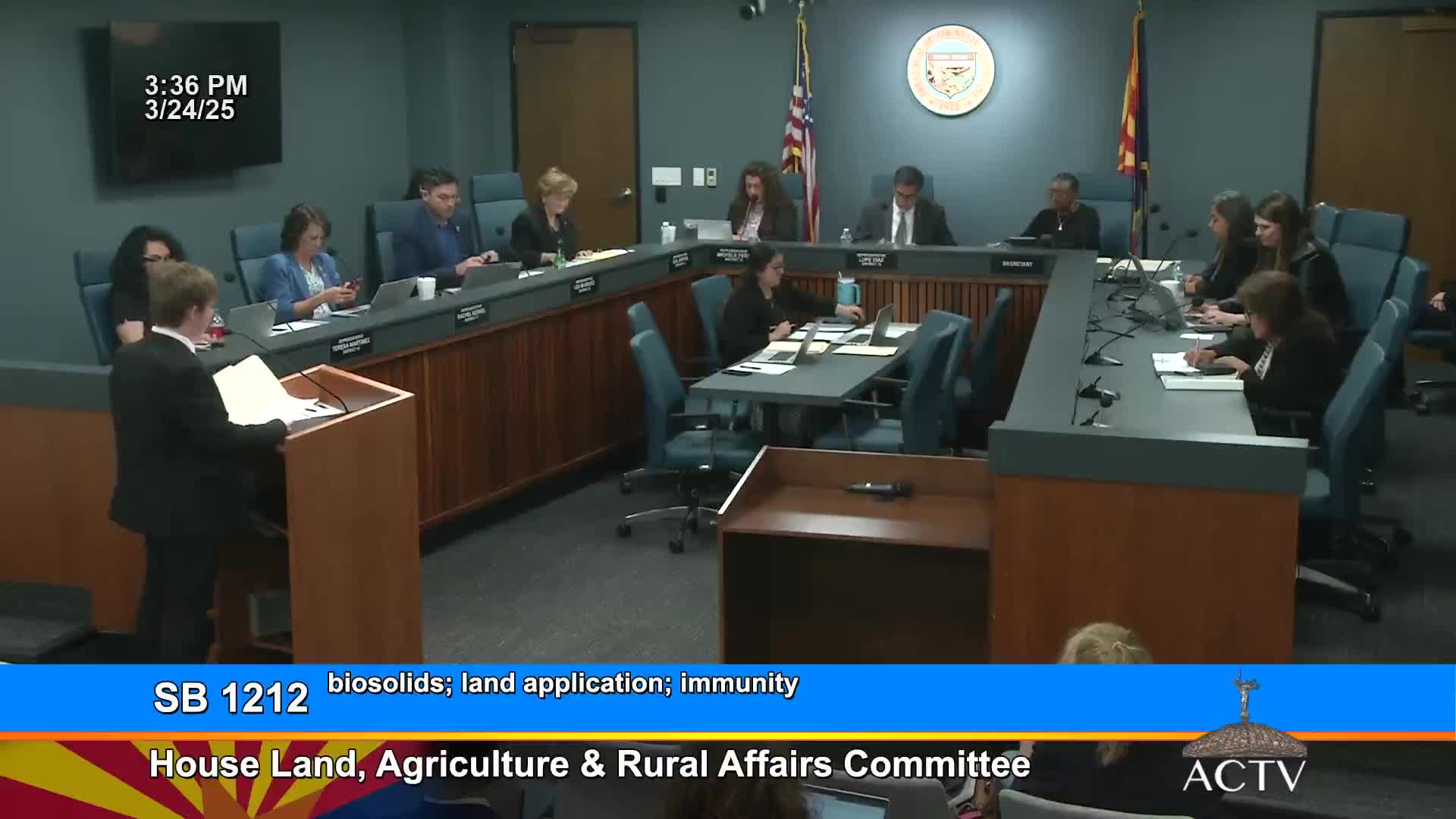
Senate Bill 12‑12, which would require ADEQ to adopt rules governing biosolids application to agricultural land and includes a presumption favoring biosolids use on state trust lands, advanced from committee after extended testimony and requests for clarifying amendments.
Senate Bill 12‑12 — which would require the director of the Arizona Department of Environmental Quality to adopt rules for the application of biosolids to agricultural lands and contains language that, as presented in committee, made fertilizing state lands with biosolids presumptively reasonable — drew extended testimony and substantive questions about public health, regulatory authority and local impacts.
Sponsor Senator Tim Dunn described the bill as an effort to clarify how biosolids (sewage sludge) are managed on state trust lands and to reconcile ADEQ water and air roles with state land administration. Dunn said the goal is “to get something done that we can move the regulation forward” while protecting property‑lease rights and addressing local concerns.
Speakers at the committee included residents, conservation advocates and growers. Kristen Brady — who identified herself as “a concerned Arizonan” — urged a “no” vote, warning that biosolids “are sewage sludge” and pointing to studies that have found thousands of chemicals, including PFAS, in biosolids and soils where they were applied. Brady said the bill’s language that makes biosolids use on state land “presumptively reasonable” could make it harder for people harmed by contamination to seek redress.
Sierra Club testimony raised similar concerns about PFAS, pathogens and other contaminants, and urged caution because of potential long‑term contamination of soils and watersheds. County representatives said supervisors had received public complaints about odors and insect impacts and asked for clearer oversight and enforcement mechanisms.
Growers and a long‑time biosolids operator, Mike Gardner of AgTech Farm in Yuma, said biosolids are a long‑standing agricultural input and contended the practice is safe when managed under EPA and state rules. Gardner said the EPA and University of Arizona studies support the agricultural use of biosolids and that current permits are subject to annual reviews and surprise inspections. He added that biosolids can be a productive route to recycle organic matter and improve soil health while reducing water use on some sandy soils.
ADEQ representative Krista Osterberg told the committee ADEQ was neutral and working with the sponsor on amendment language. ADEQ staff noted the bill’s current text would create air‑quality rulemaking duties that include water‑quality topics already regulated elsewhere, and recommended reconciling air and water authority and making sure ADEQ has clear authority and standards before assigning new enforcement duties. County representatives asked for an additional full‑time position to oversee accountability and enforcement if state land application expands.
The committee adopted the bill with a due‑pass recommendation; committee members recorded a vote of 5 ayes, 3 nays and one present. Several members said they were voting with reservations and sought amendments to clarify immunity language, operational controls for dust and vectors, and whether ADEQ has adequate statutory authority and staffing to enforce new requirements.
The bill as drafted directs ADEQ role‑setting for biosolids application and would change how state trust land leases are treated with respect to biosolids; the record shows stakeholders expect follow‑up amendments to clarify enforcement, immunity and oversight.