Get Full Government Meeting Transcripts, Videos, & Alerts Forever!
Get email alerts on the Homelessness Opioid Funding topic
No spam. Unsubscribe anytime.
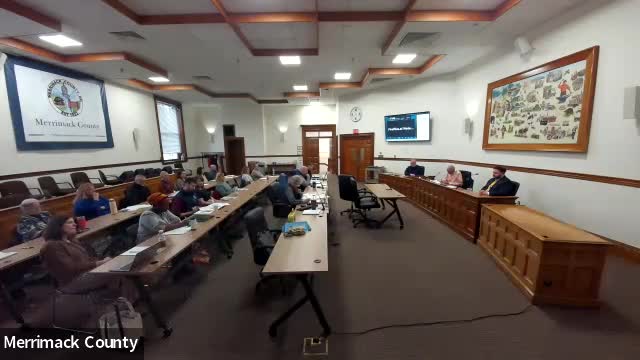
Commissioners discuss homelessness response, cold‑weather grants and opioid abatement funds
Summary
Commissioners and staff discussed rising homelessness along the Merrimack River, existing cold‑weather shelter grants administered by the county, and the potential for opioid abatement funds to support prevention and wraparound services; county staff said $27,000 remained in the cold‑weather shelter grant this cycle.
Multiple commissioners raised concerns about visible homelessness along the Merrimack River and asked county staff and counsel to review the county's authority to address camping on county land.
Commissioner David Shurtleff described growing constituent concern about encampments, public health risks and visible disorder; he asked staff to investigate whether the county has authority under state law to engage more directly. County Administrator Ross Johnson said the question is complex and that the county can review options and report back, noting that entering the homelessness arena could create expectations that the county will assume ongoing responsibility and costs.
Kara (county staff) briefed the board on a state subaward the county administers for cold‑weather shelters. Kara said Merrimack County received a grant through the New Hampshire Department of Health and Human Services; the county started with $219,000 for the program period, issued an RFP and awarded multiple local groups to operate activities; staff reported $27,000 remained unallocated specifically for cold‑weather shelter needs (blankets, tarps, added hours, utility costs) and that the county submits monthly requests to the state for reimbursement.
In public comment, resident Lynn Blanketbecker urged the county to pursue prevention and treatment funding related to substance use disorders. Blanketbecker described the state’s opioid settlement and abatement process and said the county’s allocation had been about $800,000 (attributed to her public comment). She encouraged connecting opioid‑abatement money to local wraparound services (transportation to drug court, recovery supports) and said prevention is essential to reducing homelessness in the long term.
Commissioners noted several groups working on homelessness, including the Concord Coalition to End Homelessness, Friendly Kitchen, Family Promise and town partners. Kara said the county had coordinated a point‑in‑time count and that multiple partners had participated in grant‑funded cold‑weather activities; she said the county acts as the grant recipient because only one entity can apply on behalf of the county and its towns.
No formal board action was taken beyond directing staff to return with legal and programmatic options and to provide details of past grant awards and remaining funds for cold‑weather shelter purposes.