Get Full Government Meeting Transcripts, Videos, & Alerts Forever!
Get email alerts on the Community Services topic
No spam. Unsubscribe anytime.
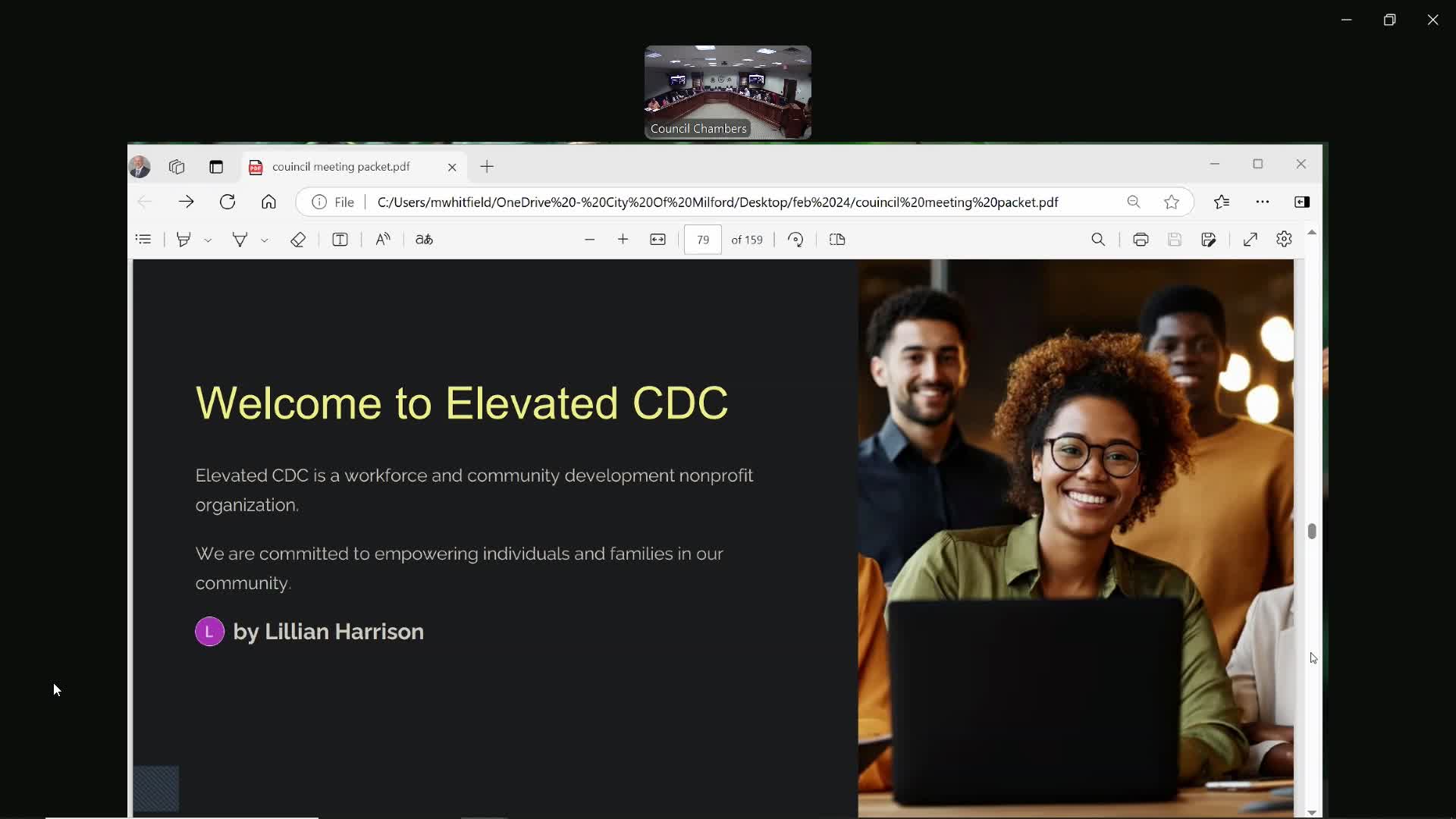
Elevated CDC outlines workforce, reentry and housing plans for Milford and region
Summary
Elevated Community Development Corporation told the council it is expanding workforce and reentry programs, plans affordable housing developments in Seaford and Georgetown and seeks to scale services including transitional housing and supportive services for formerly incarcerated people.
Elevated Community Development Corporation (Elevated CDC) presented an update to Milford City Council Tuesday outlining expanded workforce development, reentry services and housing projects across Delaware and into the Eastern Shore of Maryland.
"Our mission is to elevate communities by providing opportunities for individuals to thrive and foster economic self sufficiency, and creating a vibrant and equitable society and to be a leading advocate for social change," the organization's representative told council.
The nonprofit said it is separating its operations from the Milford Armory site administratively and growing staff after initially operating with volunteers. The organization described core programs that include workforce training, employer-paid internships, job placement across sectors including medical and banking careers, and a reentry program focused on training and rapid placement for people leaving incarceration. The speaker said Elevated CDC aims to expand reentry work and establish another transitional house.
On housing, the group reported two development tracks: 13 single-family homes in Seaford planned as affordable housing and a 30-unit studio rental project in Georgetown. The presenter said the Seaford homes were targeted at incomes at or near 80% of area median income and said project pricing was projected around "$260,000" in the presentation text while acknowledging a funding gap that might require adjustments.
The speaker described partnerships with the Department of Labor, Department of Corrections, Independent Resources (a Center for Independent Living), True Access Capital and Stepping Stones Community Credit Union. She said the organization has a 96% success rate across programs, has created more than 100 jobs and has more than $3,000,000 in housing projects proposed for the upcoming year.
On homelessness and transitional housing, the presenter said short-term shelters of 30'45 days are often insufficient and advocated for longer-term transitional housing with supportive services. "In 30 to 45 days, that is not enough time," she said, adding that supportive services and counseling are essential to help people move to more stable housing.
Council members asked about capacity to support homeless populations and housing affordability; the presenter pointed to the organization's work on state-level housing task forces, CDAC subcommittees and local partnerships to shape housing solutions that can include transitional housing and supportive services.
What happens next
The presentation was informational; no council action was recorded. Elevated CDC said it is seeking funding, pursuing memorandums of understanding with corrections agencies for reentry work and continuing to develop its housing projects and partner relationships.