Get Full Government Meeting Transcripts, Videos, & Alerts Forever!
Get email alerts on the Zoning Code Administration topic
No spam. Unsubscribe anytime.
Board discusses code tweaks after 119 variance applications in three years
Summary
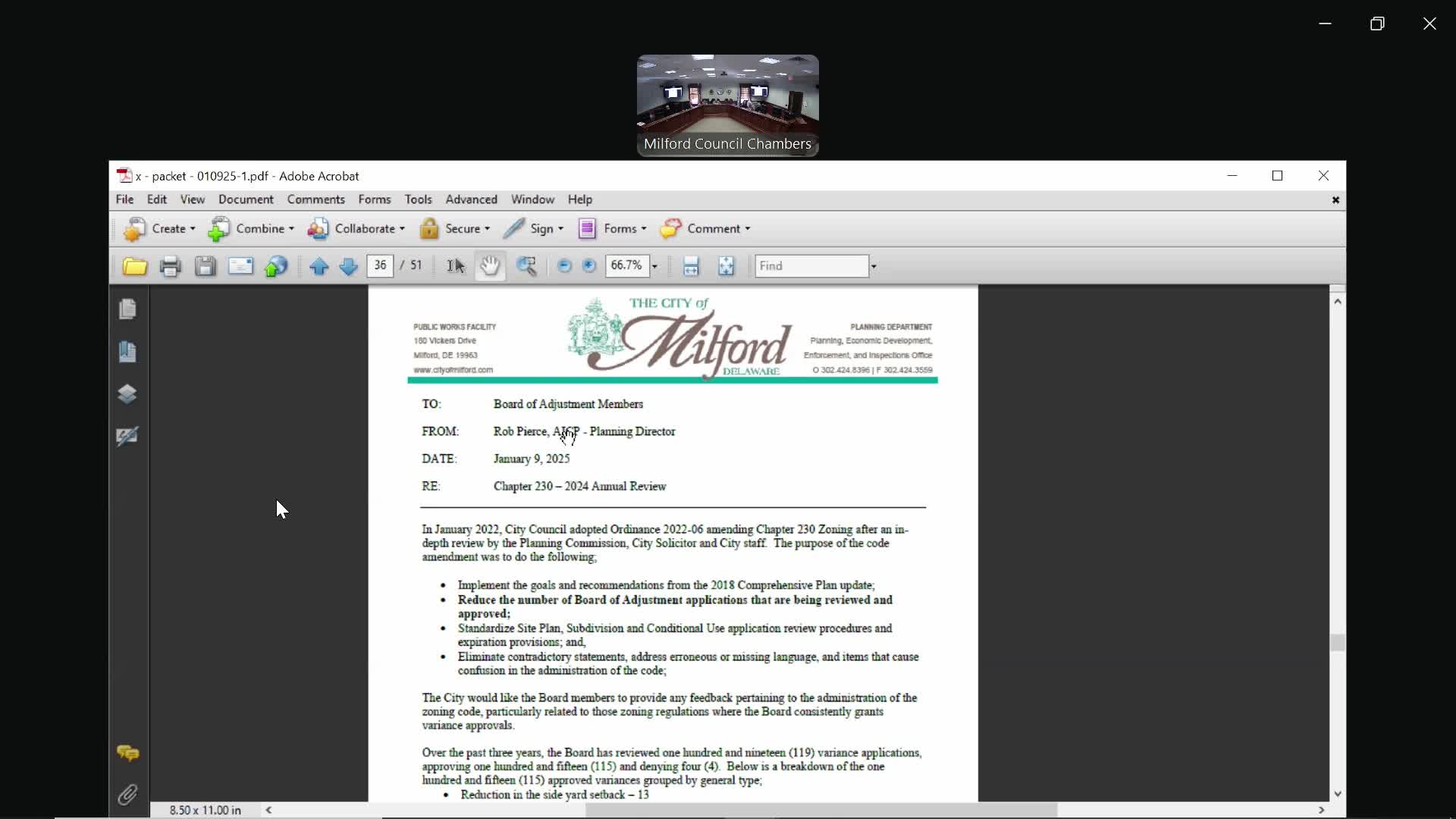
City staff reported 119 variance applications over three years (115 approved); the Board of Adjustment discussed administrative changes such as expanding use of average front-setback rules and examining side/rear setback exceptions to reduce routine variance applications.
City staff presented an annual summary of variance applications to the Milford Board of Adjustment, reporting 119 variance applications over the last three years, with 115 approved and four denied. The board used the summary as the basis for a broader discussion about whether portions of the zoning code should be amended or whether staff could be given limited administrative authority to reduce repetitive, routine Board of Adjustment applications.
Rob Pierce, a staff member, explained the summary and the most frequent variance types: side-setback reductions, lot-coverage exceedances, lot-width reductions and rear-setback reductions. Board members said many of these requests come from older neighborhoods where lot dimensions and existing building patterns differ from current code. One board member suggested an approach used in other jurisdictions: compute an average setback on the block and allow administrative relief where a proposed change is consistent with that average. Pierce noted the city already allows average front-setback calculations within 200 feet on the same block and said he would research expanding similar administrative processes for side or rear setbacks.
Members also discussed corner-lot fence rules, the administrative burden on applicants for minor, consistent requests, and how nonconforming adjacent lots complicate lot-line adjustments. The board asked staff to explore best practices from peer municipalities, clarify where administrative approvals might be appropriate, and draft potential code language for Planning Commission consideration.
Why it matters: repeatedly granting the same kinds of variances can impose cost and schedule delays on applicants and staff and suggests a mismatch between the written code and the physical character of older neighborhoods. The board’s direction to staff could lead to code changes or administrative policies that reduce routine variance appeals and speed project approvals for consistent, low-impact requests.
Pierce said staff will return with research and possible code amendments for the board and Planning Commission to consider.