Get Full Government Meeting Transcripts, Videos, & Alerts Forever!
Get email alerts on the Multifamily Parking Trash topic
No spam. Unsubscribe anytime.
Board approves parking reduction and centralized trash compactor for Reserve at Herring Branch
Summary
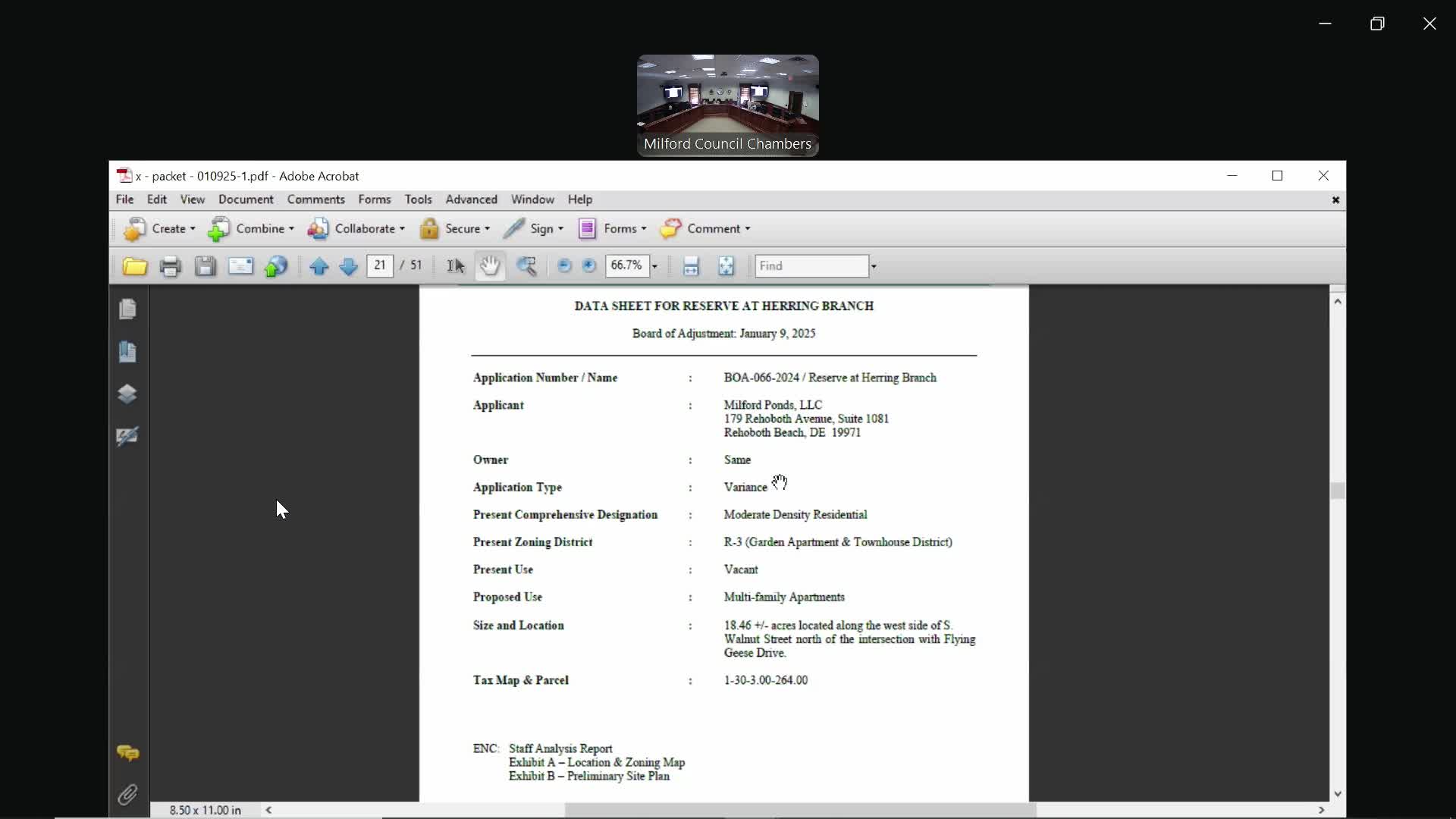
The Board of Adjustment granted two variances for the proposed 264-unit Reserve at Herring Branch development that reduce parking requirements to two spaces per unit and allow a single centrally located trash compactor rather than multiple enclosures within 300 feet of every building.
The Milford Board of Adjustment voted to grant two variances for the Reserve at Herring Branch, a proposed multi-family development adjacent to the Milford Ponds site. The board approved a reduction of the zoning code’s required parking from 2.5 spaces per dwelling unit to 2 spaces per unit and also approved a variance to allow a single centrally located trash compactor rather than multiple trash enclosures within 300 feet of each building.
Tim Metzner, an associate and senior landscape architect with Davis Bonafordell, presented the application on behalf of the developer and said the proposed project would include 264 units. Metzner and developer representative Sean D'Ignazio said market studies and the developer’s experience show multifamily properties typically need fewer than 2.5 spaces per unit—somewhere near 1.8—and that requiring the full 2.5 would add about 88 parking spaces to this site, equal to roughly 14,256 square feet (about one-third of an acre) of additional impervious surface. Metzner said that extra pavement would reduce on-site open space and recreational area and increase stormwater-management needs.
Metzner also explained the developer’s experience using a single, centralized trash compactor at other communities and said that approach reduces scattered litter and truck traffic. He said residents may opt into an on-site valet trash service for additional convenience; that option is an amenity and may carry a nominal charge or be part of the rent depending on the lease structure. Staff noted the state requires multifamily recycling and that the project’s private hauler arrangements would need to accommodate recycling requirements.
Board members asked about distances residents would need to walk to reach the compactor, ADA access and whether valet service would be available and at what cost. Metzner and D'Ignazio said the furthest apartments would be separated by a pond and that the longest walk would be roughly 1,000 feet along internal paths; they described ADA ramps and maintenance/valet options for residents with mobility needs. Board members also discussed previous city approvals: the parcel had been part of the original Milford Ponds PUD, and City Council had previously allowed a reduction to two spaces per unit when the site was considered within a PUD.
The board’s votes: Variance 1 (parking reduction to 2 spaces per unit) passed unanimously on recorded votes by Ron Rizzo (yes), Mr. Riley (yes), Ron Mascola (yes), Andrea White (yes) and Michael Warfel (yes). Variance 2 (single centralized trash compactor in lieu of enclosures within 300 feet) passed by a majority; Ron Mascola voted to disapprove, citing concerns that centralized compactor service would push residents to transport trash by vehicle and create a nuisance. Recorded votes for variance 2 were Ron Rizzo (yes), Mr. Riley (yes), Ron Mascola (no), Andrea White (yes) and Michael Warfel (yes), producing a 4–1 approval.
Why it matters: the variances alter the site layout and reduce impervious surface while changing how residents will deliver refuse, both of which affect circulation, maintenance, and stormwater planning for the 264-unit development. Staff and the applicant will incorporate the board’s determinations into the site-plan review and any conditions required for final approvals.
Authorities cited in the staff presentation included Milford City Code chapter 230-21B (parking for multifamily units) and chapter 230-20P (requirements for trash enclosures). Metzner emphasized the application was seeking the minimum variance necessary and argued the changes would improve recreational area and cleanliness on site. Concerns from board members focused on resident access to the compactor, ADA accommodations, recycling logistics, and the potential for increased vehicle trips to transport trash.