Get Full Government Meeting Transcripts, Videos, & Alerts Forever!
Get email alerts on the Planning And Zoning topic
No spam. Unsubscribe anytime.
Community Planning and Development outlines 2025 work plan, regulatory overhauls and code changes
Summary
Community Planning and Development (CPD) presented its 2025 work plan to the Budget and Policy Committee, describing major planning projects, a diagnostic review of the Denver Zoning Code, proposed building-code amendments and a Proposition 123 fast-track process for affordable housing.
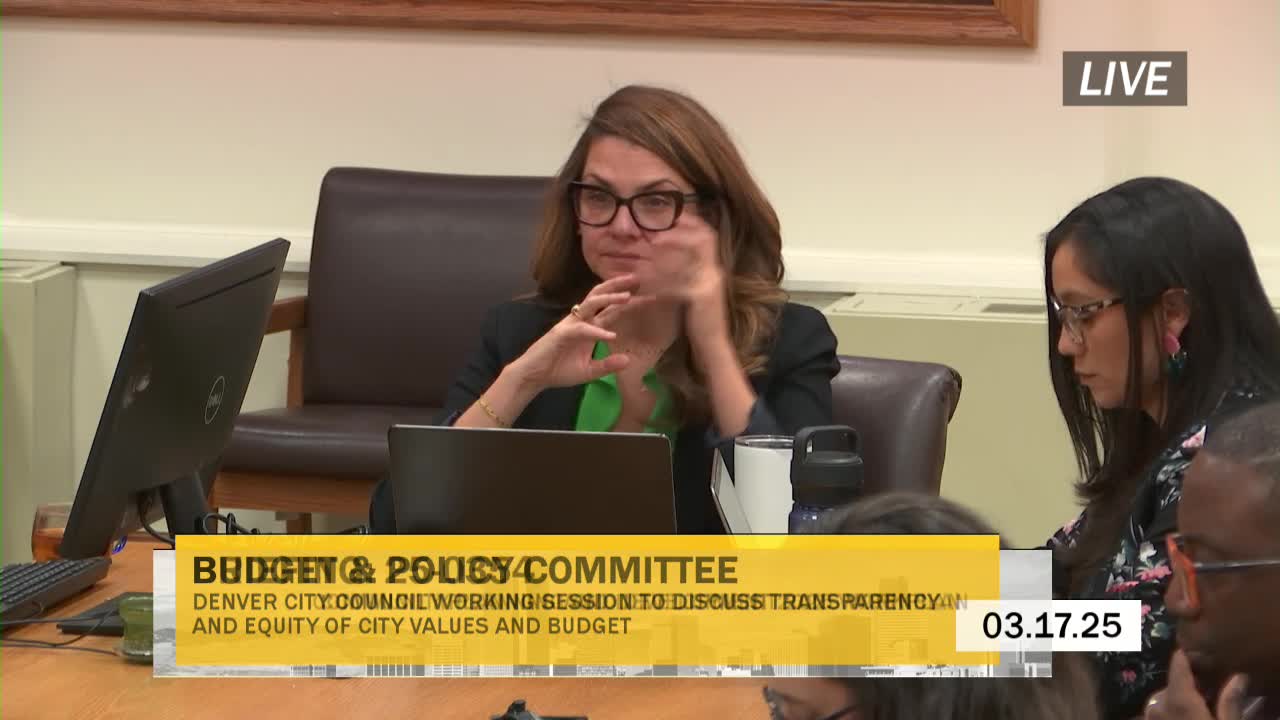
Community Planning and Development Executive Director Manish Kumar told the Budget and Policy Committee on March 17 that CPD will focus in 2025 on regulatory overhaul, plan implementation and improving permitting and customer service.
The presentation listed major projects coming to council this year — a downtown area plan geared toward post-COVID recovery, Southwest and Far Southwest neighborhood plans, a Burnham Yard planning effort and regulatory initiatives including removal of parking minimums and a citywide effort to allow “gentle density” in single-unit neighborhoods. CPD also described a diagnostic review of the Denver Zoning Code and draft 2025 Building and Fire Code amendments.
The work plan matters because it sets the department’s priorities and identifies the proposals and code changes that will come before council this year. Kumar said the department’s overall budget is $42,300,000 and outlined permitting workload from 2024 — 213,000 building inspections, 48,000 CNIS inspections and about 75,000 permits with a valuation near $3.5 billion — as context for the work plan.
“Today we’ll talk about the work plan for 2025 in community planning and development,” Kumar said at the start of the presentation. Staff framed three internal goals: reorganizing operations to reduce bottlenecks and clarify permitting and plan-review responsibilities, streamlining workflows with sister agencies (DOTI, Parks, Fire) and expanding in-person and online customer services.
Sarah Showalter, director of planning services, described the downtown area plan as “our opportunity to think about downtown post COVID” and said staff expect to bring a draft plan for adoption to council by late summer or early fall. Sherisha Walter, a CPD staff member who led the project overview, said the department is developing large ideas and community engagement windows this spring.
Among large regulatory projects, staff described a bill to remove parking minimums from the Denver Zoning Code and a multi-year “gentle density” initiative to allow two-plus units in areas currently zoned for single units. Sherisha Walter said the gentle-density effort will include advisory committee recruitment this summer and will likely extend into 2026 with adoption targeted for 2027.
Deputy Director Jill Jennings Golic reviewed code and process work. She said the draft 2025 Denver Building and Fire Code amendments were released Feb. 18 and will undergo at least a 60-day external review before proposed amendments are returned to council for late-stage legislative review this summer. “A big goal of this effort, in addition to moving to the 2024 series of international codes, is achieving a 30% reduction in our local amendments,” Jennings Golic said.
CPD also described a diagnostic assessment of the Denver Zoning Code to identify conflicts with other regulations, make the code easier to use and set a foundation for a larger code revision effort in 2026 and beyond.
On state-level compliance and affordable housing, Jennings Golic summarized work to prepare for the state’s Proposition 123 requirements: Denver opted into the program in mid-2023 and must develop a 90-day fast-track review process for qualifying affordable-housing projects by the fall 2026 renewal. She told the committee CPD and partner departments are working with a consultant to design a new development-review sequence and plan a May 2025 finalization and a fall pilot.
Council members pressed staff on staffing and permits. Council Member Fund asked whether CPD’s staffing level — reported as 317 positions with 16 held for vacancy savings — matches authorized positions and ability to deliver the work plan. Kumar said CPD has been reorganizing and will hire strategically where there is an identified operational need. Council Member Alvidrez described repeated construction delays where inspections introduce unanticipated requirements; staff recommended better plan-review/inspection coordination and follow-up on specific projects.
Staff also identified federal grant funding connected to projects: a Federal Transit Administration grant for transit-oriented development along the Federal Boulevard corridor, a HUD “pro-housing” award reported as $4,500,000 for removing barriers to affordable housing, and a Department of Energy buildings grant described as up to $7,000,000 to improve energy-code compliance and reduce building emissions. Staff said Department of Finance guidance is being followed as federal funding guidance evolves.
No formal votes were taken during the presentation; the session moved to a separate participatory- budgeting briefing after CPD concluded.
Ending: CPD asked council members for continued partnership as many projects proceed to public engagement and future adoption; staff said they will return with legislative items and additional briefings as drafts are ready for council review.