Get Full Government Meeting Transcripts, Videos, & Alerts Forever!
Get email alerts on the Capital Investment topic
No spam. Unsubscribe anytime.
City presents draft 2025–2029 capital improvement plan; Lake Avenue Bridge flagged for possible bonding
Summary
City director of capital projects outlined a five-year capital plan with roughly $44 million in project requests, strong emphasis on transportation and vehicle replacement, and staff recommendation to use a bond ordinance only for Lake Avenue Bridge if outside funding is unavailable.
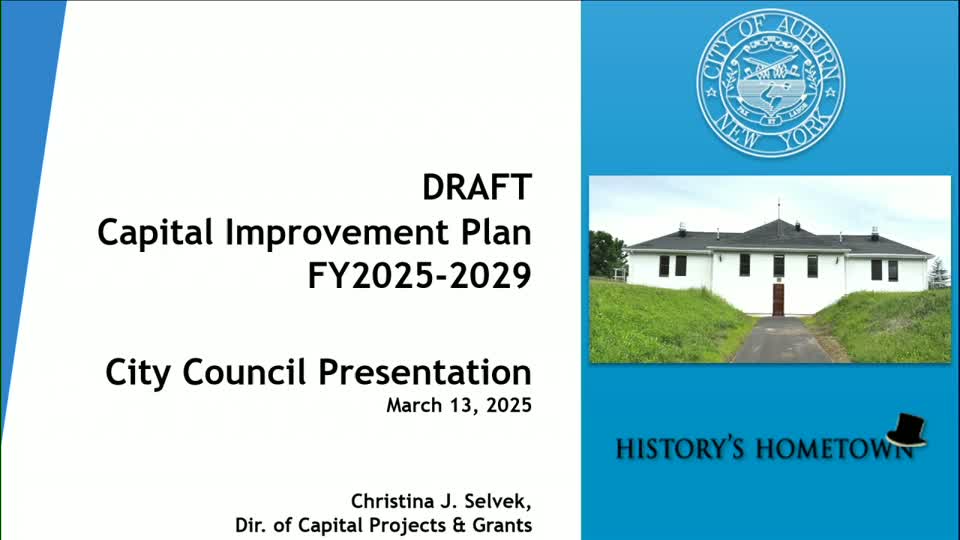
Christina Selvick, the city’s director of capital projects and grants, presented the draft fiscal year 2025–2029 Capital Improvement Plan to the Auburn City Council, describing the plan’s purpose, funding sources and a project list that staff said totals tens of millions of dollars over five years.
"I'm the city's director of capital projects and grants," Christina Selvick said in introduction. She told the council the plan follows guidance from the New York State Office of the State Comptroller, begins with a department-level needs assessment and prioritizes capital expenditures generally above $35,000. Funding mechanisms include bond borrowing, grant funding (federal, state and private), operating funds, lease-purchase agreements and donations.
Selvick said staff received nearly $9.5 million in general fund project requests and reported 31 active projects in the city financial system. She summarized recent project closeouts (parking garage elevator upgrades, Casey Park skate park, zebra mussel control closeout and ARPA-sponsored tree planting) and highlighted a substantial sewer/biosolids project that ballooned in cost during construction; that project was later funded through state intended-use funding and other measures, she said.
Staff asked the council to consider issuing a single bond ordinance — principally to address a funding gap for the Lake Avenue Bridge — because state and federal grant programs staff contacted indicated no additional bridge funding was likely. Selvick said other capital needs such as police facility repairs, fire apparatus replacement and vehicle lease-purchase requests remain part of the plan. She also noted roughly $44 million in total requests across funds for the coming years and that staff will continue to seek grants and other revenue sources and to minimize new general-fund borrowing where possible.
Councilors asked about qualifying for climate- and energy-related grants to address building issues (police and ambulance facilities) and about timeline and funding for lead service line work and water intake planning. Selvick said water fund activity includes lead service-line inspections and that engineering for raw water-line replacement will be necessary to become eligible for certain state funding programs. On the sewer side, she described interest in a citywide inflow and infiltration study to better prioritize separation and meter locations.
Selvick also outlined debt service trends: the city took advantage of low interest rates in 2020–21, then curtailed general-fund borrowing as rates rose; a large wastewater construction budget increased from about $36 million to $84 million, she said, and state help reduced the city's bond exposure by transferring much of that debt to the State. Staff said they are targeting a reduction in outstanding issuance ahead of a planned August 2025 target where lower debt levels would create savings.
Next steps: council will review the draft plan, staff will return with further funding and ordinance recommendations where needed, and staff said they would pursue grants and lease-purchase options for vehicles and equipment.