Get Full Government Meeting Transcripts, Videos, & Alerts Forever!
Get email alerts on the Transportation Roads topic
No spam. Unsubscribe anytime.
Auburn presents 2025 road program focusing on quadrant resurfacing, microsurfacing and targeted repairs
Summary
City engineering presented the draft 2025 road improvement program, proposing quadrant-based resurfacing with $800,000 targeted to failed streets in the southwest quadrant and continuing citywide microsurfacing and crack sealing.
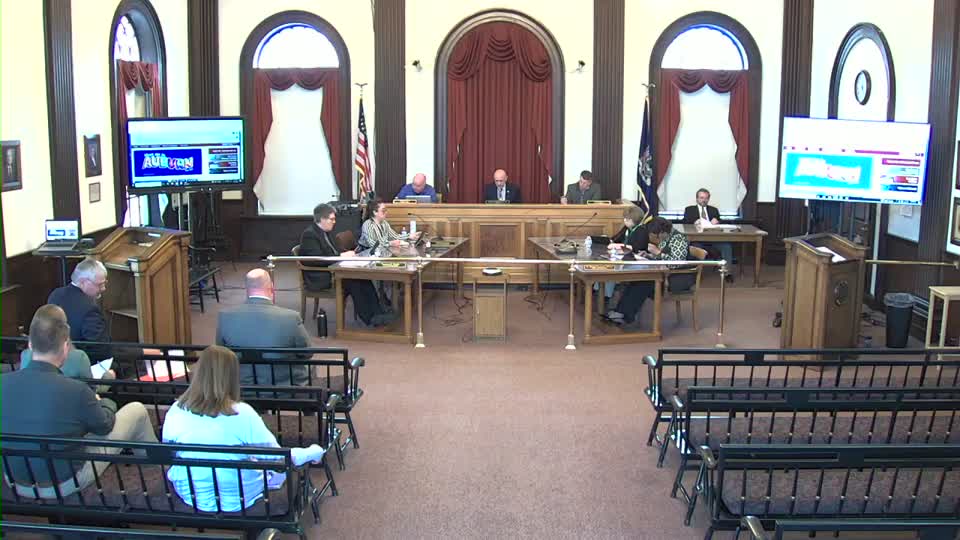
City engineering staff presented the draft 2025 Road Improvement Program to the Auburn City Council, proposing a quadrant-based paving plan that would prioritize resurfacing failed streets in the southwest quadrant while continuing citywide microsurfacing and crack sealing.
"My name is George Wethy. I thank you for the opportunity to present the 02/2025 Road Improvement Program," said George Wethy of the city's engineering department. "Our goals our goals of the program are to, repair and maintain the streets of Auburn to a good and fair condition while utilizing available funding in a responsible and efficient manner." He told council members the program mixes preventive maintenance (crack sealing and microsurfacing) with repair techniques (milling and paving).
The presentation included a nine-year condition map showing roughly 45% of streets in good condition, 45% fair, 4% poor and 6% failed. Wethy said the city rates roads by driving them and prioritizes work based on condition and available funding. He identified a proposed 2025 allocation of about $1,160,000 for the road program: $800,000 for resurfacing (sufficient, he said, to resurface the failed streets in the southwest quadrant), $168,000 for sidewalks, and $200,000 for microsurfacing and crack sealing. Staff also proposed engineering funds for the Burgess Street culvert and some DPW equipment.
The presentation listed candidate streets for resurfacing including Milligan Street, two sections of Clymer Street, Chanel Place, Hardenberg Avenue, Wood Street and Columbus Street between the arterial and the railroad tracks. Wethy said the city will explore pavement-supported water valve boxes this year, similar to pavement-supported manholes, and noted several related projects on the books including the Burgess Street culvert (planned for construction), Aurelius Avenue bridge replacement and a Bridge NY culvert project on Brookside Drive.
Council members asked detailed questions about responsibility for arterial roads, pothole repairs and use of state reimbursement programs. Wethy said the arterial and North Street are state roads (the city maintains the wearing surface under an agreement) while Lake Avenue is a city road. He told Councilor Clark the city receives a longstanding reimbursement rate for state arterial maintenance that has not increased in decades.
Councilor Coney pressed whether the city should broaden repairs beyond one quadrant given an unusually severe freeze–thaw cycle this winter. Wethy said DPW has newer equipment (mini mill, skid steer, hot box) and that some deeper milled patches and overlays could be done, but that many such repairs do not qualify for CHIPS (Consolidated Local Street and Highway Improvement Program) reimbursement because they are considered maintenance rather than capital improvements.
On funding and planning, Wethy and city staff described a conservative rollover strategy: about $2,000,000 earmarked to carry obligations into 2026, with roughly $1 million per year potentially reserved for the Lake Avenue bridge work. The council heard that state touring-route and CHIPS allocations remain uncertain until the governor’s budget and legislative actions are finalized; staff said if a proposed increase to state touring-route funding passes, the city would bring options to council on where to spend additional funds.
Questions and answers also covered contractor performance and the tradeoffs between microsurfacing and thicker overlays. Wethy said microsurfacing provides protection but loses flexibility in cold weather and can crack; without it, he said, "I would hate to see what things look like without the microsurfacing." He also said the city has seen savings by contracting ADA ramps and sidewalks separately and by value engineering State Street improvements (striping and lane changes rather than moving curbs).
Next steps: staff said they plan a second transportation presentation after state budget allocations are clearer, likely in mid-April, and that final award of the 2025 road program would follow that discussion.
Votes at a glance from the meeting: council approved the March 6 meeting minutes (sponsor Councillor Kent, second Councilor Cuddy) by roll call and confirmed Appointment Resolution 31 (appointing Courtney Hennigan to the Auburn Industrial Development Authority) by roll call.