Get Full Government Meeting Transcripts, Videos, & Alerts Forever!
Get email alerts on the Equity And Justice Plan topic
No spam. Unsubscribe anytime.
WSBA Board holds first reading of Equity and Justice Plan; committee seeks measurable implementation
Summary
The Washington State Bar Association Board of Governors received a first reading of a draft Equity and Justice Plan from the DEI Council, which frames three goals and a five-year implementation horizon and asks the board and membership for feedback before a second reading.
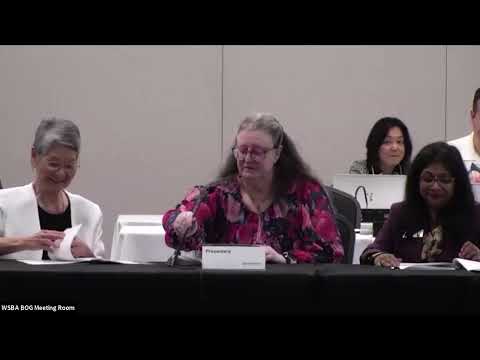
The Washington State Bar Association Board of Governors on a virtual meeting conducted a first reading of a draft Equity and Justice Plan presented by the DEI Council, outlining three goals, a five‑year framework for implementation and a process for collecting further feedback.
Francis Adewale, president‑elect (acting chair for the item), said the draft is the product of two years of work and urged board members to read it closely. “This plan is a plan that is like no other in the nation at this particular moment,” Adewale said.
Sharon Sakamoto, co‑chair of the Equity and Justice Plan Committee, reviewed the drafting process and outreach. Sakamoto said the committee relied on a 2024 membership demographic study and on focus groups and noted the committee “ultimately heard from over 80 people through that effort,” encompassing outreach to affinity bar associations and statewide surveys. She described the draft as intentionally concise and said the committee expects to refine specific language before a second reading.
Miriam Gordon, the committee’s other co‑chair, and Reyna Wagner, a DEI Council presenter, said the draft sets three high‑level goals: strengthen the legal profession by building community and belonging; advance a fair, inclusive, effective and accessible legal system; and deepen the Bar’s leadership commitments to inclusion. Gordon said the plan is intended to be a “living document” and that the committee expects to convert itself into an implementation committee if the board adopts the framework.
Board members pressed for measurable steps and clearer implementation detail. Governor Villeneuve asked for concrete action items in the second reading: “I would really love to see 10 action items,” she said, arguing that the draft currently reads more like a mission statement than an operational plan. Several governors urged more frequent measurement than the demographic‑study cadence set out in the 2013 plan; the 2013 plan had committed to a demographic study every 10 years, while presenters said the most recent study began in 2023 and was completed in 2024 by KGR and C, an independent research consultant.
Chief Singleton, a staff member on the equity team cited by presenters as instrumental to the effort, said measurement and accountability will be central to implementation and that the committee will look to established frameworks and to local variations in implementation across Washington’s diverse communities.
Several former and current governors emphasized that adoption would make the draft the organization’s plan rather than the DEI Council’s plan. Governor Nam Nguyen said, “Once this board adopts the plan, this is the plan for the organization,” and asked communications staff to ensure the message reaches the full membership.
Speakers also discussed the plan’s relationship to access‑to‑justice work. Board members asked whether language in the draft implied support for specific programs (some members referenced historical programs discussed previously in the Bar), and presenters repeatedly said the draft does not mandate revival of any specific program; rather, it identifies alternative delivery methods as examples for expanding access to justice.
No formal vote or motion was taken at the first reading. Presenters asked board members and members of the public to send written feedback; an email address for the Equity and Justice team was offered in the Zoom chat. The DEI Council indicated it plans continued outreach, to develop implementation strategies and to provide periodic reports to the Board of Governors if the plan is adopted.
The board opened the floor for additional comments and indicated a second reading and potential approval are expected in a subsequent meeting. Presenters and governors asked for clearer preamble/context in the document to show continuity with the 2013 plan and the demographic work that informed the draft.
Ending: The board closed the first‑reading discussion by inviting written feedback and reaffirming that the draft will be revised ahead of a second reading; no adoption or formal action occurred at this meeting.