Get Full Government Meeting Transcripts, Videos, & Alerts Forever!
Get email alerts on the Budget License Fees topic
No spam. Unsubscribe anytime.
Bar leaders propose formal license‑fee philosophy, plan member outreach ahead of 2027 rates
Summary
Washington State Bar Association leaders on Wednesday presented a draft “license‑fee philosophy” to guide annual license‑fee recommendations and a communications plan intended to prepare members for modest, predictable increases.
Washington State Bar Association leaders on Wednesday presented a draft “license‑fee philosophy” to guide annual license‑fee recommendations and a communications plan intended to prepare members for modest, predictable increases.
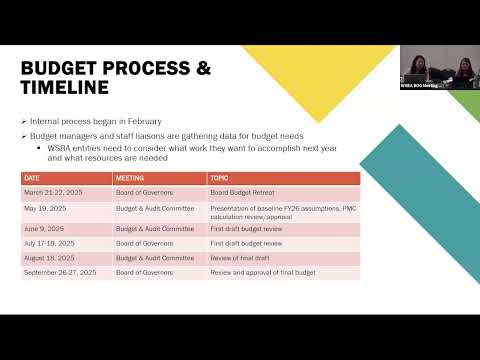
The presentation, led by Treasurer Kari Petrasic, Finance Director Tiffany Lynch and Chief Communications Officer Sarah Nagowsky, described a proposed approach that starts fee calculations with a cost‑of‑living adjustment (COLA) benchmark, then adjusts the figure up or down using membership trends, program needs and available reserves. The board’s Budget Audit Committee drafted the proposal and will seek member feedback this spring before the board considers final action in September.
Why it matters: license fees supply three‑quarters of the association’s general‑fund revenue and directly fund regulatory work, member services and programs the association says are required or expected by the Washington Supreme Court. Leaders said a transparent philosophy would let governors, staff and members understand why modest, periodic increases may be necessary rather than allowing a long period of flat fees followed by a large single‑year jump.
Lynch told governors the association “practices fund accounting. The general fund is our largest with the majority of our staff. Our budget is a total of a hundred and 47.5 FTEs,” and that about 36.5 of those FTEs are funded from the general fund. Lynch said the association budgets conservatively but typically outperforms budgeted revenues; the organization had a net income of about $200,000 in the general fund in the most recent year, largely because of a one‑time reallocation from a facilities reserve.
Under the approach presented, the committee would use an industry marker as the starting point for the annual fee calculation. The committee recommended using Washington State L&I’s COLA as that marker, because “COLA is more closely tied to the cost of labor, which … more than 80% of [the association’s] budget is staffing costs,” Lynch said. She added the committee considered other markers but favored a single, clearly dated benchmark so the association can communicate a concrete starting point to members.
Several governors questioned which inflation or wage marker the association should use. Governor Todd Bloom asked whether the Bureau of Labor Statistics (BLS) series could be used instead; Lynch said the committee discussed alternatives and chose the state L&I COLA but remained open to other options. Governor Tom Bloom and others noted the historic divergence between the COLA and regional CPI measures shown in the materials, and cautioned that different starting points produce different long‑run results.
The packet of materials included a worked example from the 2026 process: the committee began with a $458 base, applied a 5.9% COLA (about $27), and proposed using $17 per active member from reserves to offset part of the increase, producing a net $10 increase for members in the example presented. Lynch emphasized that reserves are a planned, limited tool to smooth changes rather than a permanent subsidy.
Governors pressed staff on member messaging and tactics. Chief Communications Officer Sarah Nagowsky said the association has prepared a multilayered outreach plan — including a one‑page member summary, Bar News coverage and targeted presentations to county bars and sections — and stressed that governors serve as personal messengers to members in their regions. “We have been super careful stewards. We have done everything we can, and we've kind of masked this philosophy that we've been using, and we want to make it real overt,” Nagowsky said.
Several governors recommended adding materials that say plainly “what’s in it for me.” Governor Mary Rathbone said, “members want to know that their bar dues are benefiting them,” and urged a short resource list of member services to hand governors during outreach. Director of Advancement Kevin Placci highlighted member benefits that can be framed as direct value: “the free CLEs that we offer, if they take advantage of them, will cover their CLE requirements,” and he said thousands of solos and small‑firm attorneys use the association’s legal research tool and wellness services.
Regulatory staff also briefed governors on how fee revenue supports regulatory functions. Chief Disciplinary Counsel Doug Ende said those functions are performed for the Washington Supreme Court and argued that maintaining robust disciplinary capacity protects the value of every license: “we enhance the value of every lawyer’s license when we ensure that practitioners who are stealing client money … are disciplined or removed from the profession,” he said.
Governors raised tactical and political concerns. Some asked for comparative data on fees in other states; staff cautioned that cross‑state comparisons are often “apples to oranges” because different bars include different services and membership sizes. Others warned against wording that could be interpreted as an automatic annual increase; Governor Nancy Hawkins said the draft language implying guaranteed annual increases would alarm members and recommended revising phrasing so increases are presented as a likely outcome when costs rise, not an unconditional promise.
Next steps: staff said the first budget draft will be shared with the full board in July and a final budget recommendation will come to the September meeting. The Budget Audit Committee will take member feedback at its June 9 meeting; staff encouraged governors to bring the one‑page summary and solicit input from county bars and sections before then.
The discussion closed with an invitation for governors to send feedback to staff and attend the next Budget Audit Committee meeting on April 14 to help refine the proposal.