Governors raise implementation concerns about proposed indigent defense standards
Summary
Board members warned the proposed indigent defense rules now before the state Supreme Court could strain small counties and urged the Bar to form a committee to craft implementation guidance and solutions.
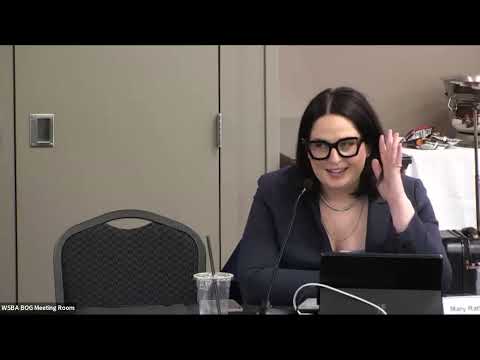
During the Board of Governors’ roundtable, Governor Rathbone warned that proposed indigent defense standards submitted to the state Supreme Court could have significant operational impacts on smaller counties and urged the Bar to develop implementation guidance.
"I am not against the indigent defense standards as they're proposed," Governor Rathbone said. "Where I am having some significant conflicts with myself is when we start getting into the details of the plan ... there are some holes in the application of the rules, if they're adopted, that have significant impact on counties like mine." She said Grant County would need about 16 lawyers to meet the proposed case limits, while it currently relies on nine to ten contract counsel to handle misdemeanor cases.
Rathbone said some private contract counsel have expressed concern about certification and case assignment under the proposed rules, and that counties may lose contract attorneys if certification or case limits make practice impractical. "If we lose those private contract counsel, there goes our whole department," she said. She urged the board to provide tools and answers to counties and public defenders rather than leaving implementation questions unresolved.
The chair responded that, with the matter now before the Supreme Court, the Bar will need to help with implementation and suggested forming an implementation or steering committee. "Maybe we could form an implementation committee or steering committee or something," the chair said; the chair then proposed Mary as a potential head for that effort. Governor Rathbone said she did not oppose reform but emphasized the need for concrete solutions and timelines to address staffing, certification and ethical concerns.
No formal motion, vote or committee charter was adopted during the meeting; the suggestion to form a committee was put forward for future consideration. The board then went into an executive session announced by the chair to receive legal advice. The chair said the executive session was permitted by WISPA bylaw Article 7.7(a)(4) and scheduled the session for 20 minutes.
AI generated
The text on this page is AI generated. Summaries, highlights, analysis, and video transcripts are all produced from the original source material.
AI can make mistakes, so if you spot one, and we will fix it for everyone.
Note: the source content is unaltered by us. Any content source we link to, be it a video, an audio recording, or a document, is presented exactly as its publisher released it. That publisher is usually a government body, sometimes an individual official or another organisation.