Get Full Government Meeting Transcripts, Videos, & Alerts Forever!
Get email alerts on the Economic Development topic
No spam. Unsubscribe anytime.
Akron committee prioritizes business retention in economic development budget review
Summary
The Budget & Finance Committee heard presentations on business-retention efforts, a $500,000 BRE grant line, support for the polymer cluster and neighborhood business programs, and contracts for local business partners; staff emphasized relationship-building over broad incentive packages.
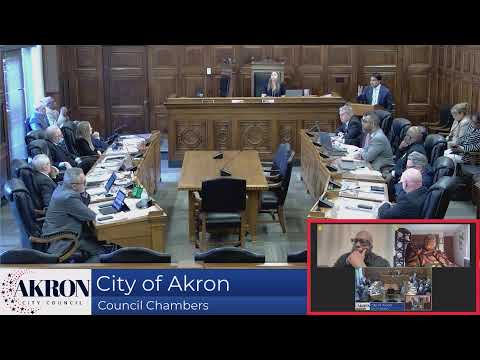
The Akron City Council Budget & Finance Committee on Monday reviewed the economic development portion of the city budget, with staff and council members emphasizing business retention, targeted grants and relationship-driven support for local firms.
Committee members were told the city has kept a $500,000 allocation on the capital side for business-retention and expansion (BRE) grants that appears on page 203 of the budget manual and that the city will prioritize outreach to top employers, scale-ups, mid-market firms and minority- and women-owned businesses. An economic development staff member said the city and partner organizations also aim to reach businesses outside downtown and the Great Streets geographies.
Why it matters: Committee members said retaining existing employers and strengthening neighborhood businesses will have more sustained impact than competing on large incentive packages. Council members pressed staff for detail about recent results and how the city will use staff capacity to sustain outreach.
Economic development staff told the committee that the city and its partners logged several hundred retention and expansion visits last year through the Elevate Greater Akron program and related outreach. The staff member said those visits “yielded over $13,000,000 of investment from those businesses and $24,000,000 in increased payroll.” The staff member added that grants are useful but “do not necessarily build a stronger business practice,” and described connecting owners to technical assistance, finance partners and nonprofit resources as the core of the BRE role.
Council President Margot Somerville asked what the city had accomplished in the past year; staff highlighted revitalization and facade grants under the Great Streets program and the Elevate portfolio’s focus areas, including the polymer industry cluster. The city is also budgeting an amount council authorized to support the polymer cluster and the university Polsky project over the next three years, staff said; the transcript did not specify the authorized total.
Staff said the BRE manager position (previously held by Brad Becker) is being refilled and that councilors should meet the new hire soon. Latanda Olatangi, Great Streets administrator, told council members that neighborhood business owners’ most common needs are training, technology access and soft skills: “we are finding that the challenges that some of our micro enterprise business owners are facing are professional development, technology, and soft skills.”
Committee members asked about incentive strategies. Staff described a cautious approach to tax grants, saying such incentives can trigger “anti‑poaching” or job‑preservation provisions with neighboring jurisdictions (referred to in discussion as agreements with Summit County communities). Staff said tax grants are possible in areas not covered by those agreements but should be used only when the city gains a clear net tax benefit.
Budgeted service contracts on page 203 increase to include a $125,000 pre‑K/childcare support item, ongoing support for the Black Chamber of Commerce, the downtown CDC and a multi‑year contribution to the Summit Medina Business Alliance (listed in the budget discussion as $75,000 this year). Staff also described funding for a site‑ready program and trade‑show participation for economic development employees.
Several council members requested more frequent reporting on outcomes, including quarterly updates on business visits, grants and vacancies in Great Streets districts. Staff said much of that data will be available on the city’s Great Streets pages on the city website.
Ending: The committee closed the economic development segment of the hearing and invited remaining questions to be sent to the chair and the administration prior to final passage of the budget.