Get Full Government Meeting Transcripts, Videos, & Alerts Forever!
Get email alerts on the Ai In Education topic
No spam. Unsubscribe anytime.
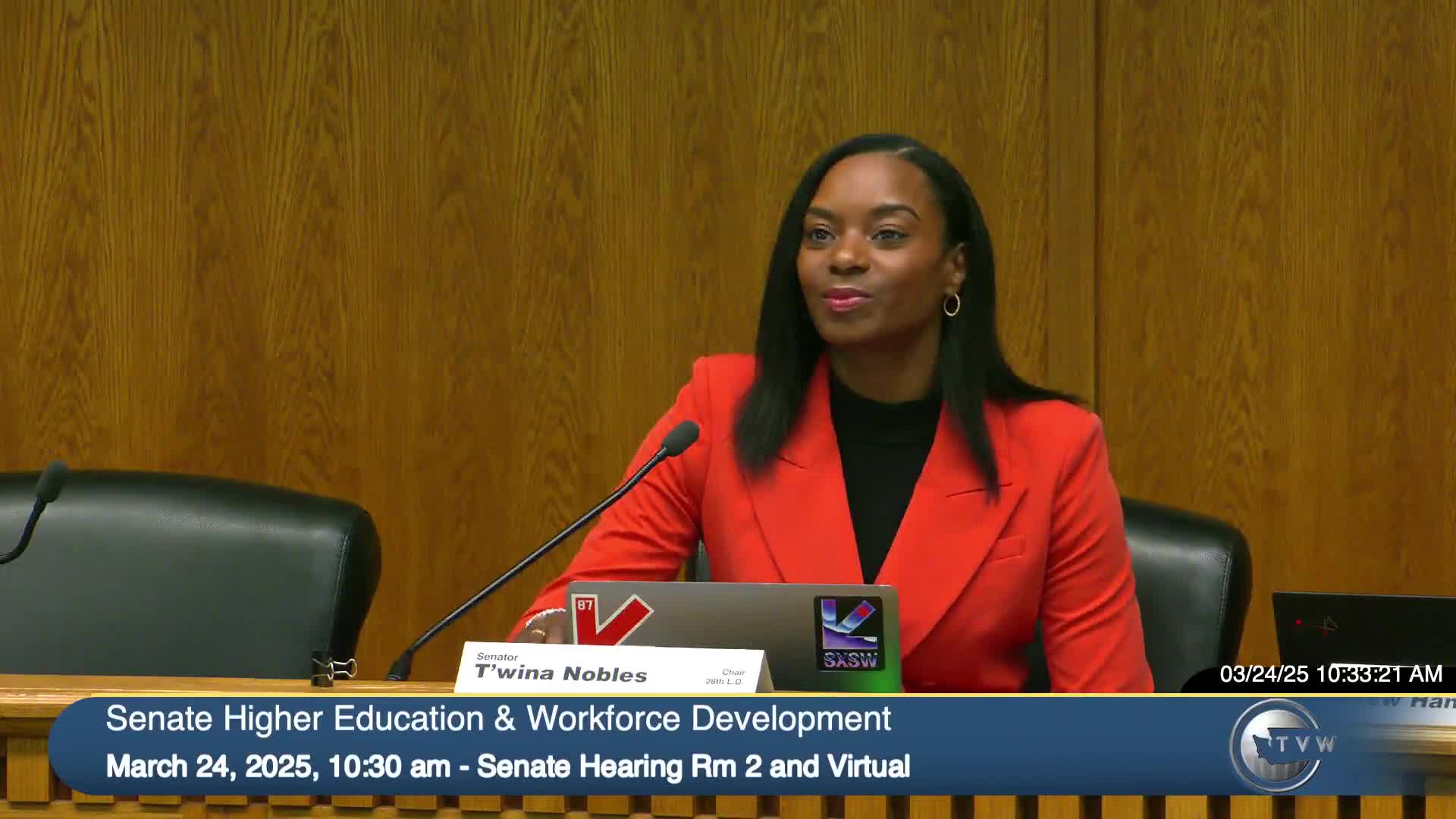
Senate committee hears AI task force briefing; higher-education leaders outline workforce priorities
Summary
The Senate Higher Education & Workforce Development Committee heard from the Washington State Attorney General’s AI Task Force and higher-education leaders on how to prepare students and workers for an AI-driven economy.
The Senate Higher Education & Workforce Development Committee heard from the Washington State Attorney General’s artificial intelligence task force and a panel of higher-education leaders about preparing students and workers for an AI-driven economy.
Samayo Hassan, policy analyst staffing the AGO’s Washington State Artificial Intelligence Task Force, told the committee the task force was created by Senate Bill 5838 and is producing a series of reports: a preliminary report released in December 2024, an interim report due December 2025 and a final report due July 2026. “The task force mandate requires us to examine the development and use of artificial intelligence by private and public sector entities and make recommendations to the legislature,” Hassan said, adding that the task force includes 19 members and eight subcommittees, including an Education and Workforce Subcommittee.
Why it matters: Committee members said the state’s AI leadership presents economic opportunity but also requires coordinated investment so Washington can retain research and workforce advantages. Panelists said investment should include professional development for faculty, reliable broadband for students, and expanded access to AI coursework beyond computer science.
University and college presenters stressed three recurring themes: (1) teach AI literacy across disciplines so students understand risks such as data privacy and bias; (2) emphasize competency- and skills-based credentials that employers can evaluate; and (3) invest in access (devices and broadband) and instructor support so underserved students benefit.
Magda Balazinska, professor and director of the Paul G. Allen School of Computer Science & Engineering at the University of Washington, described Washington as an “AI powerhouse” with strengths in industry and academia. Balazinska said UW offers broad AI-related coursework and research and highlighted pipeline concerns: “We need to really come together and strategize, have a comprehensive vision for Washington State, explore opportunities for partnership with industry, academia,” she said, urging attention to equity and retention of talent in the state.
From Eastern Washington University, Stu Steiner, director of the Cybersecurity Center, and Travis Massengill, professor in the Department of Design, described classroom approaches that teach students to use AI as an “augmented” tool rather than a shortcut. Massengill said his design courses teach layered prompting—starting with simple prompts, then structured prompts and finally having students create their own prompts—so AI becomes a learning aid rather than an answer machine.
Clover Park Technical College and Columbia Basin College described system-level efforts to scale faculty development and student exposure. Thomas Broxson of Clover Park said the college ran a summer institute that enrolled more than 400 participants and has embedded UNESCO’s AI competency framework into faculty training; Michael Lee, vice president for instruction at Columbia Basin College, said the college convened a work group to align academic-honesty policies with AI tools and is partnering with K–12 and industry advisory boards to keep curricula current.
Committee members asked about the pace of policymaking versus the pace of technological change. Hassan said the task force’s role is to gather perspectives from teachers, researchers and administrators to inform meaningful policy rather than rush to duplicate efforts. Balazinska and the panel urged the legislature to consider investments in infrastructure, educator professional development and partnerships with industry that would allow institutions to access shared AI infrastructure.
The discussion produced no formal committee action; presenters and staff were invited to continue discussions with senators and participate in follow-up tours and briefings.
Ending: Senators thanked presenters for the briefing and moved on to an executive session on pending bills and appointments.