Get Full Government Meeting Transcripts, Videos, & Alerts Forever!
Get email alerts on the Personnel Records Access topic
No spam. Unsubscribe anytime.
Committee weighs bill giving employees quicker access to personnel records
Summary
Substitute House Bill 13 08 would require employers to provide copies of personnel files within 21 calendar days and create a private cause of action for noncompliance. Advocates—particularly injured workers and labor organizations—supported adding enforcement; business groups urged administrative remedies instead of a private right of action.
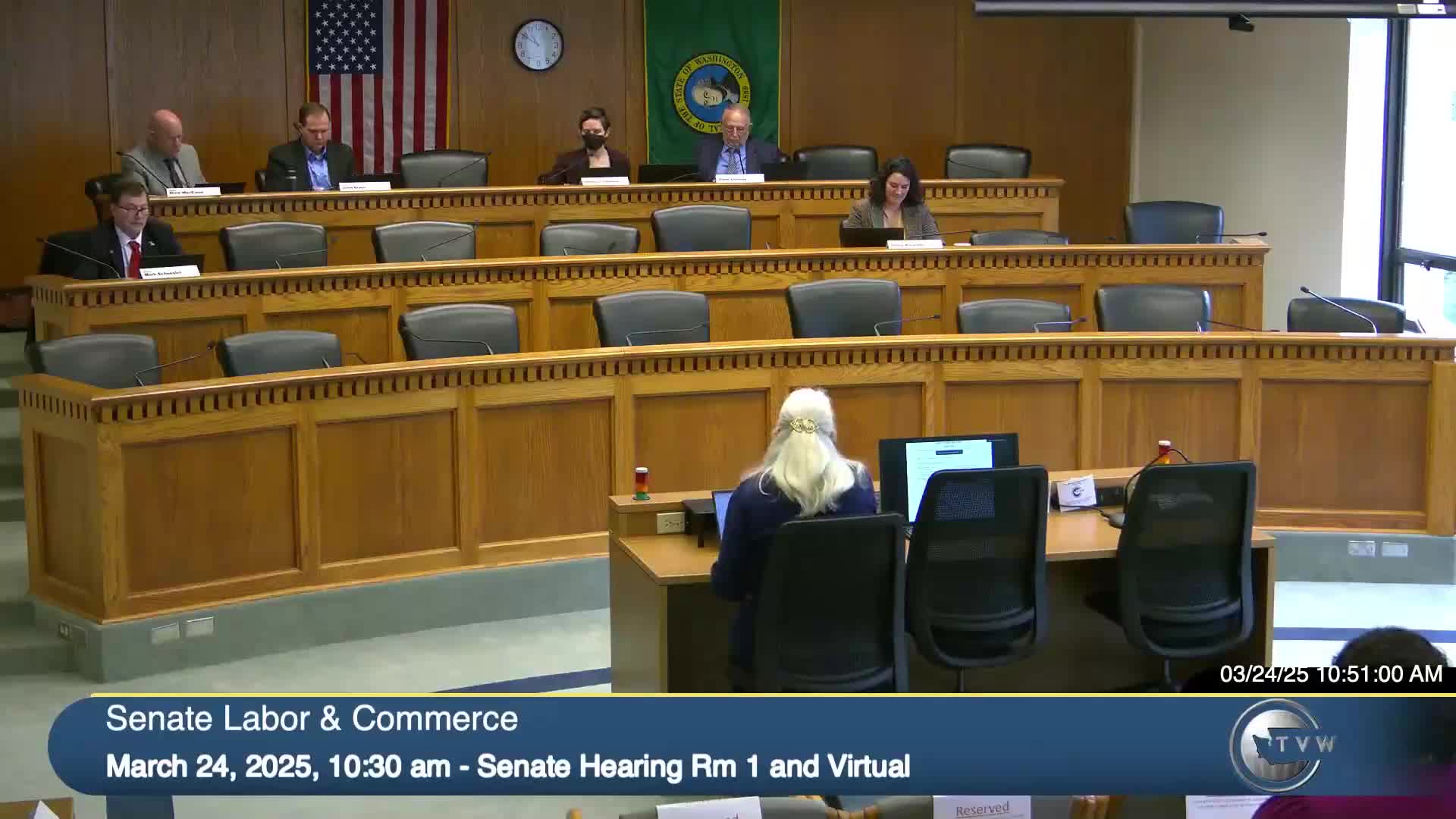
Substitute House Bill 13 08, concerning employee access to personnel records, was reported into the Senate Labor & Commerce Committee and drew extensive testimony from labor advocates, injured‑worker attorneys and business trade groups.
Committee staff Susan Jones summarized the bill, characterizing it as an amendment to the Industrial Welfare Act. Jones said the bill would require employers to allow inspection of personnel records within 21 calendar days after request, would require private employers to provide a no‑cost copy within that period, and—for private employers—would create a private cause of action with statutory damages between $250 and $1,000 and reasonable attorney’s fees for failure to comply. Staff also noted that the bill removes medical records from the personnel‑file list included in prior proposals and clarifies the list does not supersede federal or state privacy laws.
Representative Julia Reed, the bill’s prime sponsor, said the change “asks employers to follow the existing law” and provides a modest private enforcement mechanism intended to give workers recourse when employers ignore personnel‑file requests. Reed said the 21‑day window is a right to cure for private employers and that an additional five‑day notice requirement was included before a worker may file suit.
Proponents included injured‑worker practitioners who said current practice forces workers to litigate to obtain payroll and benefits records needed to calculate time‑loss benefits. Jane Dale of the Washington State Association for Justice said the bill would reduce litigation for injured workers because employers often ignore records requests and “workers currently have to hire an attorney, pay litigation costs, so we can compel these documents through subpoenas.” Jesse Wing of the Washington Employment Lawyers Association described the bill as “simple” and argued it “puts teeth into existing law” by addressing a pattern of employers ignoring personnel requests.
Business groups urged alternatives to a private tort claim. The Washington Food Industry Association and the National Federation of Independent Business (NFIB) recommended administrative remedies administered by an agency rather than a private right of action, citing small employers with minimal administrative capacity. Industry witnesses said the bill’s catchall “other records” language (section 1(g)) and a private enforcement mechanism risked increased litigation and compliance costs for small businesses.
Supporters, including unions and labor councils, said workers lack a practical enforcement route under current law. John Trainer of the Washington State Labor Council AFL‑CIO said enforcement is necessary because employers “simply refuse” to provide copies and that collective bargaining agreements only sometimes remedy the problem. Testimony reflected a broad split: labor and injured‑worker advocates uniformly supported the bill; most trade and small‑business groups opposed the private right of action and urged administrative enforcement or narrowed language.
The committee did not take final action during the hearing. Staff reported the bill’s House passage figure during the readin: “it passed House 50 six‑forty 1” (as read into the record). Several committee members asked staff and proponents for additional fiscal and implementation details.