Get Full Government Meeting Transcripts, Videos, & Alerts Forever!
Get email alerts on the Police Accountability topic
No spam. Unsubscribe anytime.
Residents and oversight advocates press council on Office of Professional Standards as patrolmen's contract is approved
Summary
Multiple public commenters criticized the Office of Professional Standards (OPS) and urged compliance with the consent decree; the council approved a collective bargaining agreement with the Cleveland Patrolmen's Association the same evening.
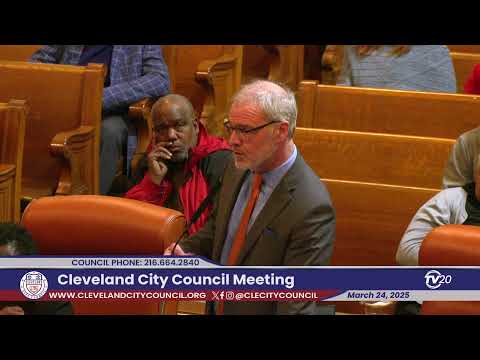
Several residents and oversight advocates used the public-comment period at the March 24 Cleveland City Council meeting to criticize the Office of Professional Standards and to object to fast-tracking a collective bargaining agreement they said could reduce accountability. The council approved the collective bargaining agreement with the Cleveland Patrolmen's Association (Ordinance 389-2025) that evening by placing the ordinance on final passage.
Andre Simmons, introduced as a resident from Ward 1, said the Office of Professional Standards (OPS) was failing complainants. "In my opinion, they are not only rude and unprofessional, they give off the impression, in my opinion, that either they're related, nepotism, or they have deep relationships because they can do whatever they wanna do," Simmons said during public comment. He described an assault allegation involving a police officer at a casino and said "the professional office standards is doing nothing." Simmons asked the council to provide him with legal help to pursue the matter.
Brenda Bickerstaff, identified as a Ward 9 resident, told the council it was wrong to rush a collective bargaining agreement through as an emergency ordinance and invoked the city's consent decree concerning police oversight. "You rushed it through, you're rushing it through, you wanna do an emergency ordinance, you cannot do that," she said, adding that citizens have a right to comment and that the collective bargaining agreement must align with the consent decree and the Cleveland Police Commission. Bickerstaff read aloud an excerpt from the consent decree (identified in the transcript as "section 359") describing how parties may petition the court for relief, including replacing the monitor.
Terry Wong, who identified herself as a former community police commissioner and who said she submitted formal taxpayer demand letters to the law director, raised appointment and compliance concerns and said OPS likely was not the proper investigator in the officer-by-officer matter raised by others. "OPS should not be investigating mister Racine because OPS does not investigate civilians," Wong said, adding she was concerned about appointment processes and the potential for retaliation in oversight roles.
The council's adoption of Ordinance 389-2025 approving the Cleveland Patrolmen's Association patrol officers' collective bargaining agreement occurred later in the evening as part of a package of emergency ordinances the council moved to final passage after a motion to suspend the rules. The transcript shows the vote on that ordinance passed (clerk recorded 15 ayes when the roll was called for the package).
Why it matters: Public commenters and oversight advocates said the city risks undermining civilian oversight and the consent decree's requirements if personnel agreements are advanced without clear alignment to accountability provisions. The collective bargaining agreement governs discipline and workplace terms for patrol officers, areas that intersect with oversight, discipline processes and public-safety outcomes.
What the record does not show: The transcript excerpt includes public comments and the ordinance adoption but does not include the full text of the collective bargaining agreement, the council's legal analysis of its compliance with the consent decree, or any staff memorandum explaining how the agreement aligns with oversight obligations. The transcript records citizens' allegations about specific incidents but does not provide documentary evidence in the meeting record; those claims remain subject to follow-up and verification.