Get Full Government Meeting Transcripts, Videos, & Alerts Forever!
Get email alerts on the Civics Education topic
No spam. Unsubscribe anytime.
Committee hears bill to add voter registration, media literacy and civic‑engagement training to high school civics course
Summary
Senate Bill 5,637 would require Washington’s stand‑alone high school civics course to include voter registration processes, media literacy and tools for civic engagement; the bill directs OSPI to post resources in collaboration with nonprofits by Sept. 1, 2025.
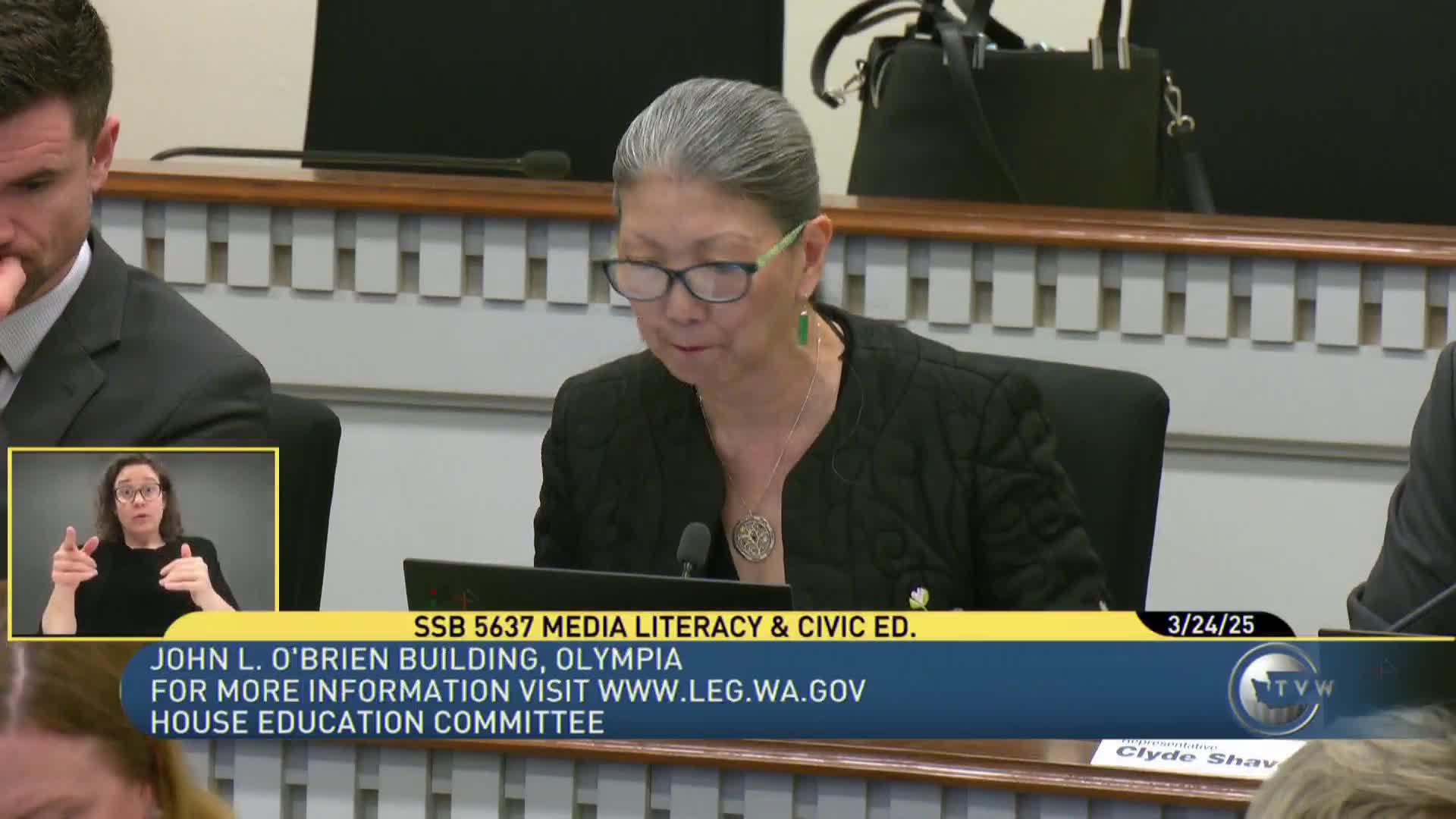
The House Education Committee heard testimony on Senate Bill 5,637, which would expand the required content of Washington’s stand‑alone high school civics course to include voter registration processes, media literacy (including critical engagement with online information and misinformation), tools and methods for initiating public policy change, and factors that influence political participation and representation.
Staff said OSPI must identify and post materials and resources on its website by Sept. 1, 2025, working with specified nonprofits and leveraging existing resources such as the Washington Open Educational Resource hub; OSPI would review the materials at least every five years.
The Washington Library Association, which testified before the committee, urged stronger support for school library and information programs to ensure districts have teacher‑librarians and infrastructure to deliver media‑literacy instruction. "A lot of our districts around the state are missing the school library information technology programs taught by teacher librarians that would be absolutely imperative to making sure that this can be done on a school‑wide basis," said Carolyn Logue of the association.
Several high‑school students also testified in favor of the bill. Kate Fogel, a senior at Lake Washington High School, said a stand‑alone civics class helped her learn to ‘‘discern truth from deceit’’ and argued that stronger civic education will encourage youth participation. Adi Hurvitz said media literacy equips students to identify bias and combat misinformation, citing social media misinformation about international events. Sabina Kolozynski, a member of the Washington Legislative Youth Advisory Council, said the bill helps young people learn how to engage with the legislature and reduce civic hopelessness.
Opponents raised concerns about potential bias in materials selected by OSPI and the use of nonprofits to create curricula; some warned that centrally curated lists of "reputable" media could skew classroom discussions. Committee members asked staff and witnesses about existing resources, model curricula and the role school librarians play in delivering media‑literacy instruction.
The committee recorded public sign‑ins and concluded the hearing on the bill; staff said a fiscal note is available in the committee packet.