Get Full Government Meeting Transcripts, Videos, & Alerts Forever!
Get email alerts on the Criminal Justice Firearms topic
No spam. Unsubscribe anytime.
Committee hears testimony on requiring one year of community custody for unlawful firearm possession
Summary
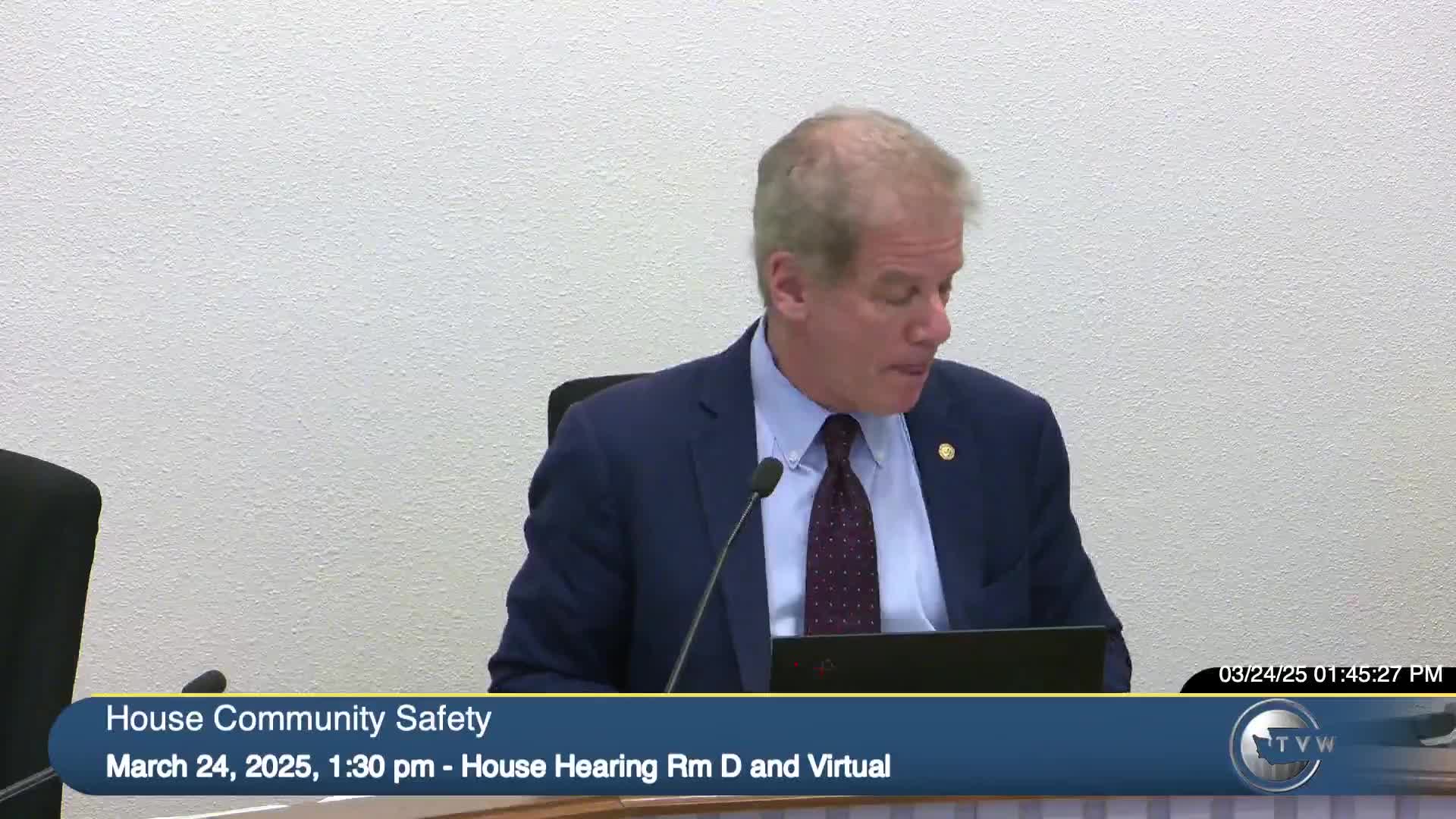
The House Committee on Community Safety held a public hearing March 24 on Engrossed Substitute Senate Bill 52 68, which would require courts to impose one year of community custody for people convicted of unlawful possession of a firearm regardless of whether they are criminal street gang members or associates.
The House Committee on Community Safety held a public hearing March 24 on Engrossed Substitute Senate Bill 52 68, which would require courts to impose one year of community custody for people convicted of unlawful possession of a firearm regardless of whether they are criminal street gang members or associates.
The bill’s sponsor, Senator Keith Wagoner, 39th Legislative District of Sedro‑Woolley, told the committee the measure is intended to “bridge that link between a felon who should not have or somebody who should not have a firearm in a future crime where we lose an officer or civilian or somebody gets hurt or killed with a firearm.” He said the bill stops short of reclassifying the offense as a violent crime but “has good utility and will help make our communities safer.”
Corey Patton, staff to the committee, summarized the bill for the record and noted it applies to unlawful possession in both the first and second degree. Patton explained that unlawful possession in the first degree applies when a person possesses a firearm after conviction of a serious offense; that offense is ranked at seriousness level 7. Possession in the second degree covers other circumstances (including possession by some persons under 18 or those free on bond) and is ranked at seriousness level 3.
James McMahon, policy director for the Association of Sheriffs and Police Chiefs, testified in support and said law enforcement sees a strong link between unlawful firearm possession and other violent or drug‑related crime. “We think that 12 months of community supervision is a good idea,” McMahon said, adding that the Department of Corrections (DOC) can tailor supervision intensity based on its assessment.
Anne Anderson, representing the Washington State Narcotics Investigators Association, said the association would have preferred classifying unlawful possession as a violent offense but supports the bill as written because it creates “some deterrent to unlawful possession of a firearm.” She said the provision could improve safety for officers and the public and that “anything we can do to deter this crime will improve community safety and the safety of officers.”
Several committee members asked about the cost implications of mandatory supervision. Representative Fosse noted the fiscal note appeared small and asked whether expanding mandatory community custody would increase supervision costs; staff deferred fiscal details to budget staff. Committee members also discussed whether a set 12‑month supervision period should apply uniformly or whether individual risk assessments should guide supervision intensity.
The public hearing concluded with the committee taking no executive action on the bill during the meeting. The chair said the committee would “give very serious consideration” to the measure; no amendment or vote on SB 52 68 was recorded in the executive session that followed.
Details clarified during testimony: the bill requires a 12‑month period of community custody if imposed; unlawful possession in the first and second degrees carry different seriousness rankings under current sentencing guidelines. The committee record did not include a fiscal analysis presented in committee and staff said fiscal questions would be referred to budget staff.
The bill remains under committee consideration pending any amendments, fiscal analysis and further executive action.