Get Full Government Meeting Transcripts, Videos, & Alerts Forever!
Get email alerts on the State Taxation topic
No spam. Unsubscribe anytime.
Department of Revenue outlines implications of Antio LLC Supreme Court decision for B&O investment deduction
Summary
Department of Revenue staff briefed the Ways & Means Committee on the 2024 Washington Supreme Court ruling in Antio LLC v. Department of Revenue and described the agency's interpretive guidance, including a 5% safe-harbor for incidental investment income and expedited ruling requests.
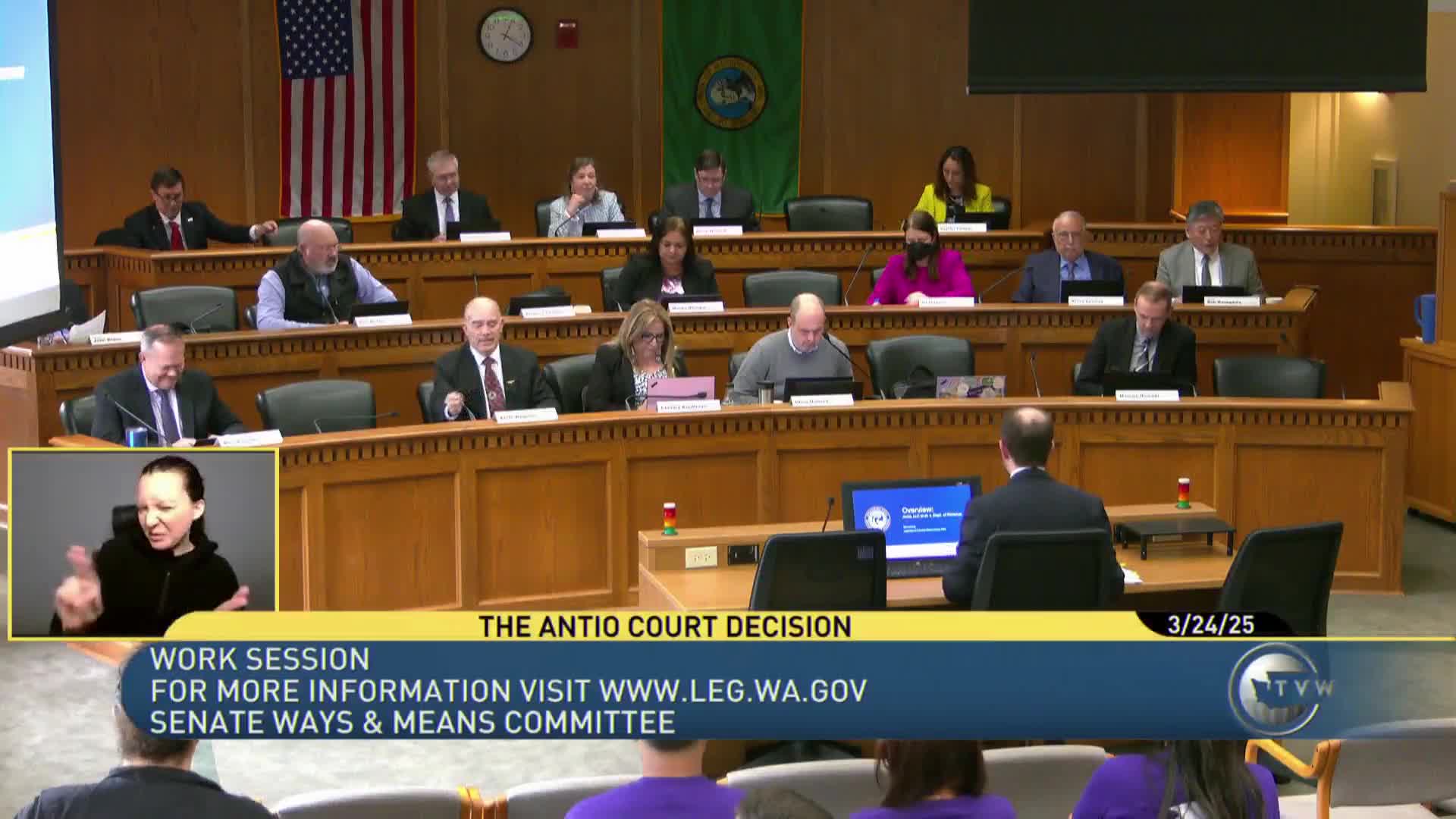
Steve Ewing of the Washington State Department of Revenue told the Senate Ways & Means Committee on March 24 that the Washington Supreme Court's 2024 decision in Antio LLC v. Department of Revenue reaffirmed a decades-old interpretation of what qualifies as "investment" income for the business-and-occupation (B&O) tax deduction. The ruling, Ewing said, follows the court's earlier decisions in O'Leary v. Department of Revenue and Sellen Construction v. Revenue and concluded that investment income must be incidental to a business's primary purpose to be deductible under RCW 82.04.281.
The briefing matters because the court's decision narrows which operating entities can take a full deduction for investment income, and it prompted the Department of Revenue (DOR) to issue clarifying administrative guidance. "We automatically presume that investment income that's less than 5% of total gross revenue is incidental," Ewing said, adding that businesses with higher percentages may still make a showing to the department.
Ewing summarized the legal history the court relied on: Sellen (1976) applied ejusdem generis to limit a statutory "other financial business" catchall; O'Leary (1986) adopted an "incidental" standard for investment income; later statutory changes (House Bill 2641 in 2002) removed the catchall but did not redefine "investments," so the court in Antio looked back to O'Leary to interpret unchanged statutory language. The department emphasized that Antio addressed only the RCW subsection governing investment deductions and did not address other B&O deductions in RCW 82.04.282.
Committee members pressed staff on practical effects. Ewing said DOR has applied an automatic 5% safe-harbor and that the agency is expediting ruling requests, generally returning rulings within ten business days. He also noted that apportionment to Washington for multi-state businesses follows the standard apportionment method referenced in the tax code (cited in remarks as RCW 82.04.462) and that economic nexus rules mean out-of-state location alone does not remove B&O liability. He identified other entities explicitly unaffected by Antio, including the Washington State Investment Board, nonprofit endowments, family investment vehicles and individual taxpayers, citing exemptions and WAC/RCW guidance used by the department.
Senators asked for more detail on specific situations such as mutual funds, endowments and the practical reach of the 5% presumption. Ewing said the answer often depends on business specifics and that mutual funds generally fall within categories that the legislature intended to allow deductions for, but whether a particular mutual fund's income is deductible under Antio depends on its operations and the incidental inquiry.
The department also described stakeholder outreach and a voluntary disclosure program for businesses that have not been contacted by DOR; that program reduces potential lookback years and can waive certain penalties if businesses come forward. Ewing concluded by offering the department's assistance for businesses seeking individualized rulings.
The committee did not take action on tax policy during the work session; the presentation was informational and intended to inform legislators drafting or considering bills that reference the Antio decision.