Get Full Government Meeting Transcripts, Videos, & Alerts Forever!
Get email alerts on the Early Learning topic
No spam. Unsubscribe anytime.
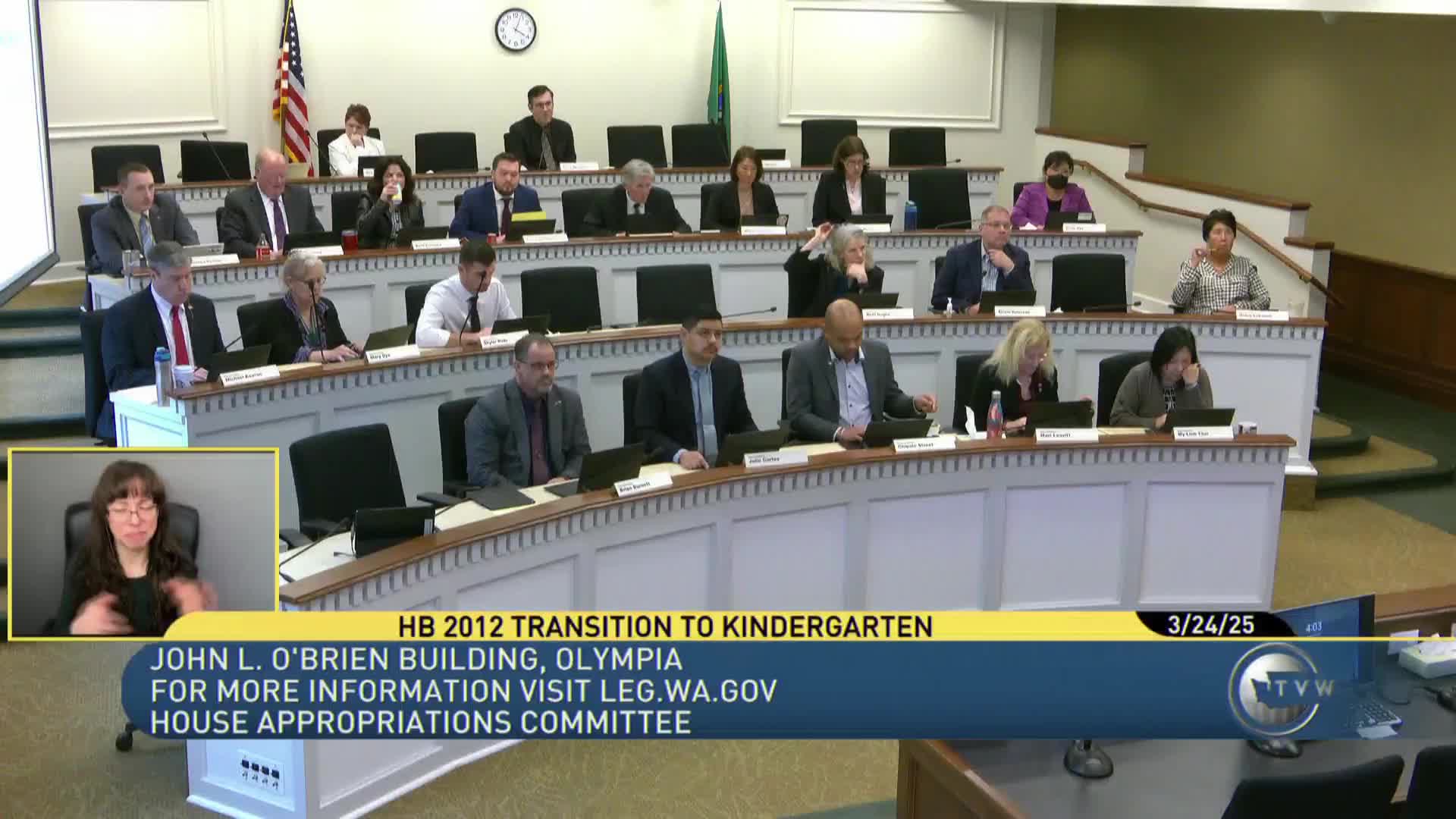
Committee hears testimony on pausing growth of Transition to Kindergarten program
Summary
The House Appropriations Committee held a public hearing on substitute House Bill 2012, a proposal to cap district TTK enrollment at 2024–25 levels beginning in 2025–26, following a staff briefing on funding mechanics and caseload forecasts.
The House Appropriations Committee held a public hearing on substitute House Bill 2012, a proposal to limit growth of the Transition to Kindergarten (TTK) program by capping each district’s average annual full‑time‑equivalent (FTE) TTK enrollment at that district’s 2024–25 level beginning in the 2025–26 school year, Jordan Clark, staff to the committee, told members.
Clark summarized the program and funding mechanics, saying TTK ‘‘must be calculated using the actual number of annual average full time equivalent eligible children enrolled’’ and that a TTK child ‘‘must be counted as a kindergarten student for purpose of the model’s funding calculations, but be reported separately.’’ Clark also said TTK funding is ‘‘not part of the state statutory program of basic education and must be expended only for the support of operating a TTK program.’’ Clark told the committee the Caseload Forecast Council projects about 7,266 average annual FTE students enrolled in TTK during the 2024–25 school year and that the February 2025 forecast assumed increases to 9,451 in fiscal 2026 and 11,636 in fiscal 2027. Clark said maintaining 2024–25 enrollment levels would yield roughly $194 million in NGF‑O savings over a four‑year outlook and that those numbers are preliminary.
Why it matters: TTK serves 4‑year‑olds judged to need extra preparation for kindergarten; testimony at the hearing stressed that pausing program growth could limit access for children in rural and underserved communities while supporters said the bill preserves existing classrooms during a tight budget cycle.
Sponsor remarks and bill language Representative Harrison Bergquist, the prime sponsor, told the committee she brought the bill ‘‘with kind of a heavy heart’’ and that the proposal seeks to ‘‘put a pause on growth of the program, but keeping current programs whole’’ given the state’s budget situation. Clark walked the committee through the substitute’s key change: beginning 2025–26, ‘‘the average annual FTE enrollment of eligible children in each TTK program operated by a school district, charter school, or state tribal education compact school may not exceed the average annual FTE enrollment ... during the current 2024–25 school year.’’ Clark also noted an OSPI fiscal note and that the briefing included an updated chart reflecting March 2025 inflation adjustments.
Public testimony A broad set of early‑learning advocates, superintendents and district staff testified almost unanimously in favor of maintaining current TTK slots and urged planning for equitable future growth. Representative excerpts: Erica Hallock, Start Early Washington: "While we are extremely disappointed to see this bill move forward, we recognize it is a result of budget realities and we urge that the final adopted budget, at a minimum maintain this approach for TTK and not cut any additional TTK slots."
Nasue Nishida, Washington Education Association: "Since transition to kindergarten legislation was adopted in 2023, we have seen opportunities and options grow for students and families ... The outcomes transitioned to kindergarten students show coming out of these programs is really amazing."
Charlie Brown, representing South Sound superintendents: "Transition to kindergarten is actually an economic development tool ... We are getting our kids to a point where they're ready for kindergarten. They're ready for third grade reading."
Colleen Frakes, Quincy School District: "In our small rural district ... our students year after year are outperforming their peers. The students that had TTK are outperforming their peers."
Jim Kolkoski, director of the Rural‑Led Center Cooperative: "This bill does some really good things. First of all, provides funding this current school year, so those districts are operating TTK. We made whole." He asked the committee to consider modest flexibility for districts that might have slightly higher need next year.
Kimberly Hedrick, superintendent, Medical Lake School District: "We're actually considering moving out of the area presently because of the shortage ... We need to expand to add another school in town, as it's so desperately needed."
Wade Smith, superintendent, Walla Walla Public Schools: "Research shows that for every $1 our legislature allocates in high quality early learning like TTK saves our state up to $9 in remediation costs down the road." He urged consideration of measured enrollment growth targeted to areas of greatest need.
Melissa Johnson, Washington State Association of Head Start and ECAP: testified that quality standards and coordination with early learning providers are essential, and said given current budget constraints it is appropriate to maintain TTK slots at 2024–25 enrollment levels.
Jenny Plaja, Office of Superintendent of Public Instruction (OSPI): said TTK ‘‘is one of the most effective programs we have for closing gaps early’’ and asked the committee to consider language changes to allow a statewide cap rather than district caps and an out‑year process for targeted growth in high‑need areas.
Outcome and next steps The public hearing concluded with no committee vote on substitute House Bill 2012. Committee staff closed the hearing and the committee moved on to other items on the possible executive session agenda. Representatives and testifiers urged that OSPI and the Department of Children, Youth & Families coordinate with stakeholders during any pause, and several witnesses asked for mechanisms to prioritize growth where needs are greatest.
Ending: The committee did not take action on substitute House Bill 2012 during the hearing; questions and technical requests for language and additional fiscal detail were raised by members and by OSPI staff during testimony.